


Review Roundup: THE FEAR OF 13 Starring Adrien Brody and Tessa Thompson Opens On Broadway
Critics are weighing in on the true story of Nick Yarris and its exploration of justice, belief, and freedom.
 Click for Tickets!
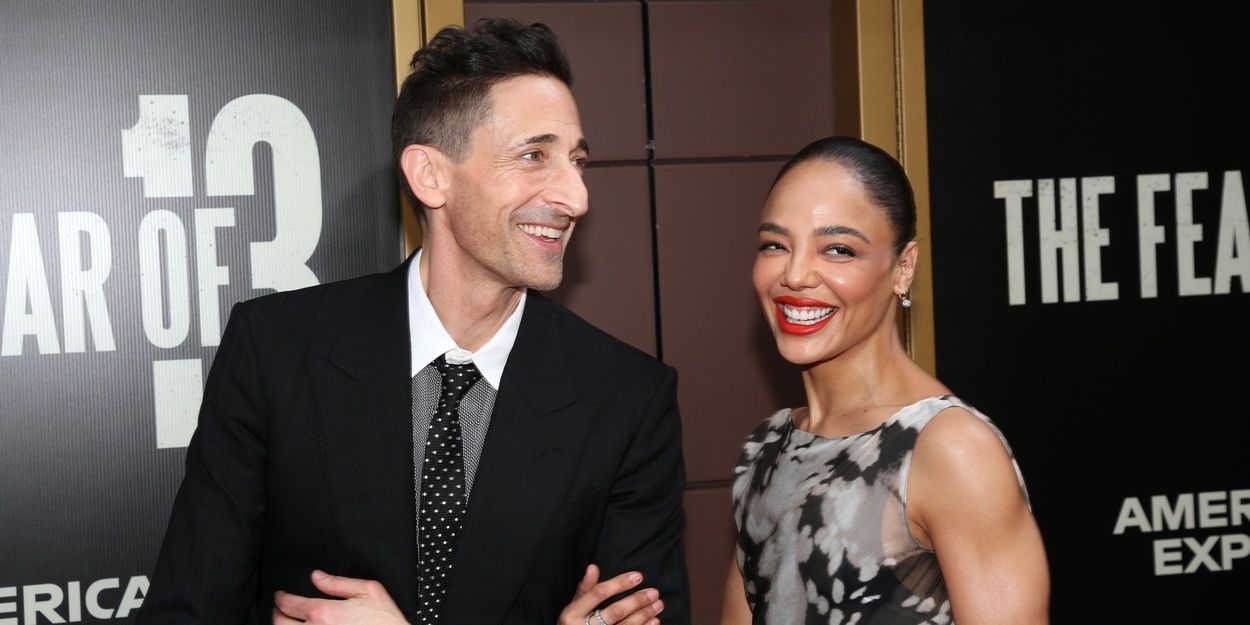
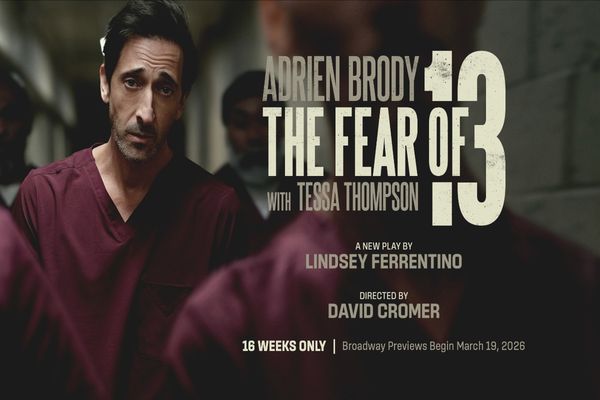
Reviews are in for The Fear of 13, Lindsey Ferrentino’s new play now open on Broadway at the James Earl Jones Theatre.
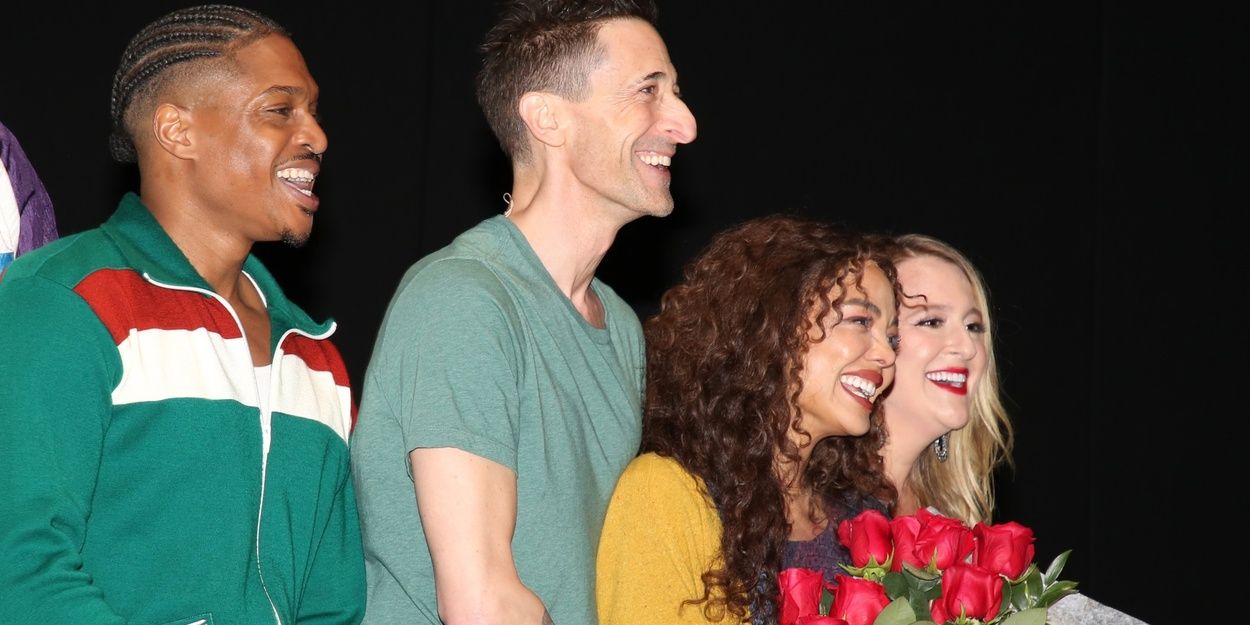
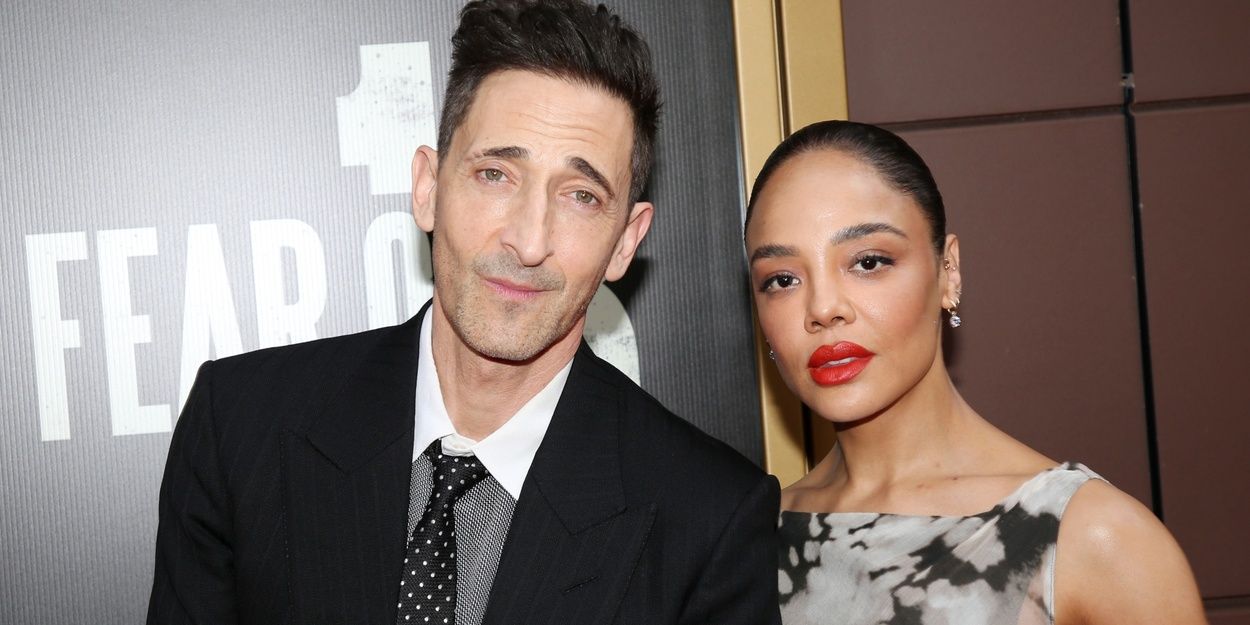
The production marks the Broadway debuts of Adrien Brody and Tessa Thompson, who lead a cast that also includes Ephraim Sykes, Michael Cavinder, Eddie Cooper, Victor Cruz, Eboni Flowers, Joel Marsh Garland, Jared Wayne Gladly, Joe Joseph, Jeb Kreager, and Ben Thompson.
Based on a true story, The Fear of 13 follows Nick Yarris, a man who spends more than two decades on death row for a murder he maintains he did not commit. Through a series of prison visits with a volunteer named Jacki, the play traces a life shaped by impulse and consequence, as their evolving relationship blurs the line between witness and participant and raises questions about justice, belief, and the fragile boundary between freedom and self-determination.
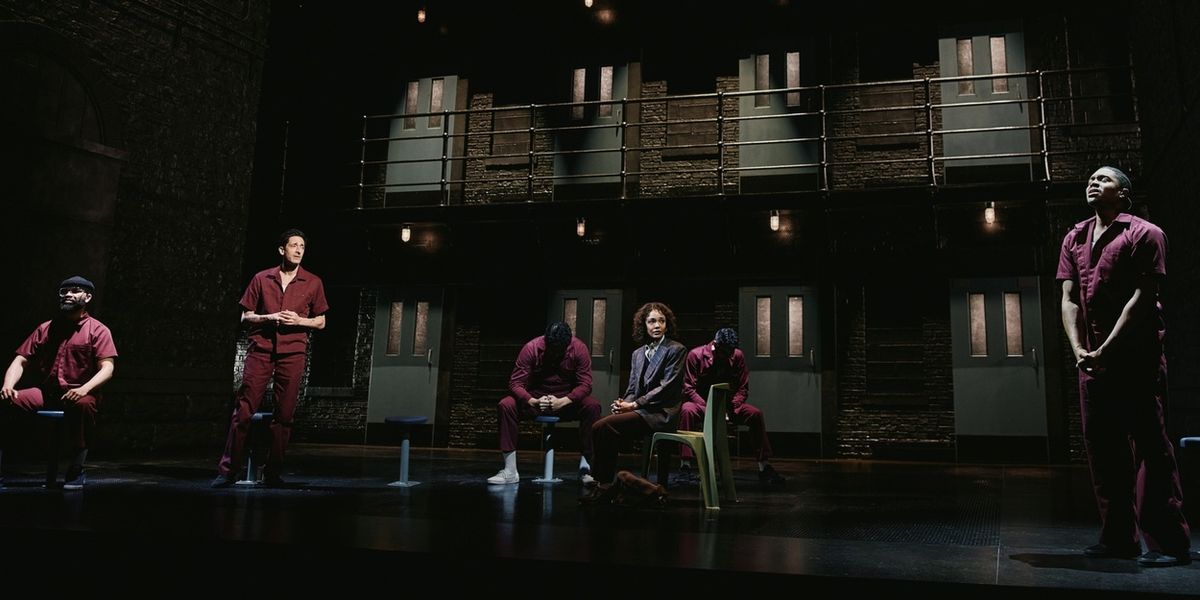
 Helen Shaw, The New York Times: At first glance, Ferrentino’s play seems like a chance to see the pair in a shadowy, troubling romance, one unfolding between a man languishing on death row in Pennsylvania, Nick (Brody), and a sympathetic volunteer advocate, Jacki (Thompson). It’s an unlikely place for a love story, but this production makes their intimate isolation its whole atmosphere: Arnulfo Maldonado’s simple set of a wall of cell doors is sunk in ink-black gloom by the lighting designer Heather Gilbert; the deft director David Cromer encourages us to believe we are watching one 110-minute-long waking dream.
Jackson McHenry, Vulture : Even in the harshest descriptions of the violence and almost unbelievably cruel twists of fate that Yarris endured (the DNA testing keeps getting accidentally mucked up), Brody lends him a vital indomitable spark. But he’s so enamored with that bravado, that of his character and his own, that he only glancingly finds a dimension beyond it. He was, as is the play itself, repeating a good story but not providing deeper insight, giving us a mythology without a deeper sense of a man.
Adam Feldman, Time Out New York: The play is closely based on David Sington’s 2015 documentary about Nick Yarris, a Pennsylvania man who spent more than 20 years on Death Row before being exonerated by DNA evidence in 2003. The film is an absorbing 95-minute monologue in which Yarris describes his long ordeal in detail; Ferrentino’s adaptation, though still anchored in narration by Yarris, builds out his stories for an onstage cast of eight. The end result is bigger but not, I fear, better.
Aramide Timubu, Variety: At age 21, Nick Yarris was stopped during a routine traffic stop, arrested and sentenced to die for the rape and murder of a young wife and mother. Though Yarris did not commit this crime, he would spend the next 22 years of his life in confinement awaiting an execution date. Based on the documentary by David Sington, playwright Lindsey Ferrentino’s “The Fear of 13” is a deeply moving play about Yarris’ experience on death row, the woman who became his lifeline and his eventual exoneration after more than two decades behind bars. With Academy Award winner Adrien Brody and actress Tessa Thompson making their Broadway debuts, the play features some profound performances. However, it also feels tonally bumpy by the end.
Juan A. Ramirez, Theatrely: Brody is expectedly watchable and uber-committed, though the white-boy-swag vibe he loves to affect becomes grating in the wandering play, whose first 80 minutes or so are mostly just Yarris/Brody doing his thing while the plot assembles in the background. If that structure is meant to reflect destiny’s quietly uncaring machinations, the script is not nearly meaty enough to uphold it. Nick eventually falls for, and marries, Jacki (Thompson) a kind-hearted prison volunteer. It’s only when the two start to feel the weight of time on their relationship, in a skillfully rendered scene where his path to freedom locks into a regressive pattern through a series of procedural blunders, that the play finally takes on a painful immediacy and stance against the inefficiencies of our justice system.
Thom Geier, Culture Sauce: The latest film-to-stage adaptation to land on Broadway is a curious fact-based yarn about a Pennsylvania man unjustly convicted of a brutal rape and murder who sat on death row for two decades before he was exonerated thanks to DNA evidence. The basis for The Fear of 13 is a 2015 documentary that stands out by shunning the usual rogues’ gallery of interviews for a single talking head: Nick Yarris, a compellingly chatty fellow from outside Philadelphia who escaped execution and relates his tragic life story with mesmerizing skill even as you constantly question the authenticity of some of his details.
 Robert Hofler, The Wrap: Brody also resists the grand gesture, even though Yarris is a very flashy character, especially in the way he tells a story. It has been said of movie actors that a great face is more important than great talent. Paul Newman comes to mind. Of course, Marlon Brando possessed that rare combo of having both. I always thought stage actors were different. Talent is everything. Brody may be an exception. He’s definitely a gifted actor, and in “The Fear of 13,” he puts a damper on his tendency to push it, as he sometimes does onscreen. On stage, he’s a real theater animal and his performance is immeasurably enhanced by a face and body that rivet an audience’s attention for two straight hours.
Greg Evans, Deadline: Still, when The Fear of 13 finally arrives at something close to Nick’s Rosebud revelation, we’re meant to connect the dots between past trauma and current predicament, and it is a tenuous connection at best, a possible cause for an effect we’ve been told repeatedly to distrust. The climactic scene, set amidst a downpour evocatively conveyed on the moody, spare, grid-like and often pitch-dark set (Arnulfo Maldonado is the scenic designer, with lighting design by Heather Gilbert), does provide a deeper meaning to the play’s title beyond the word – triskaidekaphobia – that Nick taught himself in prison (no spoilers), but if it’s meant, as it seems to be, to somehow explain the beginnings of outlaw behavior and character faults that got Nick in deeper water than he ever could have imagined, we’re left with the unsettling feeling that The Fear of 13 is asking the victim to shoulder at least a modicum of the blame that should fall entirely on a grossly unfair system, and there’s no justice in that.
Chris Jones, Chicago Tribune: Ferrentino gave her play the structure of twin narrators, essentially telling the story of two lives from two perspectives, even as she also tries to broaden it all out so this story can represent all of the wrongly convicted on death row and those who love them. That burden, along with the conventions of the true-crime genre, not to mention that of theater in service of a political point, sometimes hampers the interpretive space of the actors and the creative team, who have to spend a lot of their time getting the facts and the history across. The scenes typically are brief and monologic, making it harder to build momentum. And I suspect Brody was worrying a bit too much about being true to Yarris himself.
Frank Scheck, New York Stage Review: But despite its good intentions and powerful true-life story, The Fear of 13 fails to galvanize. It’s surprising, considering Cromer’s directorial talents and the top-notch production values including Arnulfo Maldonado’s multi-level set design and Heather Gilbert’s piercing lighting. Perhaps the play had more impact in the intimate Donmar Warehouse where the claustrophobic physical proximity would have made Nick’s plight more palpable. Here, it feels more like sociology than fleshed-out drama.
David Finkle, New York Stage Review: At the end, however, The Fear of 13 is Brody’s domain. Never offstage and often really as well as symbolically solitary, he presents a man fighting for his life until fight is drained from him. And then what seems miraculously restored to him. It’s restored, and yet at the last moments, he’s left wondering what’s left for him, what kind of future he faces. Right up to those final moments, Brody instills frayed dignity. Incidentally, the title The Fear of 13 is somewhat obscure. The key to it appears to be couched in a late in the drama reminiscence from Nick that requires close listening. Go for it.
Matthew Wexler, One-Minute Critic: Director David Cromer (Bug, Meet the Cartozians) navigates the play with his typical precision, and Brody carries much of the weight with charisma and charm. But when an exasperated Jacki asks Nick, years into his sentence, why he never told anyone what really happened, he says, “Now, even the truth sounds like a lie.” Such lines land, but the relationship doesn’t. Without it, The Fear of 13 feels as handcuffed as its hero.
Charles Isherwood, The Wall Street Journal: Even with the wider lens, Mr. Brody’s performance remains the focus of the play. He’s onstage for virtually the entire two-hour, intermission-less running time, often directly addressing the audience as—with a thick Philadelphia accent and arms slicing the air, rapper style—Nick relates the series of events that ended in his long incarceration and ultimate redemption. While Mr. Brody has a lithe, lanky and compelling presence, he can bring only limited bursts of animation to a play that never gains much dramatic propulsion, a liability of its oppressive setting and the slow trudge of the narrative. The proverbial wheels of justice grind at an almost unbelievably rusty pace, leaving Nick facing the prospect of imminent death for 22 years.
David Rooney, The Hollywood Reporter: At one point Nick’s protracted wait becomes so agonizing that he petitions the state to set an execution date. He is subsequently cleared of all charges after conclusive DNA evidence proves his innocence. That should make for a powerful indictment of a legal system in which a man’s life can be put on hold for more than two decades because of the ineptitude of law enforcement and the judiciary. But Ferrentino struggles to synthesize the true story’s larger themes, so even if Brody has some affecting moments in the closing scenes, the play is flat, emotionally ineffectual.
Richard Lawson, The Guardian: When the rain starts pouring toward the end of the play, though, Brody swells to fit the hokey staginess of the moment. Yarris’s particular story is eventually flattened out into a more general consideration of life’s quotidian beauty, all that is taken for granted until one is, like Yarris, stolen away from the world. It’s a worthy enough sentiment, but one more wrenchingly and articulately rendered in, say, Our Town. One leaves the Fear of 13 certainly horrified by the injustice done to Yarris, and moved by his journey to freedom, but it’s a fleeting feeling. Ferrentino and Brody have not burrowed deep enough to make the play stick. It is polite theater that soothes rather than sears.
Brian Scott Lipton, Cititour: But that turnaround shouldn’t be the point of “The Fear of 13”; the dismal failures of the American criminal justice system is what should shock us out of our seats. Indeed, had the story been told in the proper chronological order, our outrage would have been stronger than the crowds yelling “Attica! Attica!” a few blocks away at “Dog Day Afternoon.”
Joe Dziemianowicz, New York Theatre Guide : There are exceptions: An arresting moment comes when two inmates use music to express their love and rebel against the brutalizing prison system, and a final scene with Nick succeeds at tugging the heartstrings. Too often, however, the play leans into gravity-sapping laugh lines. Case in point: Nick calling a cop’s false testimony an Oscar-worthy performance — “Fuckin’ Daniel Day-Lewis over here” — is a needless knee-slapper.
Jonathan Mandell, New York Theater: Under the direction of David Cromer, the theatrical production expands the one-man movie with a 12-member cast portraying dozens of characters, with dark and fluid staging, and a theatrical flair that even includes some gospel singing (led, no less, by Tony nominee Ephraim Sykes.) But the focus largely stays on Nick. How could it be otherwise, given Adrien Brody’s skill in embodying the storyteller’s gifts of passion, precision, and charm? Brody has won two Oscars for portraying intense characters of great resilience and endurance in the face of unimaginable brutality — Polish pianist Władysław Szpilman in The Pianist (2002) and as Hungarian architect László Tóth in The Brutalist (2024). But he has also exhibited a dry sense of humor in a series of Wes Anderson’s quirky comedies. He brings all this to bear in a performance that goes beyond the thrill of seeing a movie star’s first time on stage.
 Johnny Oleksinki, The New York Post: It speaks volumes about Adrien Brody’s choice of roles that next to his anguished, Oscar-winning turns in “The Pianist” and “The Brutalist,” his Broadway debut as a wronged man who spends 22 years on death row comes off as positively chipper. Cracking jokes and animatedly telling stories in a sing-song street-corner voice, our Sufferer Laureate plays Pennsylvania inmate Nick Yarris in “The Fear of 13,” Lindsey Ferrentino’s curiously unmoving and talky, talky, talky play that opened Wednesday night at the James Earl Jones Theatre.
Average Rating: 58.4%
Prefer BroadwayWorld in Google Search?
Add us as a preferred source so our stories show up more often in Top Stories and Google’s AI answers — for you.
- To read more reviews, click here!
- Discuss the show on the BroadwayWorld Forum

Sign up for all the news on the Fall season, discounts & more...
Powered by

|
.jpg?format=auto&width=300)






Reader Reviews
To post a comment, you must register and login.