


Review: OCTOPUS'S GARDEN at Theater At Boston Court
Weston Gaylord's play explores the limitless possibilities of creation.
 Click for Tickets!
References to playful Beatles tunes of yore notwithstanding, the central character of Weston Gaylord’s play Octopus's Garden is, in fact, an actual octopus who does something so mind-blowing that it shakes the foundation of the play’s three human characters and nearly splinters the limits of human thought and creativity. “That must be one outstanding octopus,” you might be inclined to say. Except that the marine researchers would jump on you to correct the redundancy…all octopuses are comparably amazing, deep, wise and unfathomable. Especially our lady Sylvia who, in Gaylord’s play, is at the very least an eight-armed Mozart, if not more.
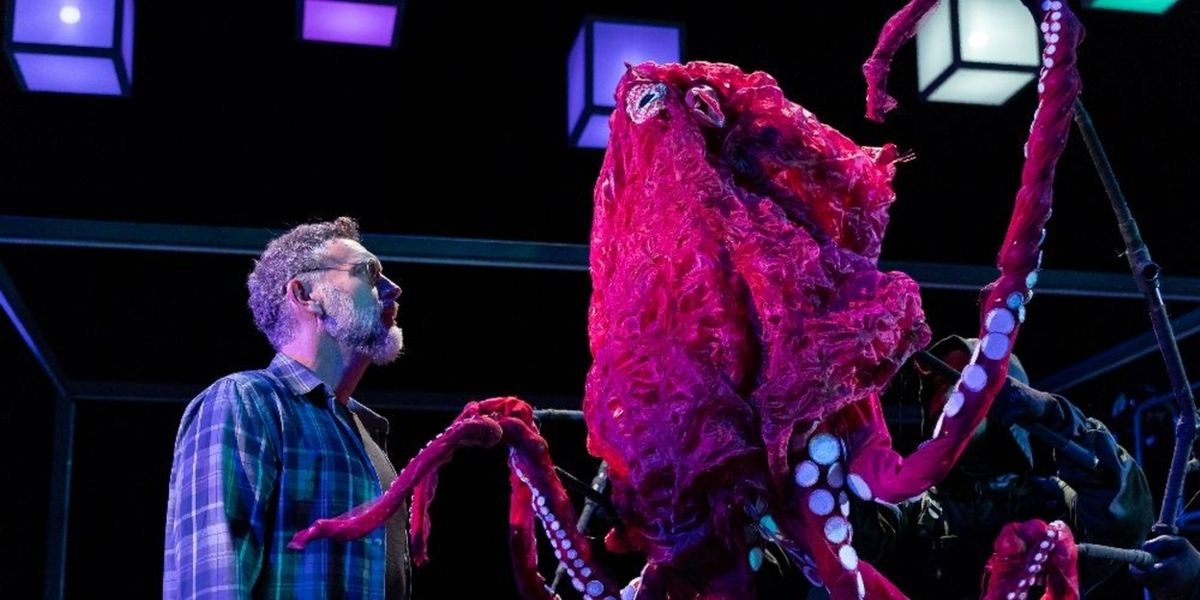
An octopus this captivating — we’ll tell you how very amazing she is erelong — if she’s to actually take the stage had better not look chintzy. As it happens, the puppet created by Michaela Heaphy, Brette O’Brien, Emory Royston, Miles Taber and Jodi Wofford and brought to life by Zachary Bones, Perry Daniel and Danielle McPhaul isn’t just a scene-stealer. She’s hypnotic. It also helps that the play surrounding her is intelligent and challenging in the best kinds of ways. A three-way co-production between Circle X Theatre Co., Outside In Theater and Boston Court Pasadena (on whose stage the production takes place), Octopus's Garden is directed by TBCP Artistic Director Jessica Kubzansky.
We first meet Lucas (played by Vincent R. Williams), a young composer as he haltingly but eloquently introduces a new string quartet arrangement of “Home! Sweet Home!” that he has written. Referencing the death of his father, Lucas’s impassioned intro delves into the “interiority” of music, its capacity to see inside the person who creates it. He recounts a “battle of the bands” anecdote during the Civil War which may or may not be true. But who cares because “Now for you, the story is the song and the song is the story,” he concludes.
The action thenn moves to a cephalopod research marine research lab run by Lars (Tim Cummings) and his associate Tara (Kacie Rogers). In the course of their normal work with octopuses, squid and cuttlefish, Lars and Tara are ever-hopeful of some breakthrough research. During a just so-so date with Lucas a few days ago, the two discussed the workings of the octopus’s brain prompting Tara to posit that perhaps an octopus could do something musical. Accordingly, she rigs up a waterproof and very sophisticated noisemaking device and plops it into Sylvia’s tank.
The overnight results are mind-blowing, first to Tara, then to Lars (who is brought nearly to tears) and ultimately to Lucas whom Tara brings in to assess the composition’s musical value. Tara is ready to trumpet Sylvia’s achievement to the world, while the ever-careful Lars insists on a second trial to see whether the octopus can repeat the output. Lucas, meanwhile, is fearful of too much exposure, that Sylvia’s brilliant composition could never be matched by human efforts and — worse — that human beings would stop trying. (If some of this rhetoric around the problematic miracle of “creation” by something other than a human being echoes debate around artificial intelligence, that’s probably intentional).
As for that second trial that would help establish the miracle of what has transpired, not only won’t Sylvia touch the instrument again, now she’s giving off signals that she’s sick. Which should mean that she gets released back into the ocean. But Tara has other ideas and matters start to take a turn for the devious.
Some slightly contrived second act plotting aside, Gaylord’s play works solidly as a three-sided examination of ethical questions around artistry and science. Lucas is as much a stranger to Tara and Lars’s world as the two scientists are to his, but powerful music can serve as a bridge. The quiet chemistry established between Williams and Rogers is credible; these two very different people can and will probably find common ground.
Conversely, the musical trial exposes a rift between the scientific approaches of Tara and Lars. Cummings effectively moves Lars from a by-the-numbers scientist to a man who has to question whether he has ever accomplished anything. As the not always ethical engine who bucks the system and engineers the play’s central conflict, Rogers locks in on Tara’s youth and ambition. She’s not always likeable, but her actions make sense.
The play’s fourth character never utters a word. Interspersed in Gaylord’s plot machinations, we watch Sylvia at rest, at play, in the wild and also interacting with the humans with whom she has bonded. With a head that looks a bit like an expertly-crafted paiper mache volcano, the puppeteer-controlled octopus is as mesmerizing as the descriptors. She mostly hangs out in the enormous tank that is the centerpiece of Francois-Pierre Couture’s scenery, but occasionally bursts through for ocean scenes. The bank of light boxes designed by Karyn D. Lawrence further enhances the other-worldly aura that the production establishes.
Visitors to Octopus's Garden will probably never look at a live octopus an aquarium in quite the same way. In this regard, Gaylord’s mind-bender of play enhances the mystery of an already fascinating creature and of the limitless possibilities of what we don’t know.
Octopus's Garden plays through March 29 at 70 N. Mentor Ave., Pasadena.
Photo of Tim Cummings and Sylvia by Brian Hashimoto.

Sign up for all the news on the Fall season, discounts & more...

|
CLUB27 Jaxx Theatre (10/01-10/30) |

|
Crone Creed El Portal Theatre (9/30-10/17) |

|
Good Night, Oscar North Coast Repertory (9/16-10/11) |

|
A Killer Night in Studio City Vitello's (9/06-10/31) |

|
Catch Me If You Can Colony Theatre (9/17-10/18) |

|
Dinner with Friends Santa Monica Playhouse (9/26-9/27) |

|
Gershwin and the Golden Age The Soraya (10/11-10/11) |

|
Melt : The Play The Marilyn Theatre at the Lee Strasberg Institute (9/24-10/02) |

|
New Works Festival Shoebox Theatre (9/11-9/26) |

|
Worthy The Un-Erasable Solo Festival - Willie Agee Playhouse (9/12-9/25) |

Reader Reviews
To post a comment, you must register and login.