


Lost Broadway Theaters That Are Still Standing
Are there any lost, existing Broadway theaters that could be returned to Broadway?
Do you have a burning Broadway question? Dying to know more about an obscure Broadway fact? Broadway historian and self-proclaimed theatre nerd Jennifer Ashley Tepper is here to help with Broadway Deep Dive. BroadwayWorld is accepting questions from theatre fans like you. If you're lucky, your question might be selected as the topic of her next column!
Submit your Broadway question here!
Broadway currently boasts 41 theaters. This number has always been ever-changing—since even before the first time the word “Broadway” was used to describe professional theater in New York.
The most recent change was in 2017 when the Hudson Theatre became a Broadway house again for the first time since 1968. The Hudson was built by Henry B. Harris in 1903, on 44th Street east of Broadway. Sadly, Harris perished on the Titanic in 1912. His wife, Renee Harris survived and upon returning to New York, took over management of the Hudson, saving it from destruction a few times. Although for many years the space was a television studio, a night club, or a hotel event space, it was never destroyed, so Ambassador Theatre Group was able to return it to Broadway usage eight years ago, bringing our Broadway theater count from 40 to 41.
Are there other lost, existing Broadway theaters that could be returned to Broadway someday in a similar way?
I’ve written recent articles about two of the most prominent examples here. The Times Square Church on 51st Street was once one of our most lavish and glorious Broadway theaters, the Mark Hellinger. Home of the original productions of My Fair Lady and Jesus Christ Superstar, the Hellinger remains in sparkling shape today. There have been many attempts to bring it back to Broadway since it was sold to the church in 1989. You can read about those here.
More recently, the Ed Sullivan Theatre on Broadway between 53rd and 54th Streets has been widely discussed. Since it was announced that The Late Show with Stephen Colbert will vacate the space when the show ends in spring of 2026, rumors have abounded that the former Broadway theater that has belonged to CBS for many years could become a Broadway space yet again. First known as Hammerstein’s when it opened its doors in 1927, the Ed Sullivan has an extraordinary history as a television studio, including major performances by both Elvis and The Beatles. Its last moment as a Broadway theater was almost 90 years ago, but because the venue is landmarked, it is completely possible for it to become a space for legit theater again. You can read about the storied past of the Ed Sullivan here.
Unlike the Times Square Church and the Ed Sullivan Theatre, used for religious purposes and television tapings, respectively, there are a few former Broadway houses that still present legitimate theatre—just not Broadway shows. One of these is the New Victory. The beautiful theater on 42nd Street that presents a season of family shows each year is a former Broadway house that is older than any of our current spaces! The Theatre Republic opened in 1900 after being built by Oscar Hammerstein (i) (namesake of the above-named Hammerstein’s Theatre). The eccentric producer David Belasco took over two years later and his renovations included expanding an elephant pit underneath the stage so that Houdini could showcase his prized animals.
One of the first notable productions at the space, once it had been renamed the Belasco in 1902, was The Girl of the Golden West. One of Belasco’s biggest hits as a playwright, the show glamorizing the California Gold Rush was written by, directed by, and produced by Belasco, at a theater he named after himself. In 1907, when Belasco built the theater we currently know as the Belasco, on 44th Street near 6th Avenue, the Belasco on 42nd Street became known as the Theatre Republic yet again.
1910 also brought an adaptation of the beloved novel from seven years earlier, Rebecca of Sunnybrook Farm. Good Gracious Annabelle was a hit 1916 play by Clare Kummer, who made history working on plays and musicals from 1903 to 1945, when it was incredibly rare for a female writer to be given a spot at the table. Another notable show with an all-female writing team hit the theater the following year: Lilac Time by Jane Cowl and Jane Murfin. A play with a memorable name hit the stage in 1921: Getting Gertie’s Garter; it later became a hit film.
For more than five years in the 1920s, the Theatre Republic was host to what is still one of the longest-running plays in Broadway history. This was Abie’s Irish Rose by Anne Nichols, who also produced. At the time, the show attained the title of the longest running show in Broadway history, period, with its unassuming plot about young star-crossed lovers, one from a Jewish family and one from an Irish family.
Like many Broadway theaters during the Great Depression, the Theatre Republic struggled to find bookings. In 1931, it became a burlesque house, run by Billy Minsky. It later became a movie theater, growing increasingly decrepit during the mid-20th century. In 1972, the former Theatre Republic became the first X-rated movie theater on 42nd Street, marking a new era for Times Square. A few decades later, it would be returned to former glory during the 42nd Street Redevelopment Project clean-up of the 1990s. The New Victory is a crown jewel of 42nd Street these days, welcoming families to see shows that never could’ve imagined feeling safe on the block a few decades earlier. The capacity of 499 as well as the current contracts and programming make the New Victory an off-Broadway space—and a thriving one. There are no signs it could return to Broadway use soon, but the theater does shine in a central area with an intimate number of seats—so never say never!
Similarly standing proud and functional but unlikely to return to the Broadway fold is the Village East by Angelika. The current movie house that screens both popular and independent films is in the East Village, on Second Avenue near 12th Street, and yet it does have an illustrious past as a Broadway theater.
The theater at 189 Second Avenue opened as the Louis N. Jaffe Theatre in 1926. Intended as a home for the prestigious Yiddish Art Theatre, one can still spot physical evidence of this history on the theater’s exterior where its original name is engraved and inside the interior where there is Jewish influence in the design. In the 1920s, this area was the heart of the Yiddish Theatre District, nicknamed The Jewish Rialto. The Jaffe would not have been considered a Broadway house or an off-Broadway house at that time, but rather specifically a Yiddish theatre house. This was before firm distinctions were made between Broadway and off-Broadway.
Due to the Great Depression as well as the assimilation of Jewish Americans into mainstream culture, the Jewish Rialto began to wither in the 1930s. By 1937, the theater was called the Century and showed movies. Films and Jewish programming alternated until 1946 when movies took over for good for seven years at the then-named Stuyvesant Theatre.
In 1953, the revolutionary off-Broadway company the Phoenix took over the space. As a top tier repertory company, they attracted preeminent New York talent for limited runs at the former Yiddish theater. The Phoenix was a big part of the off-Broadway revolution that sought to give theatre makers freedom to create ambitious pieces away from the hit-or-flop Broadway formula. Under the name the Phoenix, both The Golden Apple and Once Upon a Mattress opened in their original productions and eventually transferred uptown. Herein the confusion lies, because some sources note that the Phoenix was an off-Broadway space during this time and some considered it a Broadway space based on the level of the productions and the large size of the theater.
The Phoenix Theatre Company vacated the space in 1961, and it became the Casino East Theatre. Under this name, the venue welcomed everything from Yiddish theatre to the revue This Was Burlesque, which ran for three years. Then, actual burlesque moved in and the theater became the only house in New York still dedicated to the genre. From 1969 to 1975, the venue was named the Eden Theatre and legit live theatre returned. Three of its shows were massive hits: the nudie musical Oh! Calcutta!, the original production of Man of La Mancha (which made a stop at the theater), and the game-changer musical Grease. Again during this time the distinction was not agreed upon about whether the Eden was a Broadway or off-Broadway space. Some folks argued that it depended on which contract a production was on, not the space itself. Grease was one of several shows eligible for Tony Awards based on its run at the Eden, which is a vote in favor of the Eden being considered Broadway, despite its location. The last show at the Eden was The Fifth Season, performed by Yiddish theatre actors; it was meant-to-be that the Eden was sent off with a show celebrating the Jewish Rialto.
There was a brief return to movies before the former Louis N. Jaffe Theatre became the Entermedia, a full-fledged off-Broadway house. Between 1978 and 1983, its tenants included The Best Little Whorehouse in Texas, God Bless You, Mr. Rosewater, and Joseph and the Amazing Technicolor Dreamcoat. In the late 1980s, the house was called the Second Avenue Theatre and somewhat less high profile off-Broadway shows took the stage. Then in 1991, movies took over the theater in a major way, with the space divided into seven separate movie auditoriums. There are movies screened in what used to be the theater’s backstage and all throughout the building. The main movie theater is called the Louis Jaffe Art Theatre and showcases the original auditorium design. Both the interior and exterior are landmarked meaning that even though the space has been divided, it cannot be majorly altered. Technically, it could become a space for live theater again someday. Its past is certainly known for twists and turns… and although the theater has shown movies for over three decades, you never know.
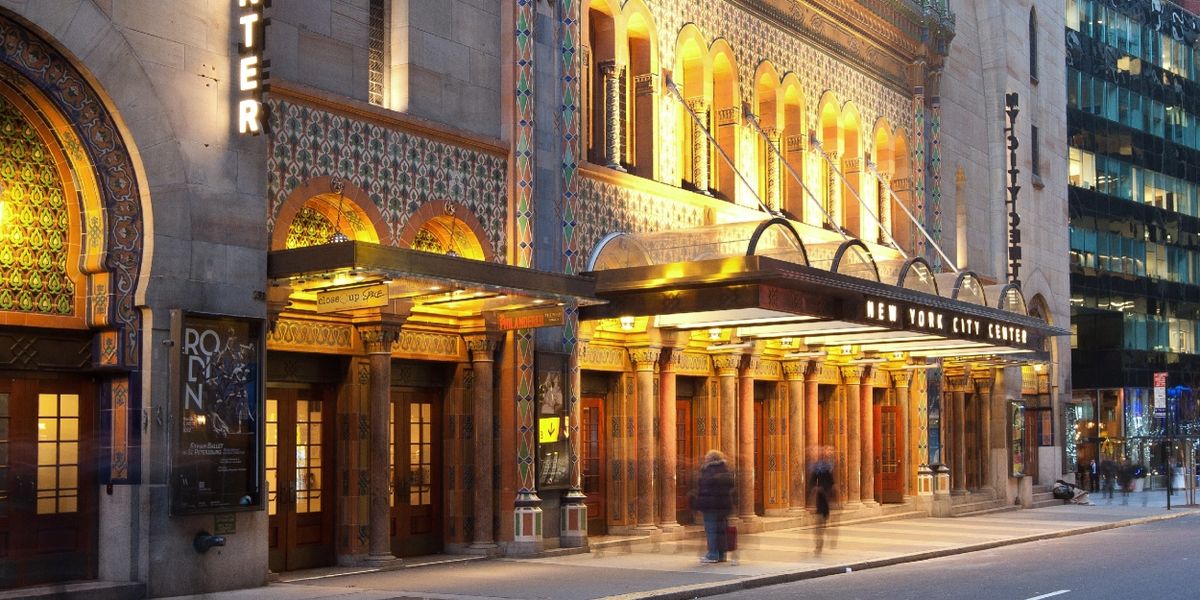
There are several prominent performance spaces in New York that are now considered off-Broadway if they host theatre productions, but in previous decades could engage in contracts that gave their tenants Broadway status. One is New York City Center. Home of the famed Encores! series, City Center from the 1940s through 1980 hosted a number of productions considered as Broadway ones. With their location on 55th Street, this made some sense. Some examples include a 1965 two-week engagement of Guys and Dolls presented by the New York City Center Light Opera Company which earned Jerry Orbach a Tony nomination for his take on Sky Masterson and a one-month engagement of West Side Story produced by the same company the previous year. Bob Fosse was also Tony nominated for leading Pal Joey at New York City Center in 1963. These days, high level theatre productions with short limited runs at New York City Center are delineated as off-Broadway.
There are several other lost Broadway theaters that are still standing in the current theatre district and beyond! To be continued…
Photo courtesy of New York City Center




Comments
To post a comment, you must register and login.