


Lost Broadway Theaters Still Standing... Continued!
Are there any lost, existing Broadway theaters that could be returned to Broadway?
Do you have a burning Broadway question? Dying to know more about an obscure Broadway fact? Broadway historian and self-proclaimed theatre nerd Jennifer Ashley Tepper is here to help with Broadway Deep Dive. BroadwayWorld is accepting questions from theatre fans like you. If you're lucky, your question might be selected as the topic of her next column!
Submit your Broadway question here!
Broadway currently boasts 41 theaters. This number has always been ever-changing—since even before the first time the word “Broadway” was used to describe professional theater in New York.
The most recent change was in 2017 when the Hudson Theatre became a Broadway house again for the first time since 1968. The Hudson was built by Henry B. Harris in 1903, on 44th Street east of Broadway. Sadly, Harris perished on the Titanic in 1912. His wife, Renee Harris survived and upon returning to New York, took over management of the Hudson, saving it from destruction a few times. Although for many years the space was a television studio, a night club, or a hotel event space, it was never destroyed, so Ambassador Theatre Group was able to return it to Broadway usage eight years ago, bringing our Broadway theater count from 40 to 41.
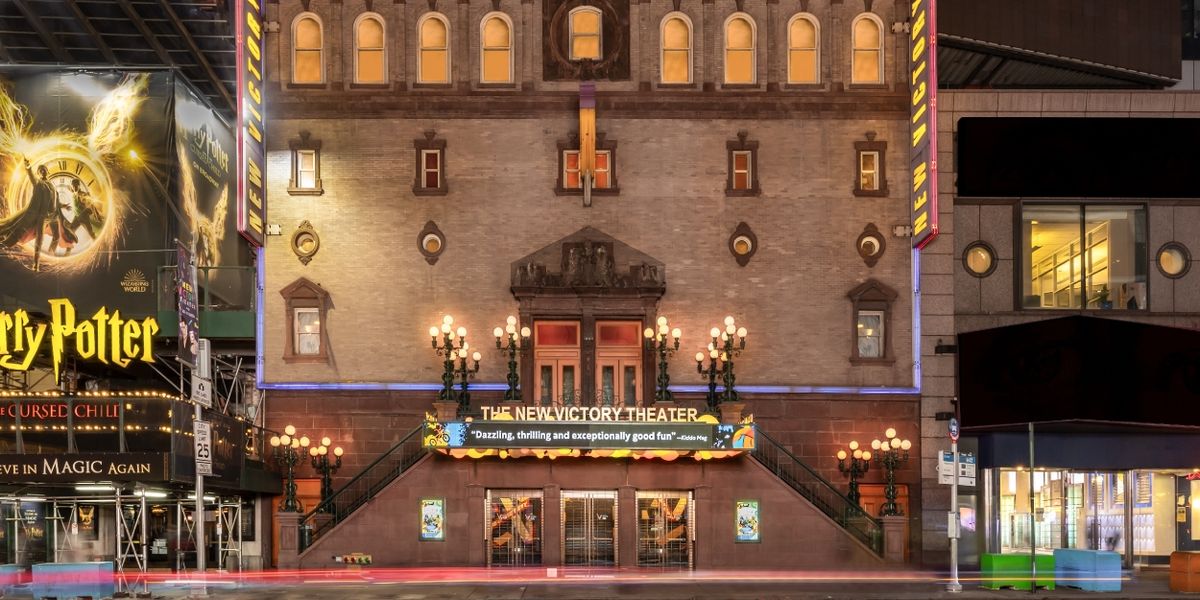
Are there other lost, existing Broadway theaters that could be returned to Broadway someday in a similar way? You can read part one of the answer to that question including explorations of the Times Square Church, Ed Sullivan Theatre, New Victory Theatre, Village East By Angelika, and and New York City Center.
Multiple lost Broadway theaters intersect with the Hammerstein family. This follows since Oscar Hammerstein (i) was a theater owner and builder. In addition to Hammerstein’s which was named after him and is today the Ed Sullivan, and the New Victory which he originally built, there is also the Hammerstein Ballroom.
In the same decade that Hammerstein built the Theatre Republic (later New Victory) he also built the Manhattan Opera House (later Hammerstein Ballroom) on 34th Street. Meant to compete with the Metropolitan Opera, the Manhattan Opera House is a large venue with multiple balconies. For a time in the 1910s it was leased by The Shuberts for Broadway productions, and it presented Broadway shows as early as 1908 and as late as 1937. But this former Broadway house and opera house also had quite a variety of uses otherwise from freemasonry temple to Warner Brothers soundstage to trade union headquarters to warehouse storage.
By the 1990s the now-named Hammerstein Ballroom, within the Manhattan Center, was a performance venue again. Much of its architecture was restored, including its hand-painted ceiling. From Britney Spears’ New York City concert debut to a Grammy Award-winning concert by Patti LaBelle, the space honored live music again, although in a much different manner than its creators intended. While the former Manhattan Opera House was not a well known Broadway palace, it was home to a few dozen Broadway shows, including the British musical theatre phenomenon Chu Chin Chow (1917). It is a well kept former Broadway venue that could technically return to legit theatre someday.
One of the most unlikely and forgotten former Broadway theaters that still stands today—albeit in much different form—is the Castle Garden in Battery Park. Our oldest former professional New York theater that is still standing, Castle Garden hosted live entertainment including plays and operas from the 1820s through the 1850s. Originally opening in 1811 as Fort Clinton, the structure existed as a peaceful fort for a decade before becoming a performance venue and then America’s first immigration station from the 1850s through the 1890s. For five decades following that, it was the home of the New York Aquarium. Today, what is currently known as Castle Clinton is the lower Manhattan departure point for the Statue of Liberty and Ellis Island.
The walls of the structure that millions pass through each year on their way to these monuments once hosted popular soprano Jenny Lind’s American debut, produced by P.T. Barnum, and the New York premiere of opera by Verdi. In its early years, Castle Garden was on its own island, reachable by Manhattan via a small man-made path. Landfill made it so that the building was fully attached to Manhattan mainland starting in the 1860s. Castle Garden was an immensely popular New York pleasure palace and while it was a “Broadway theater” before that term was widely used, a place that hosted thousands of citizens nightly for theatre and varied entertainment for decades is worth noting.
A jewel box of a theater that was at one time a Broadway space, the Edison is on 47th Street, right in the heart of the theatre district. Sharing a block with the Lena Horne, the Friedman, and the Barrymore, the Edison is exactly the type of space that would-be Broadway shows need today, so one can fantasize easily about a world where it returns to Broadway. It is a more malleable and immersive-friendly space than our standard proscenium theaters. Much like the Hudson, the Edison was a Broadway house during parts of the 20th century, is connected to a hotel (the Hotel Edison), and has spent recent times functioning as that hotel’s event space. Since the Hudson found a buyer that converted it back to Broadway use, it’s entirely possible that this could happen one day for the Edison.
The Edison housed 22 productions during its time as a Broadway theater, including the long-running Oh! Calcutta! revival from 1976 to 1989. For a year in 1950, the ballroom of Times Square’s Edison Hotel was converted into a Broadway theater: its first theater in the round, decades before Circle in the Square existed. With this venue shape gaining popularity in regional theaters, it made sense for Broadway to have a theater in the round as well. Aptly called the Arena Theatre, the space presented five Broadway productions in 1950 and 1951 before throwing in the towel. The space had a capacity of a little over 500 seats.
Then in 1970, another attempt was made for the Edison to be a Broadway house. For 20 years, the Edison lit up with Broadway shows which in addition to the long-running Oh! Calcutta!, also included Don’t Bother Me, I Can’t Cope. The first Broadway musical with book, music, and lyrics by a female writer, Micki Grant, spent more than two years at the Edison (1972-1974) after initially opening at the Playhouse (now demolished). Another notable tenant was the Broadway premiere of the two-hander Love Letters in 1989, a transfer from off-Broadway. In 1990, another off-Broadway show almost transferred to the Edison and made its Broadway premiere: Assassins. Instead, the Edison closed its doors to Broadway with the appropriately named final production (for now), Those Were The Days. The ballroom is still a theater space of sorts, used these days as an event space.
Similar to the Edison as far as capacity, structure, timeline, and neighborhood is the currently named Sony Hall. The Paramount Hotel opened on 46th Street in 1928 with prime entertainment space in its basement; the Hotel Edison opened on 47th Street in 1931. The venue at the Paramount Hotel was in usage as a Broadway theater between 1970 and 1982, although its life as an entertainment spot extends beyond those years.
What is now Sony Hall, a concert venue on the same block as the Rodgers and Lunt-Fontanne Theatres, was once the famed Billy Rose’s Diamond Horseshoe. Like the name Hammerstein, the name Billy Rose is also associated with multiple lost Broadway houses that are still standing. The impresario Rose who was once married to Fanny Brice at various times took over multiple Broadway theaters, including Studio 54, the Nederlander, and the Ed Sullivan. In 1938, his nightclub on 46th Street featuring live shows was a huge success. Unfortunately the decline of this type of entertainment meant the Horseshoe closed up in 1951. At this point, the basement of the Paramount Hotel was used as an ice rink, an off-Broadway theater called the Mayfair, a cabaret venue, and a burlesque house.
In 1970, the Stairway Theatre became the first official Broadway space located inside the Paramount Hotel. Two Broadway shows were presented by the theater with this name before the venue was renamed the Mayfair (as it was called when it was an off-Broadway space with a lower capacity). Again only two productions happened before the theater was renamed. One of these was the cult flop Tubstrip (1973), a gay bathhouse-set play that predates the better-known The Ritz. While Tubstrip had a short foray onto Broadway it played many performances elsewhere, often starring actors better known for pornography. The other was Dance With Me, a completely forgotten musical from 1975 that started at the Public, ran for a year on Broadway, and was nominated for three Tony Awards.
The theater’s longest run under one name was as the Century from 1978 to 1982, where the 13 productions that came in and out included a return engagement of the original production of On Golden Pond and the Broadway premiere of Melvin Van Peebles’ Waltz of the Stork. In 1982, the theater became an event space. Since then, it has hosted engagements of theatre productions considered off-Broadway like Queen of the Night (2013-2015) and since 2018, has been known as Sony Hall, where concerts including many featuring Broadway actors, occur. While the venue feels ornate with many seemingly older elements, in fact the theater had fallen far into disrepair by the 2010s and was gut renovated. The current space shares a location and an exterior with the old theater, but not much else. If you do want to see what the theater once looked like, look no farther than the 1945 film Diamond Horseshoe, which was filmed inside.
How many of our present Broadway theaters have on display pieces of their former structures? The answer is one: the Stephen Sondheim Theatre*. Inside of the theater on 43rd Street near 6th Avenue, an array of pieces of what opened as Henry Miller’s Theatre in 1918 are mounted on the walls for patrons to observe. A rare example of a current Broadway theater renovation where the majority of the theater is actually destroyed, the Sondheim may occupy the footprint of Henry Miller’s Theatre but the structures have little in common other than their exterior. The landmarked facade was kept intact during a 2004-2009 reconstruction that erected a new theater interior. If you see a show at the Sondheim Theatre today, take extra time to walk around the lobbies and auditorium. Even the bathroom area showcases parts of the old Henry Miller’s. The old marquee, moldings from the original space, and even former theater doors can all be seen.
*… if you don’t count the defunct Martin Beck Theatre box office that is still on view outside the Al Hirschfeld Theatre!
In addition to the variety of former Broadway houses still standing, there are also some interesting fragments of former Broadway houses on display. In Washington D.C. at the National Building Museum, you can see pieces of the old Helen Hayes Theatre, before it was demolished to build the Marriott Marquis. And if you are walking around the upper east side in New York City, you might just stumble upon a giant limestone goddess head that was once attached to the Ziegfeld Theatre on 54th Street and 6th Avenue. The luxurious home of the original Show Boat was demolished in 1966 but this piece of history was saved and transported to the front of a brownstone.
Several former Broadway theaters on 42nd Street have fractions of their bones visible to passerby. The Candler Theatre (later the Cohan and Harris Theatre and the Sam H. Harris Theatre) just to the right of the New Amsterdam had its interior destroyed and converted to Madame Tussaud’s Wax Museum but its entrance is still visible from the street. The entrance of this theater, originally built in 1914, was not ornate and the bulk of the theatre real estate was toward 41st Street, but one can still view the theater’s original entrance archway which is now a Madame Tussaud’s exit.
Also on the south side of 42nd Street between Broadway and 8th Avenue is the former Liberty Theatre. For years, there were rumors that the entire abandoned Liberty Theatre was accessible through a private door at the 42nd Street Applebee’s. These days, the theater that once premiered George M. Cohan’s famous musical Little Johnny Jones is an event space. Visitors can see some of the interior structure of the former Liberty Theatre still standing within the room. Although its last Broadway show was in 1933, the Liberty didn’t have the majority of its interior destroyed until the 1990s. Sadly, the Liberty is one of the few Broadway houses that was not landmarked following the Great Theatre Massacre of 1982. The theater that premiered “Fascinating Rhythm” in Lady, Be Good! and “I Can’t Give You Anything But Love” in Blackbirds of 1928 was considered for landmark status but rejected. For many decades, it housed movies like many of its neighbors, and these days, one can book a private event inside or see its still intact back wall on 41st Street, neighboring the back of the New Amsterdam. The rear facade of the Liberty is remarkable, if you know where to look.
Like the Candler and the Liberty, Eltinge’s 42nd Street Theatre exists slightly today, in pieces. Eltinge’s 42nd Street Theatre opened in 1912, named after Julian Eltinge, a man who performed as a woman. Mostly a play house, the Eltinge had different sized seats for different sized patrons. Like many other theaters, it transitioned into other usage like a burlesque house and eventually a movie theater (called the Empire) during the Great Depression and then became more run-down over the years before being cleaned up in the 1990s. In 1998, the former Eltinge was moved 168 feet west and turned into a multiplex movie house, with the theater’s former auditorium now acting as the movie theater lobby. The AMC Empire on 42nd Street has the exterior of the old Eltinge.
There is one piece of a former Broadway theater that is still in its original location, although it no longer is attached to what it once was. The Apollo Link is a hidden hallway on the north side of 42nd Street, between Broadway and 8th Avenue. The current Lyric Theatre was created in 1998, by combining two existing Broadway houses: the Lyric and the Apollo. A few ghost spaces still exist in the structure, without any real usage, due to the Frankenstein-ing required to create the new mega-theater. A special one is the Apollo Link, a long mirrored hallway with decorative mosaic ceiling that travels from 42nd Street into the space. It functions as a dimly lit emergency exit, and sometimes a spot for actors to warm up or informally rehearse. The Apollo Link is only accessible by those already inside the Lyric Theatre but passerby can peek in its windows.
What was once the entrance to the now-destroyed Apollo Theatre looks today exactly as it did when the theater was built, 115 years ago! The Apollo actually opened in 1910 as a movie and vaudeville house, different from most of our other lost 42nd Street Broadway theaters. Also different is that after presenting live legit theatre in the early 20th century (from 1920-1933 in the case of the Apollo), theatre actually returned to the venue in the late 20th century! From 1979 to 1983, the New Apollo hosted the original productions of On Golden Pond, Bent, Fifth of July, and The Guys in the Truck. Audiences in the late 1970s and early 1980s were the last to use the Apollo Link as an actual theater entrance, although those with access today can imagine what it was like.
Right next door to the Apollo Link is one of the holy grails of lost Broadway theaters: the Times Square Theatre. Obsessed about by theatre folks over the years, the Times Square has sat completely abandoned behind its notable exterior for decades. Many plans for its resurrection have fallen through or been denied. A large-scale Ecko store and Broadway 4D, a project that would combine live theatre with projections, both received attention as they won the space and both eventually fell through. Everyone from MTV to Marvel has engaged in deals about the Times Square Theatre over the years, but no transformation has materialized yet.
Because of the fact that the Times Square does not have a load-in zone separate from 42nd Street, it has proven difficult so far to transform the theater into a Broadway space again. All working theaters on 42nd Street are able to load in either on 41st Street or on 43rd Street. While the auditorium of the Times Square is still intact, it would take a massive amount of construction to make it possible for the space to host live theatre. From 1920 to 1933, Broadway shows took place at the Times Square. I had the opportunity to see inside the theater a few years ago on a sanctioned hard hat tour and it is extraordinary to see the still-intact proscenium and structure of the auditorium where artists from George Gershwin to George S. Kaufman to Ira Gershwin to Noël Coward to Eubie Blake to Noble Sissle to Jerome Kern to Clare Kummer once premiered their shows. The Broadway premieres of Gentlemen Prefer Blondes and The Front Page happened at the Times Square back-to-back in the late 1920s. Someday, this abandoned Broadway theater, with a prominent exterior on 42nd Street, will gain life yet again.
Photo Credit: Elizabeth Leidel



Comments
To post a comment, you must register and login.