


Review: THIS LITTLE EARTH, Arcola Theatre
Jessica Norman's debut play is a thin exploration of the debris of grief at a time where reality flickers
 The UK government website has a full page about visiting Antarctica. It opens with “The Antarctic Treaty signed in Washington on 1 December 1959 preserves the Antarctic continent for peaceful and scientific use.” Later on in 1991, another document was signed to ensure that all human activity in Antarctica is carefully planned and managed.
Some might think it fair; Antarctica is, after all, the most inhospitable place on the planet, and it would be too easy for ill-equipped travellers to lose their lives to its environmental conditions. Other people will say, well, this is sus. What are they trying to hide? Why can’t one simply up and go? These folks are more often than not Flat-Earthers.
Modern flat-Earth beliefs are promoted by a staggering number of organisations. Pythagoras et al. are turning in their graves. One of the core principles of these anti-science hacks is that Antarctica wraps around the edge of our dish-like planet. A wall of ice contains everything in and prevents continents and seas from falling off. Conjure all those medieval drawings in your mind and add some more imagination.
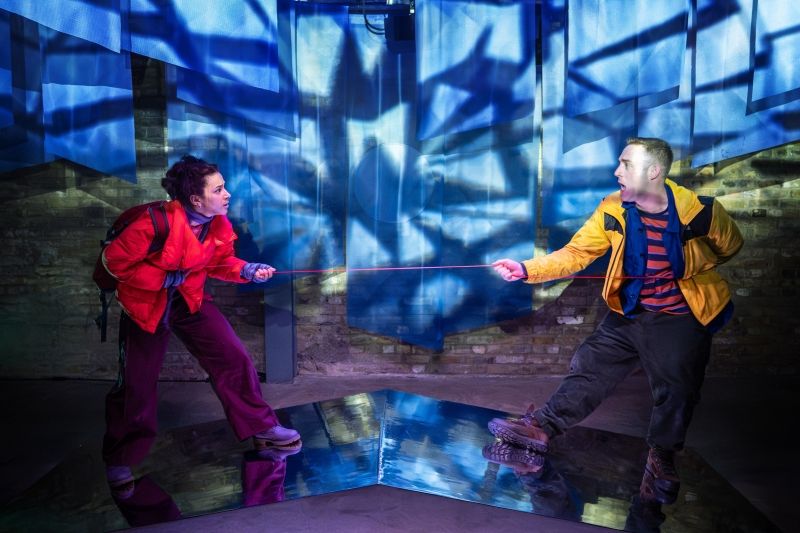
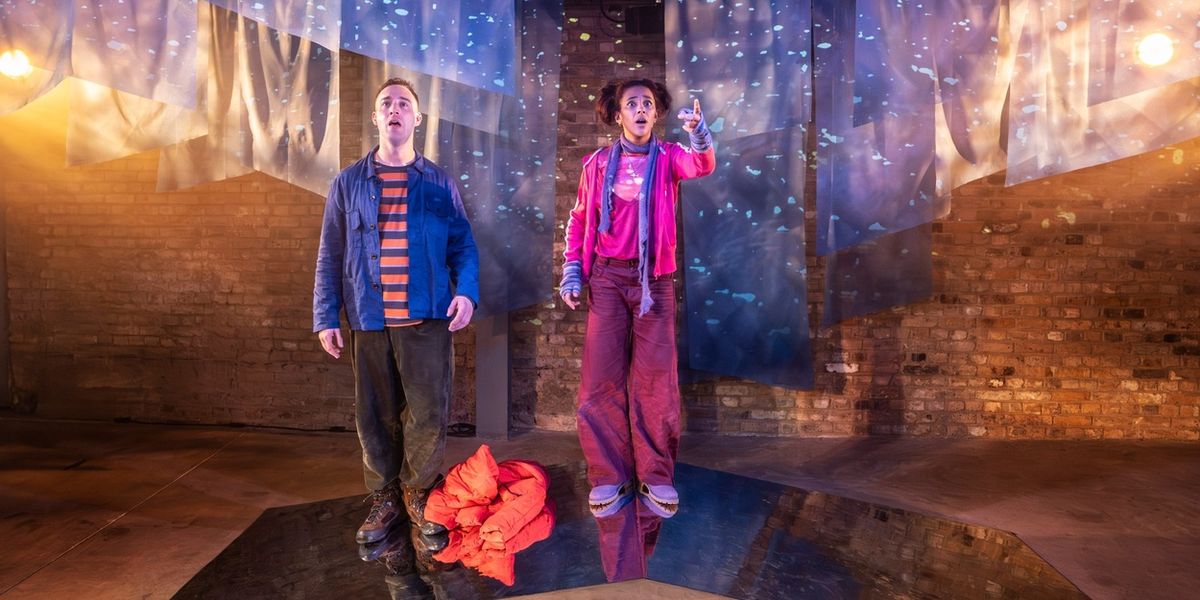
For her debut, playwright Jessica Norman leans into the singular speculation that “the people in power” keep us humble citizens from the truth. It’s fascinating stuff. Long-listed for the Women’s Prize for Playwriting and directed by Imy Wyatt Corner, This Little Earth is a thin exploration of the debris of grief at a time where reality flickers. It’s alright, but it could be so much more.
Honey’s been obsessed with Antarctica forever, even in spite of her irrational fear of penguins. When her sister Sadie dies, her world is thrown off its axis. Lost and alone, she meets Christopher, an oddball with baggage, who believes that The Truman Show is “practically a documentary”. When Honey gets sucked, they navigate conspiracies in the post-truth era.
Norman’s dialogue is fairly natural, but doesn’t dig deep in any sense or way. Her characters are annoying just enough to be real, but the catalyst is a lot of under-detailed hearsay. Its runtime (90-ish minutes straight through) isn’t exploited, so the narrative becomes too short and too long at once. Rather than diving into the matter, they talk in circles.
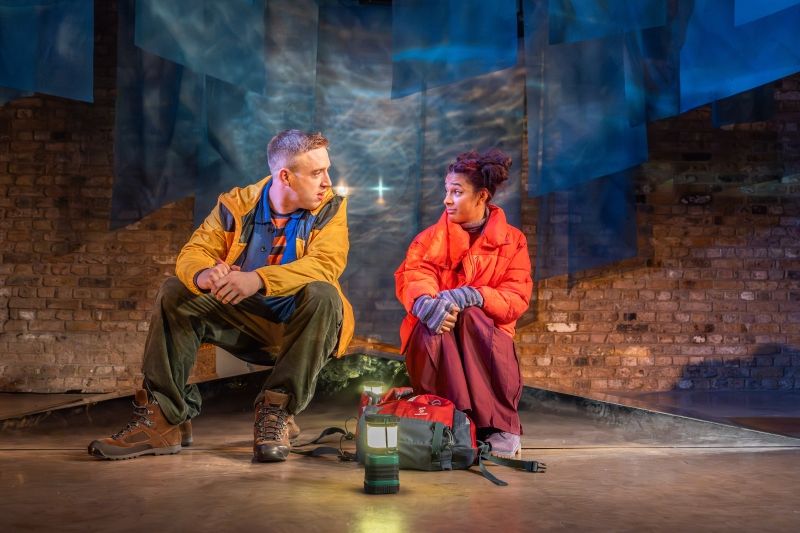
Stuck on a snow bridge after falling into a crevice somewhere in Antarctica, Honeh and Christopher are dying. We go back and forth across the timeline, finding out how they met and how they got there. It’s a shame that we’re supposed to take the whole thing at face value. As we’ve mentioned, travelling the continent is extremely difficult. Reaching it undetected must be near impossible. Yet, there they magically are.
We’re told they took a flight and stole a boat, but we’re stripped of all the adventure. That’s not the point of the play, fair. But in depriving us of the logistics of setting off for a trip of this magnitude, we don’t get any of the external pressure that would impact the couple. The writing also lacks urgency. Honey's sister Sadie is a crucial figure in the development of her characterisation, but comes off merely as an accessory.
Honey’s grief is touched upon at the start and her guilt complex is revealed at the end, but these points don’t inform the project sufficiently enough for them to be as important as they should. There is no current running between Fanta Barrie and Ross O’Donnellan either. They would both benefit from a more nuanced perspective. The script, however, is limited in that too. The direction is as strong as it can get despite the restraints of a minimalist vision.
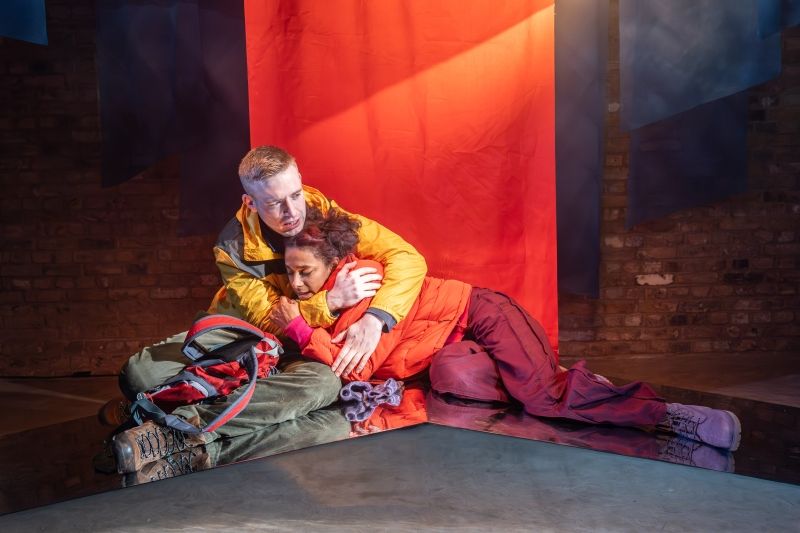
The glacial landscape (both natural and spiritual) comes to life designed by Jamie Lu with a reflective up-and-over ramp. Hugo Dodsworth’s lights and projections wash an array of blue fabric and bounce over the allegorical mountain in playful and evocative hues. It’s striking in its expression of the unimaginable iciness and cold they find, but comes up short for the earlier preparation period.
Norman recapitulates what she’s been addressing in the denouement of the piece. She tries to blame the exploitation of ignorance by charismatic leaders and the dread brought on by capitalist governments for this type of subjugation. Honey’s hallucinations aren’t enough for This Little Earth to be a well-rounded story.
The two big themes – death and conspiracies – run parallel, only meeting briefly without much analysis. We lack any emotional attachment to Honey, whose side while we should be on arbitrarily, and that has dire consequences for the final result.
This Little Earth runs at the Arcola Theatre until 15 November





Reader Reviews
To post a comment, you must register and login.