

Interview: 'It's Quite Visceral and Brutal': Max Bennett on TITUS ANDRONICUS
'It's a timeless reflection on what people will do in the pursuit of power to each other. '

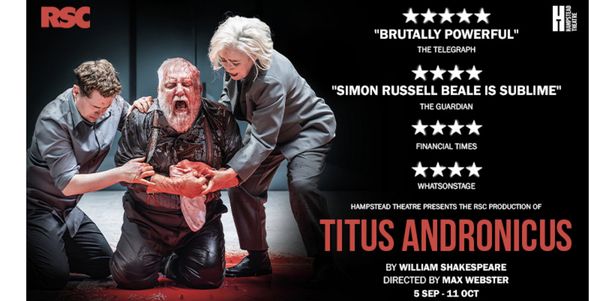
After a run at the RSC in Stratford-upon-Avon earlier this year, Titus Andronicus has arrived at the Hampstead Theatre in London. The play, starring John Hodgkinson as the titular character, is the most violent of William Shakespeare’s plays, often using gallons of fake blood! Recently, we had the chance to speak with Max Bennett, who plays the role of Saturninus in Titus Andronicus. We discussed how he first got started in the world of theatre, what it’s like performing at the Hampstead Theatre and even how Shakespeare helped him understand musicals!
So starting with a bit of a general question, how did you first get started in the world of theatre?
I did plays when I was growing up at school, and that's when I fell in love with acting. The school split in two - the older half of the school would do proper plays, and the younger half would do plays that were designed to give everybody a line, and they weren't terribly good! But the older half were doing a production of A Midsummer Night's Dream, and they wanted somebody small to be Puck, a little sprite. So I got to play Puck when I was twelve, and I fell in love with it. Then I did National Youth Theatre a little bit later, and then I went to university and did lots of plays there at Cambridge. I did French and Italian, and for part of my degree, you have to spend a year away in the country of one of the languages that you're speaking. So I spent that in Paris at a school called [L’Ecole Internationale de] Jacques Lecoq, which is movement-based - people call it a clown school or a physical theatre school. I'd signed with an agent whilst I was still at Cambridge, so quite soon after graduating, I just started auditioning for stuff and got some jobs!
And what made you want to be a part of this production of Titus Andronicus?
Well, I didn't know the play at all, so it was a real treat for me! I've done a lot of Shakespeare, and coming across the play, I was reading it like a new play. I knew that there was a very famous, horrible rape scene, and the thing about a pie, and that's all I knew. So reading it from scratch was great. I didn't see it in Stratford, but it was very well-received and is a brilliant production, So lots of reasons! I've never worked at the RSC, and I know Max [Webster], the director from way back. We were at university and drama school together, but we never worked together. In this process, it's kind of strange, because he's directing his transfer of The Importance of Being Earnest, so he's not really been in rehearsals very much. He's seen a couple of rehearsal runs. So even though I'm working with him, I'm actually more working with Kwame [Owusu], our revival director, who's been fantastic. So that was an appeal, too.
For those who might be unfamiliar with the play, can you tell us a bit about it?
So it's Shakespeare's most violent, bloody play. It's a political play and a family drama. It's his first tragedy, it's early in his career. There are lots of seeds of more famous characters in some of the characters that appear in the play. Aaron is like like Othello and Iago rolled into one, with a bit of Edmund as well. There are shades of King Lear in some of the family dynamics. But really, it's an exploration of violence. There's all kinds of violence - state violence, racial violence, sexual violence - and people are the victims and the perpetrators of it. And, like all good plays, it’s really not very binary who's good and who's bad. Even the most evil characters are wonderfully humanised by Shakespeare, so he complicates how we feel about these people and what they're doing to each other in the pursuit of power, in my character's case.
And what has it been like performing at the Hampstead Theatre?
It's a really nice place! I'd seen quite a few things there. I've never done a play there. Because it's quite banked, when you're watching something there, it feels epic, but when you're on the stage, it feels quite small and intimate. So it's great. I think it's quite a good translation for the members of the company who did the show before. It's quite a good translation from the Swan.
And what is it like performing in somewhere like the Hampstead Theatre versus Shakespeare’s Globe?
The Globe is a bigger beast. Yes, it's more intimate, but at the same time, it's a great theatre, so it can take the scale of what these plays require, moments that require huge stakes and big, almost operatic levels of stuff. But also, you can be slightly more intimate than vocally at the Globe, where there's just a necessity - there's 2,000 people, it’s outdoors, there are planes. There are things that you just have to compete with that you don't in a theatre.
What is it like to work on something classic, like Shakespeare, versus something new, like A Knight's Tale?
I've done a lot of new writing. It's really nice chopping and changing and going back and forth between things. A Knight's Tale was really a new experience for me - I've never done a musical before! It's a comic role, which is really fun. And so going back into this, which is a really nasty tragedy, playing a borderline sociopathic character . . . It's nice to surprise yourself and do different things and move from one thing to another. I love Shakespeare, but I also love working on new writing, so it's nice to be able to do both.
It's quite the contrast going from a new comedy musical to the bloodiest Shakespeare play!
I was like, “Why are people singing all of a sudden?” It's a bit like what happens in Shakespeare plays, where suddenly the emotion is too much, or they have too much of a problem that they need to solve, so they speak to the audience. That's what soliloquies are. But, in a way, in musicals, the songs work in the same way. They're like, “Oh my God, I feel this so much - I just suddenly need to start singing a pop song!” It's much sillier than often Shakespeare is, but Shakespeare is pretty silly, too! And Trevor Nunn, one of the directors of the RSC, said that Shakespeare wrote the first musicals. Twelfth Night or As You Like It, they're plays which have songs in them. And I see what he means, having done one now!
Do you find you have a preference for old work versus new work?
Not really, no - I love them all! It's nice to keep yourself on your toes and do different things.
What is it about Shakespeare's work that you think has kept it alive for so long?
He writes about what it is to be human so beautifully. They're timeless problems and stories and put in such incredible context with the most amazing language. I've read a lot and done a few of his contemporaries, and they're different, but there's something about Shakespeare that is just special. There's a reason that we continue to do him. And coming to a play like this, which lots of people struggle with in terms of him and our idea of who he is and what his work is, the play is really nasty. And Max hasn't shied away in terms of the edit - people are very horrible to each other in the play. It was Shakespeare going, “Well, all these guys are writing these bloody tragedies. Here's my attempt at it.” And, it's an early work. You can see the seeds of lots of his later characters and ideas coming through in it. I've learned to love the play in a way that lots of people do it down.
Do you have a favourite Shakespeare play?
I mean, Hamlet takes some beating! Yeah, it’s a special one.
What do you hope audiences take away from this production of Titus Andronicus?
Obviously, there are always conflicts going on in the world. And Shakespeare is so brilliant because he speaks about what it is to be human, so it always seems to be contemporary and relevant. But this show in particular, and the way in which it's been staged, hasn't shied away from some of the more horrendous political violence that is in the play, but presented in a stylized way. It's incredibly visceral. You're not going, “Oh, how did they do that trick of that little moment of violence?” But at the same time, there aren't ribbons - there's a lot of blood. It's quite visceral and brutal. And the things that happen within the play are very real for the audience. So it's speaking about our world, sadly, how many horrific conflicts are going on, and the sorts of images that we're seeing. It's a timeless reflection on what people will do in the pursuit of power to each other.
And how do you deal with being in such an emotional play? How do you leave that on the stage?
It's harder for some actors in this play than others, but we all have our own ways. It's a big thing now, but it wasn't talked about when I started acting - “de-roling.” It's very good, it's necessary. When I've had the done the show, I've had a shower, all the bloods come off, and then I cycle home. That process of cycling just lets you leave the show behind. So that helps me.
And finally, how would you describe the show in one word?
Visceral.
Titus Andronicus runs from 15 September to 11 October at Hampstead Theatre.

Sign up for all the news on the Fall season, discounts & more...
|
Powered by

|