EDINBURGH 2025: FACILITY 111: A GOVERNMENT EXPERIMENT Q&A
Facility 111: A Government Experiment runs at Edfringe until 17 August
BWW catches up with Inge-Vera Lipsius, writer of Facility 111: A Government Experiment. to chat about bringing the show to the 2025 Edinburgh Festival Fringe.
Tell us a bit about Facility 111: A Government Experiment.
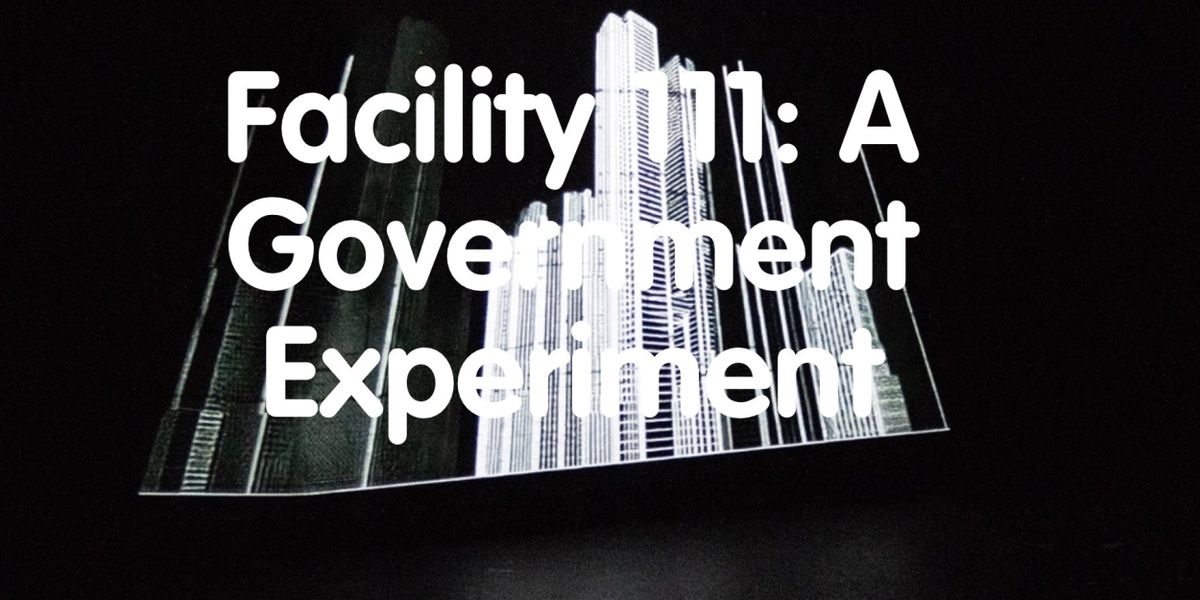
Facility 111: A Government Experiment is a surreal new audio piece that takes place in complete darkness, at Assembly's Front Room black box theatre/container at the Edinburgh Fringe (July 31 – Aug 17, at 11:25 am, except Aug 12). My name is Inge-Vera Lipsius, and I have written and staged the piece and am performing it live. In it, the audience is addressed directly—as 'you'—and is asked to visualise a series of images/situations that unfold in two different, but interconnected cities: one made of glass, another of sand.
This piece is my Edinburgh Fringe debut and has—rather wonderfully—been included in Lyn Gardner's Top 20 picks for the Fringe... I had the idea some years ago, but was only able to create the show this year, so it's an honour to be able to premiere it at the festival and to be included in Lyn's list. The piece is inspired by real events, which I chose not to make explicit in the blurb or in the text, so that there would be space for the audience to fill in the details in their mind. The show explores big themes (like migration and empathy) by tapping into the audience's imagination, creating parallels or links between different people and locations. What you end up visualising can also reveal a lot about you and your own experiences, as well as how you might relate to the themes explored in the show.
What does performing this in the dark add to the experience?
Facility 111 relies on the input of your imagination, and having the piece in darkness means that there is a 'black/blank canvas' on which to paint. There are no distractions, no inputs other than the play's text, and you are meant to construct the show in the dark, using your mind. It is an individual—and collective—imagination game from beginning to end.
It is also interesting to think about why this piece is, ultimately, a piece of theatre, rather than a radio play, for example—and what it changes to have it staged live in a theatre, with people sitting and imagining together, rather than making it available online and having people listen to it on their own in their own space. For one thing, the 'no distractions' element is important, as it makes the experience much more immersive. But, also, the show is ultimately a dialogue—between the piece and the audience (there is that conversation element, with the audience being addressed as 'you') as well as between the various audience members, as everyone will end up having completely different experiences of the same piece of writing.
How has the show been received so far?
Luckily, very positively! People have been very keen to discuss their experiences with each other (and with me), and an audience member has reviewed it as being 'Just what you've come to the Fringe for,' which is very nice! One of my absolute favourite parts of the Fringe, or of putting on a show, is getting to speak and interact with the audience, and to hear what they thought/visualised and how they found out about the piece. It's been particularly interesting to do so with a piece that so much depends on the audience's mental input. I think this show is intriguing for audiences, as you might come in with one set of expectations—or not knowing what to expect—and it might turn out to be something quite different from what you imagined...
Why bring it to Edinburgh?
I have been to Edinburgh three times in the past, as a performer when studying at the University of Cambridge, and have loved it every time—the atmosphere is special, like stepping into a theatre and living there for a bit... After university, I went to Ecole Philippe Gaulier in France (the clown school that Sacha Baron Cohen/Borat and Emma Thompson attended, among others); I am not a clown, but I came out of Gaulier having learned a lot about theatre and performance and about the kind of theatre I wanted to make. After Gaulier, I staged sold-out productions in London and Amsterdam (I'm from a Dutch-American background), including Quad Loop (a play I wrote on the Kamila Valieva doping scandal at the 2022 Winter Olympics) and Paranoia (my adaptation of the classic Dutch novella of the same name by Willem Frederik Hermans), but these have bigger casts and a more complex set-up. Facility 111 is more minimalistic to put on, which makes it great for festivals and touring, but it is also my most experimental piece to date—a piece that really immerses and speaks with and to the audience—so I thought it would be a great fit for Edinburgh.
What would you like audiences to take away from it?
I think I will leave this question open, as the show so much depends on your experience of it and who you are! If you see the show (which I hope you do), please come talk to me afterwards and let me know what you will be taking away from it and what shape it took on for you!