


REVIEW: Cihangir Atölye Sahnesi Presents SALOZ'UN MAVALI
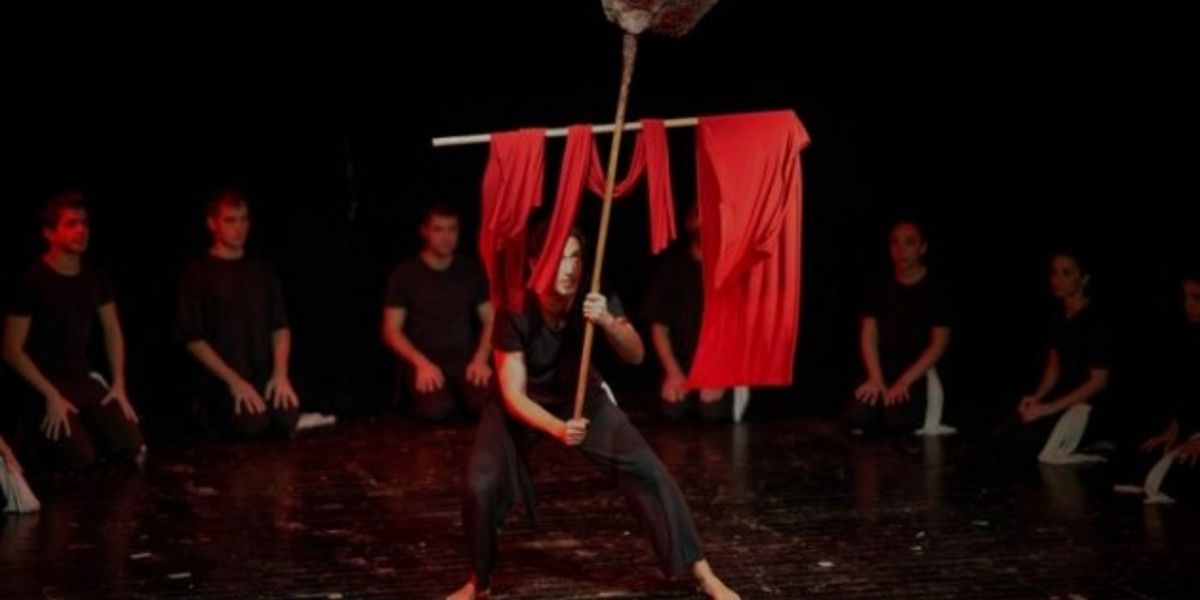
Make Portugal Great Again! In their production of Saloz’un Mavalı, adapted for Turkish stages by Can Yücel, Cihangir Atölye Sahnesi stages the clash between an imagined glorious past and a bleak, oppressive present. First performed in English as The Song of the Lusitanian Bogey in 1965, the play has, unfortunately, lost none of its relevance. Originally a two-act work, the CAS production condenses the material into just under an hour, but the ensemble fills that hour with a tightly woven collage of images, rhythms, and political critique.
As with Filler ve Karıncalar, the company leans into a devised-theatre aesthetic. Performers appear barefoot and dressed entirely in black, accented only by black-and-white scarves. Here, though, that reduction feels less like an investigation into storytelling itself and more like a deliberate homage to mid–20th-century political theatre. CAS proves itself a worthy inheritor of this tradition, adopting but not hollowing these dramatic aesthetics.
Muhammet Uzuner’s staging moves quickly between vignettes, granting each performer moments of individuality, though the ensemble always backs them as a chorus. The production’s dominant scenic element, a large, bloodied scarecrow representing Salazar, constructed by Selda Uyan, anchors the otherwise stripped-down space. Unlike some of Weiss’s more elusive works, Saloz’un Mavalı is strikingly direct. It is political theatre in the most literal sense: decades of Portuguese history compressed into less than an hour, the pace hurtling forward with a momentum that transforms epic history into fable. Weiss's political directness leads to a didactic quality that only avoids preachiness by becoming aesthetic.
Alongside Weiss and the talented CAS ensemble, this production also offers a chance to encounter the work of master translator Can Yücel. Yücel’s famously inventive approach to translation and his loose, expansive engagement with Turkish create passages with an almost rap-like velocity and musicality. Dramatic lighting by Onur Alagöz and expressive choreography by Hicran Akın enrich the ensemble-driven staging. The work is shared evenly across the gifted ten-person cast: Alper İrvan, Barış Kaan Güven, Berfin Karatay, Boran Özsaygı, Can Seçki, Dorukhan Kenger, Furkan Özkan, Murat Aytekin, Selda Uyan ve Zuhal Atalay.
|
|
ANDERS MATTHESEN inkl. 4-retters middag Musik i Haveselskabets Have (5/13-8/14) |
|
women in emotion - Vepsestikk Rathaus Stuhr (9/19-9/19) |
|
|
ASKIMHALLEN - Oktoberfest med Karlstadpojkarna Askimhallen (10/10-10/10) |
|
Sommerkonsert med Vamp Biologen (8/21-8/21) |
|
|
NØTTEKNEKKEREN - EN JULEMUSICAL Mjøndalen Samfunnshus (11/20-11/22) |