


Review: MAHABHARATA at Canadian Stage
Epic story vibrantly given life at Canadian Stage
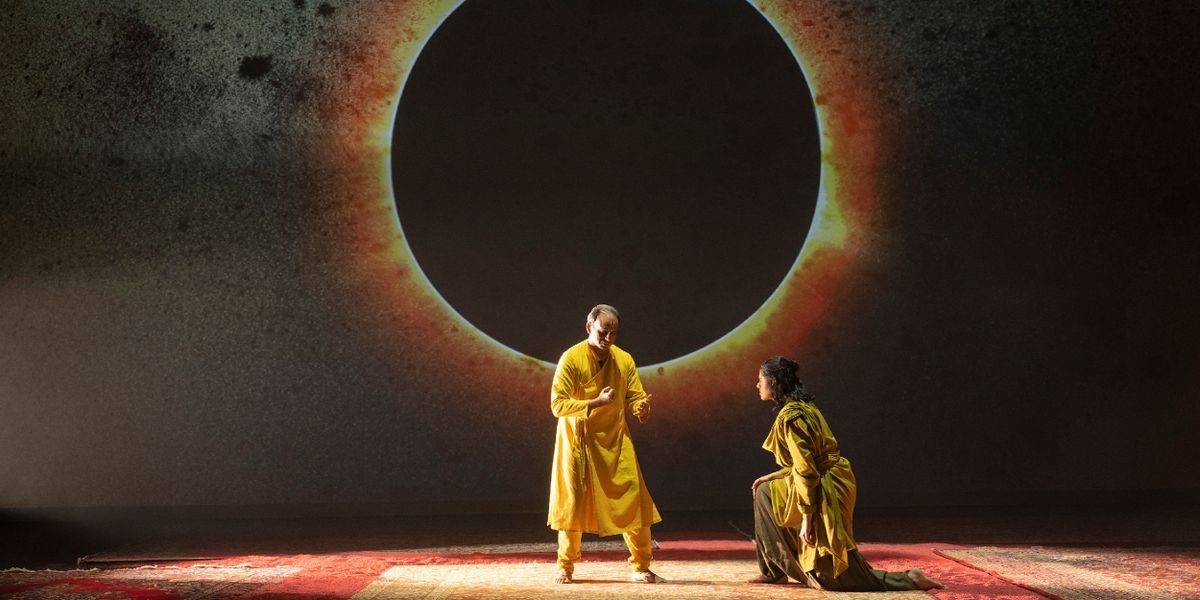
“Why do you assume all rules are good?”
The god Krishna (a dryly funny Neil D’Souza) asks this of one side of an all-consuming inter-family war, cousins against cousins, in the second half of Why Not Theatre’s two-part production of MAHABHARATA, the Sanskrit epic of fate, death, and cycles of violence, now presented by Canadian Stage after premiering at the Shaw Festival in 2023.
He’s right to question this claim; a series of vows related to heredity, procreation, and loyalty have proven destructive to the very people the vower swore to protect, yet nobody budges an inch from the words that bind them. Now, millions will die on the rules-laden battlefield as their leaders try to achieve balance by killing each other.
Under Ravi Jain’s direction of Jain and Miriam Fernandes’ script, the two halves of the show play at a central concept of balance, having significant aesthetic differences but still clearly linked to deliver a message about the power of storytelling to change minds and prevent the impulse for mindless revenge.
Beginning in PART ONE: KARMA, Fernandes effectively narrates an extended tale about royalty and inheritance. Concerns over whose descendants will get to rule the kingdom lead to those destructive vows and years of infighting. Fernandes’ Scheherazade-type story is delivered to prevent an angry king’s revenge on all the snakes in the kingdom after the sole snake survivor of a forest set ablaze to feed a god bites and kills the king’s father, a relative of the firestarter. If that sounds confusing, it doesn’t really matter beyond understanding that the “eye for an eye” philosophy has been infinitely destructive across generations.
While a detailed story in its own right, the tale is also an extended allegory that makes points about karma (the effect or consequences of one’s actions) and dharma (balance and one’s specific duty to that balance) vs. justice, with the message that who decides what justice is changes its meaning. The purpose of this type of storytelling isn’t to remember all the events and characters, but to zoom out and focus on greater impressions as the complicated tale rides by.
This also means that you’re not especially likely to care about the numerous tragedies in and of themselves (for example, one character’s son is introduced mere moments before he tragically dies), but the emotion, no less intense, comes from the epic nature of the story itself and its impact on the king who hears it.
The first half of PART ONE is mostly setup, and can be a little slow. Things really start to cook in the second act, raised to a boil for the entirety of PART TWO. PART ONE’s beautifully simple design by Lorenzo Savoini includes a bowl containing a bright flame and a large ring of red sand, with an illuminated ring around an enormous mirror above the stage that echoes its cyclical nature. After a rousing solo dance number by Jay Emmanuel in the first act sends sprays flying, the sand spreads in the second act to form a carpet. Ribbons of fabric representing the snakes suspended in the air above the fires of revenge decorate the rear of the stage behind a terrific band, whose constant backing music by John Gzowski and Suba Sankaran keeps the energy level up even when we’re in a particularly long stretch of exposition.
War is very hard to portray on stage, so the show effectively symbolizes it with dance and music; this also reminds us that the powerful play while the country burns. Some of the tensest moments, in fact, are not about the battlefield; a sequence in PART TWO, where two characters play an intensely high-stakes game of dice with a foregone conclusion, somehow manages to be more pulse-pounding than a swordfight.
While it’s a little disappointing that the band is not central in PART TWO: DHARMA, there is plenty of music in the form of an operatic solo number at the end of its first act, delivered beautifully by Meher Pavri under a gold headdress of peacock feathers (costumes by Gillian Gallow) as one character has his turbulent mind expanded by a patient god.
PART TWO is as technological as the first part is analog, removing the band to create large projections (by Hana S. Kim) that give the impression of a war film. The tenseness of the war room, as some cousins try to bargain for peace and others follow their destinies of destruction, lends itself well to closeups of angry faces across from each other at the bargaining table, with beguiling outline-heavy designs suggesting the empty maw at the heart of war. The projections range in effectiveness and quality, from the crisp, beautiful and compelling moments in the war room to occasional fuzzier, lower-quality images of “enlightenment” more reminiscent of a 90s screensaver.
The cast of MAHABHARATA, comprised of local and international South Asian actors, has a lot to do, and largely manages to weave the spell that keeps our attention through the epic. Sukania Venugopal as grandfather Bhishma, whose vow begins the troubles, comes across as intense vocally as her shock of white hair does visually. Darren Kuppan as the king’s greedy son relishes in effete evil mannerisms, and probably has a long career ahead of him playing viziers and villains.
The ineffectual but dignified and well-meaning blind king (Ravin J. Ganatra) finds rich angst in his torment over no-win scenarios, and the war-heavy story finds balance in his surprisingly tender relationship with his wife (Goldy Notay), who spends most of the show blindfolded by choice so she can experience the world in the same manner of her husband.
D’Souza plays the god Krishna as the only character with a sense of humour, his dry wit underscoring both his trickster nature and that he’s above the petty human squabbling. He provides badly-needed balance to a show that might otherwise take itself too seriously. And while Emmanuel’s dance numbers from choreographer Brandy Leary could vary a bit more, they’re hypnotic to watch at the best of times.
When compared to the power of the international cast, some of the local actors feel a little more pedestrian in vocal delivery. A major exception is the delightfully devoted Navtej Sandhu as the Moses-like Karna, whose mother sends him adrift in a basket after a god causes her to conceive out of wedlock, and who winds up opposing the “cousins” who turn out to be his closer brothers.
The occasionally gender-bent casting, presented without comment and without obvious design, works very well. The only time it comes to the fore is when Shiva reminds us at a crucial moment that the gods can present as male or female when it is relevant to their plans.
Jain and Fernandes’ MAHABHARATA is a major achievement, delivering a timeless story in a distinctive and fascinating way. If you can brave the slow start and don’t mind the occasional hand-holding (we don’t need lyrics near the end to tell us what the message of the show is, honest), you’ll find a treasure trove of theatrical delights and an emotionally resonant frame, along with some godly permission to occasionally break the rules.
Photo of Neil D’Souza and Anaka Maharaj-Sandhu by David Cooper

|
The Roll Players Comedy Bar Danforth (6/30-12/29) |

|
THE ART OF SOUND CBC Glenn Gould Studio (6/26-6/26) |

|
Tuesdays With Morrie Marsh Street Centre (9/22-9/26) |
|
The King James Bible Play Stratford Festival (8/06-9/26) PHOTOS |

|
MrBallen: Lights out Live Meridian Arts Centre (10/04-10/04) |

|
Not Dead Yet! - John Cleese and the Holy Grail at 50 The Elgin & Winter Garden Theatres (10/02-10/02) |
|
Ladies Night - Drôlement sexy Théâtre Capitole (1/22-1/23) |

|
ANNULÉ - Il était une fois... Noël Théâtre Capitole (11/25-11/29) |

|
The Play Maidsby Roman Viktyuk Living Arts Centre Auditorium (10/04-10/04) |
|
Relive the Music 50s, 60s & 70''s Show Thunder Bay Community Auditorium (9/17-9/17) |
Reader Reviews
To post a comment, you must register and login.