


Review: A STRANGE LOOP at Soulpepper
Pulitzer Prize-winning musical is a thoughtful collaboration
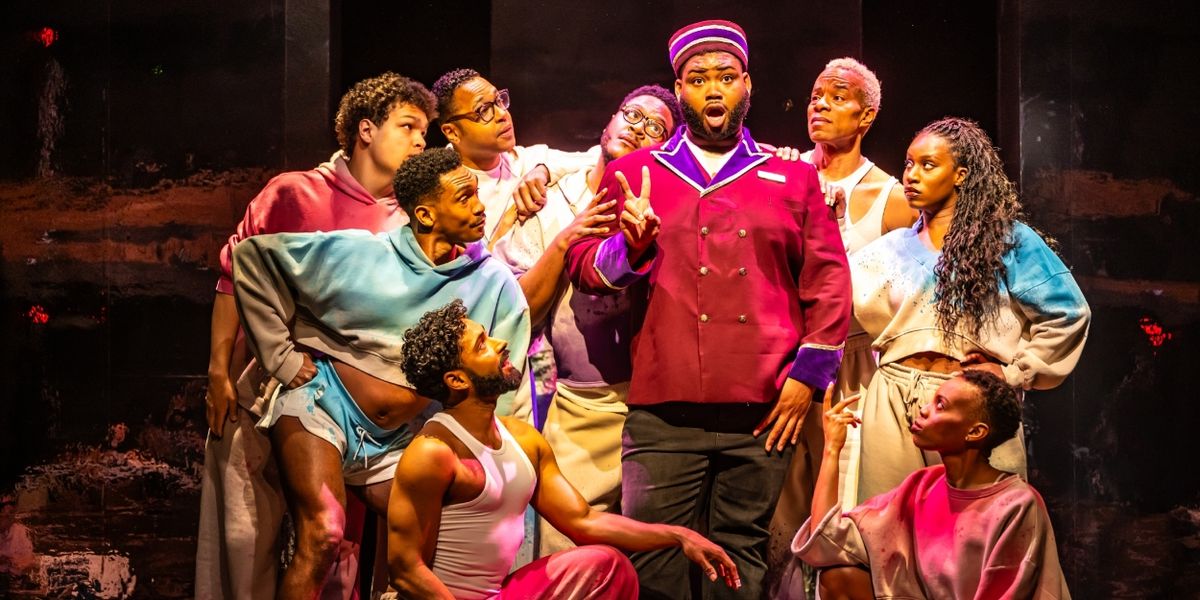
What do you do when staring into the mirror brings you grief?
You stare at it anyway.
A STRANGE LOOP might seem like a strange title for a musical, a cognitive science term coined by Douglas Hofstadter that revolves around the creation of self-identity. Having no innate essence of being or personality, the mind creates symbolic value from events, impressions, and thoughts, proceeding to weave a tapestry of self that soon takes its own word as evidence. This narrative of self becomes a feedback loop and a tautology, difficult to break free from or change.
Usher (Malachi McCaskill), the main character of Michael R. Jackson’s Pulitzer Prize-winning musical, weaves his loop on a loom of self-loathing, relentlessly looking into that painful mirror while trying to make sense of his reflection.
In the fine tradition of autobiographical musicals about musical writers trying to make art, with notes of Stew and Heidi Rodewald’s Passing Strange, Jeff Bowen and Hunter Bell’s [title of show] and the late, great William Finn’s A New Brain — and yet something completely its own — Jackson’s A STRANGE LOOP is a striking text and meta-text, calculatedly raw and messy, archly vulnerable, and sacredly profane.
It’s easy to see why no fewer than four theatre companies (Soulpepper, Crow’s, The Musical Stage Company and TO Live) joined forces to produce it at Soulpepper’s Baillie Theatre; it’s the type of show whose representation can change the lives of audience members who intimately know its patterns, while also being deeply moving to anyone watching.
Fat, gay, and Black, Usher’s working via nominative determinism as an usher at The Lion King on Broadway, which barely pays his bills as he tries to turn his MFA from NYU into a piece of meaningful musical theatre (MMT?). Meanwhile, his parents call from Detroit, broadcasting dramatic family squabbles while praying he’ll repay them for his education by coming back to Jesus and renouncing his homosexuality, or at least writing a Tyler Perry-style, commercially successful gospel play. Usher gives all of his family members the names of Lion King characters, which is both entertaining and a reminder that everything artistic is a layer built on everything else.
Usher’s ambivalent about sex at best due to shyness, self-hatred and the spectre of his older brother’s death from AIDS, but it seems to him (and his overly familiar doctor hilariously played by Amaka Umeh) like something else he should work at. Meanwhile, his personified thoughts are always on the attack, presenting him with visions of a life twisted by fatalism and distorted by pain.
Brian Dudkiewicz’s set of tall mirror panels, which revolve to form set pieces like the Broadway house at intermission or Usher’s cluttered apartment, reinforce that most of the show takes place on the mental landscape. The vaguely funhouse effect might work better in a Broadway-sized house (in fact, the production seems pitched and designed for a bigger venue than it’s currently in), but it’s nice to be in intimate proximity to a show that’s all about intimacy in its various and sometimes terrifying permutations.
Canadian productions of shows that are resolutely American, particularly those that delve deeply into what it means to be Black in America, often don’t quite capture the unique blend of discomfort and bombast that can be so vibrant on American stages. Perhaps it’s that very energetic pitching for a larger house that does it, or that Malachi McCaskill is from Jackson Springs, North Carolina, but A Strange Loop neatly sidesteps those pitfalls, hitting the vibe out of the park and across the border.
McCaskill takes on a difficult role with verve, whether he’s sardonically skewering those Tyler Perry plays in a scene that’s half Perry, half Christopher Durang absurdism, or resolutely facing his innermost demons (or his “Inner White Girl,” a persona whose privilege allows him the outspoken artistic life for which he longs; see if you can catch all the Liz Phair references).
Speaking of those demons, Amaka Umeh plays a mean Self-Loathing, in both senses, and brings life to a scene where figures from Black history taunt Usher for his inadequacies. Marcus Nance makes the most of his resonant bass voice, and menaces in the most chilling scene, where a hookup with a white man turns into a psychosexual reckoning of Usher’s self-worth and racial issues. (By the way, the production’s not for kids, full of language that Usher’s thoughts warn him will make his show dangerous and unmarketable.) Everything is always at least a shade hyperreal, Usher’s take on reality skewed by his point of view; scenes deliberately linger a little too much, a character named Rafiki's nails a little too long on purpose to blur the line between Usher's people and the theatrical world he inhabits.
Despite being a “loop,” Jackson’s script is punchy and full of surprises; the songs don’t always go where you expect, either musically or lyrically. Jackson, and Usher, stare into that mirror with their own particular kind of grief, refreshingly reflecting back a rich blend of musical theatre history with its own fat, gay, and Black sensibility.
Photo of the cast of A STRANGE LOOP by Dahlia Katz
|
LA BOHEME Terminal Theatre (11/27-11/29) |
|
2627 PAC Present Season First Ontario Performing Arts Center (9/22-5/22) |

|
Bryan Adams Sudbury Arena (8/31-8/31) |
|
Moonstruck Comedy Bar (10/09-10/30) |
|
Battles Young People's Theatre (4/26-5/06) |

|
HYPROV: The Hypnosis & Improv Comedy Experience – Live in Ottawa NATIONAL ARTS CENTRE - SOUTHAM HALL (11/12-11/12) |
|
Something Rotten! Stratford Festival (5/11-10/31) PHOTOS |

|
The Play Maidsby Roman Viktyuk Living Arts Centre Auditorium (10/04-10/04) |

|
SYMPHONY UNDER THE STARS Collingwood Music Festival (7/11-7/11) |
|
Mt. Joy RBC Amphitheatre (9/21-9/21) |
Reader Reviews
To post a comment, you must register and login.