
In these dangerous times, who will burn brightest — and who will burn out?
Winter 1591.
It is a dangerous time for artists: the country is full of conspiracy and paranoia.
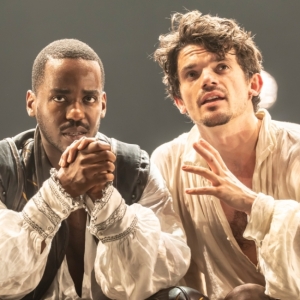
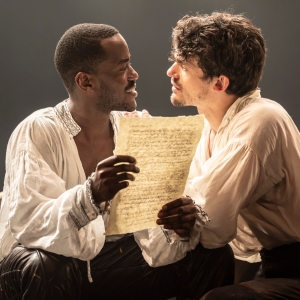
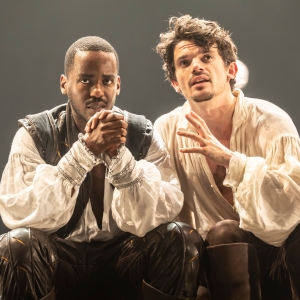
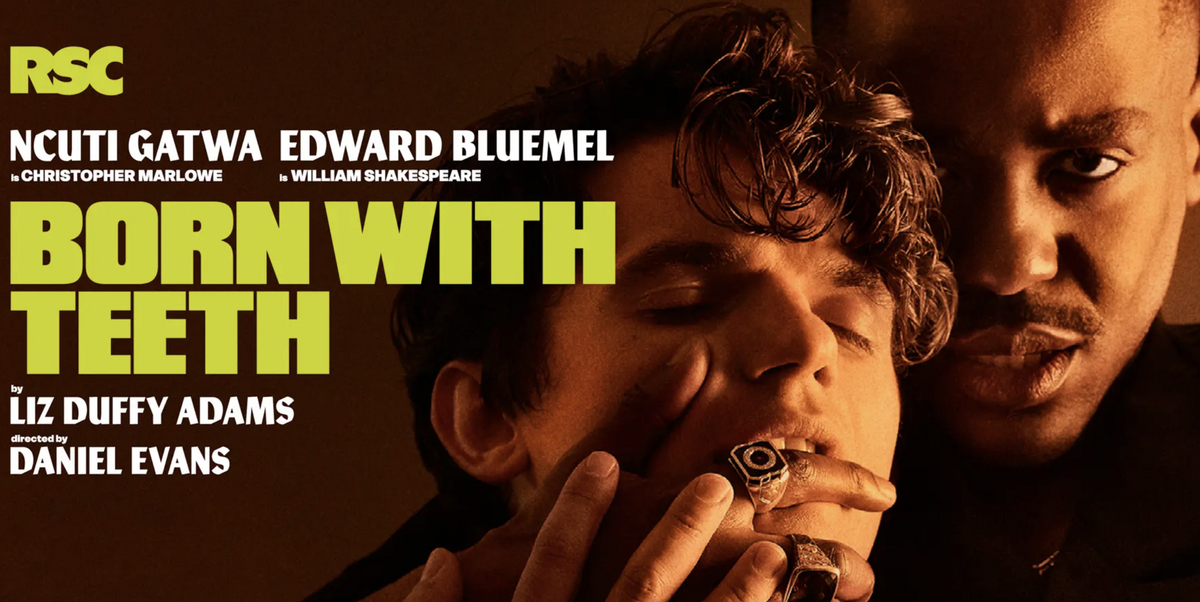
In the backroom of a pub, writing sensations Kit Marlowe and Will Shakespeare are forced together in a creative union. Alone, with the table as their stage and battlefield, they sharpen their pens – and let their genius fly.
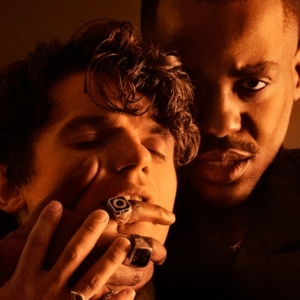
Across three secret meetings, the rivals duel and flirt like their lives depend on it – and with spies everywhere, betrayal is so tempting.
Innuendos and double-entendres immediately settle in as a second language while they start to excavate the nature of poetry and espionage. They orbit each other with crackling charisma in an ambiguous limbo designed by Joanna Scotcher. Three walls of barn-door lights (Neil Austin) suspend the performance. Brief projection work tells us it’s 1591: Marlowe and Shakespeare, therefore, find themselves collaborating on the three parts of Henry VI between the threats posed by religious imbalance and the secret services. The social unrest of late-Tudor England is the foundation of the story.
The most interesting sections – at least if you care about Shakespeare – are those which probe the differences between the two writers. Marlowe insists on inserting his own bold personality and controversial beliefs into every line he wrote while Shakespeare’s instinct is to disappear, to lose himself in every character. The moment when the two men act out Shakepeare’s inserted scene in Henry VI showing the love between a husband and wife is remarkably tender. The play’s concluding note, that Shakespeare consistently wrote Marlowe (who died in a tavern brawl in 1593 at the age of 29) back to life is intriguing.
| 2025 | West End |
West End |
Videos