


Interview: Jack Stehlin on LEAR REDUX: A QUANTUM FANTASIA
at the Odyssey Theatre Ensemble from May 24 through July 13

In the World Premiere of Lear Redux: A Quantum Fantasia, a perpetually surprising reconstruction of the Bard’s powerful drama presented by Odyssey Theatre Ensemble, New American Theatre and Not Man Apart–Physical Theatre Ensemble, Jack Stehlin (pictured), who previously starred in both Titus Redux at the Kirk Douglas and Tempest Redux at the Odyssey, inhabits the role of an aging actor whose last days strangely parallel those of Shakespeare’s tragic king.

Jack Stehlin
Photo by John Dlugolecki Photography
I decided to speak with Jack about his history portraying Shakespeare’s tragic kings, his personal connection to Lear, and how this tragic king differs or is similar to the others.
Thanks for taking the time to speak with me, Jack, as I know life must be keeping you busy in the final days before opening Lear Redux: A Quantum Fantasia.
Thank you for your interest, Shari, it’s always such a pleasure to talk with you.
Since this is your third collaboration with Not Man Apart–Physical Theatre Ensemble adapter, director, and choreographer John Farmanesh–Bocca for his acclaimed Redux series, were plans in place to take on Lear while you were portraying Titus and Prospero?
Actually, no. During Titus Redux in 2010, we were just focused on Titus. We knew we wanted to work together but we weren’t thinking this far ahead. Still, in retrospect, it made sense. Titus came not long after the Iraq War, at a time when the themes of brutality, revenge, and the devastating cost of power felt especially resonant.
A few years later, in 2016, we felt ready to try something new. We didn’t know what it would be - we just sat down and asked, “What story needs to be told now?” That’s how The Tempest and playing Prospero came about. It was during the height of the Syrian refugee crisis, when people were risking their lives at sea to escape war and seek safety. A play about exile, shipwreck, survival, and ultimately forgiveness suddenly felt necessary.
That eventually led us to Lear Redux in 2025. There was this feeling - a sense of reckoning. “What now?” And it seemed like the only thing left to explore was Lear - a meditation on family, on the choices we make, and on facing inevitable mortality as we age. In many ways, it was the natural next step in my journey as an actor, and in the broader story we were telling across time.
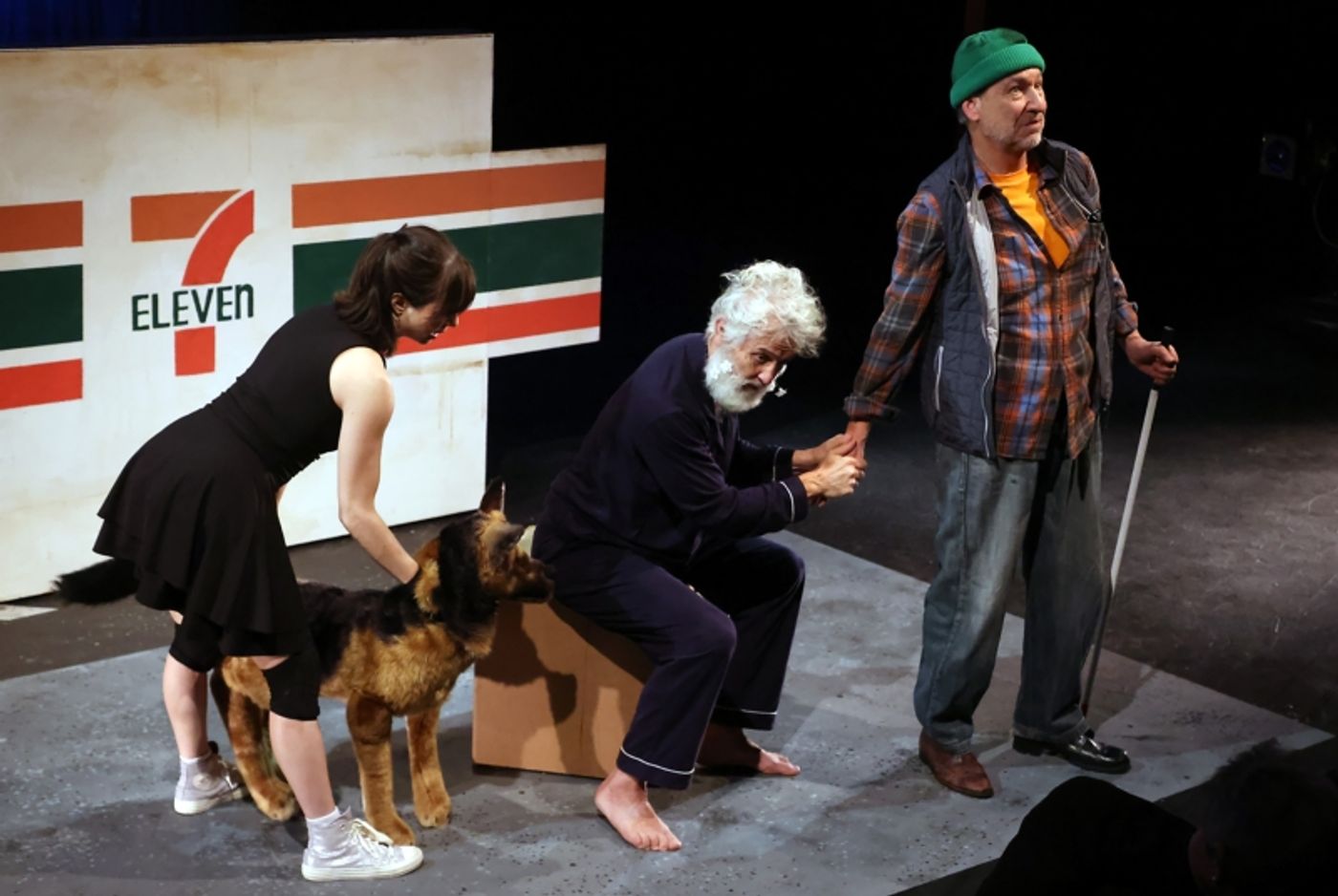
Emily Yetter, Jack Stehlin, Dennis Gersten
Photo by John Dlugolecki Photography
Your role in the play is described as “an aging actor whose last days strangely parallel those of Shakespeare’s tragic king.” In what ways?
Lear Redux follows a kind of parallel storyline. You’ve seen this device before in conceptual works like The Dresser, where King Lear is staged within a completely different narrative context. In our case, we’re modernizing Lear by bringing it to life through the story of an aging actor at the end of his career. His unraveling - emotionally, physically, mentally - mirrors Lear’s own descent. The lines blur between the man and the character: both are grappling with mortality, legacy, loss, and the fracturing of relationships. It's not just a role he plays - it's a life he's living. The tragedy of Lear becomes the tragedy of this actor.
Does the play take place both in Lear’s time as well as modern time? And if so, tell me your process of switching between characters and time frames.
Lear Redux takes place entirely in the present. That’s a core part of the concept: we’re working with the idea of the eternal now. When I’m acting and developing the story, I’m fully in the present moment. We don’t try to transport ourselves back to another historical time or pretend to live in a different era. Instead, the story is grounded in the here and now, which makes the emotional journey more immediate and visceral

Emily Yetter and Jack Stehlin Photo credit: Cooper Bates
How would you describe the similarities and/or difference between other tragic Shakespeare characters you have played?
There’s a definite through line among Shakespeare’s tragic figures as they are largely responsible for their own downfall. Their tragedy often stems from an egocentric view of themselves, making them tend to be self-absorbed rather than empathetic toward others. Their self-interest and indulgence set the stage for their tragic outcomes.
That said, the differences come down to their unique circumstances and backstories, which can make some characters more sympathetic or accessible to the audience than others. Some tragic figures are simply selfish and dangerous, while others are deeply conflicted, struggling with internal contradictions. Those conflicts are what make these characters the most interesting and rewarding to play.
You can think of it as degrees of accessibility. Some tragic figures are harder to relate to because of their destructive nature. But the most compelling ones are those who wrestle with their flaws, which makes their inner turmoil add layers of complexity.
That idea of wrestling with oneself and fate always looms large, especially when you think about the ultimate journey - the arc of a life coming to its later stages. As you approach the end, there’s an awakening that can happen, or, alternatively, a descent into darkness. There are two paths: one where you find and embrace the beauty of life despite its fragility, or one where bitterness and despair take over.
For me, Lear has become a powerful way to explore my own journey and challenges as I move forward in life. Shakespeare’s Lear is a tragedy because, in the end, the king can’t make the necessary changes in time and must face the consequences of his actions.
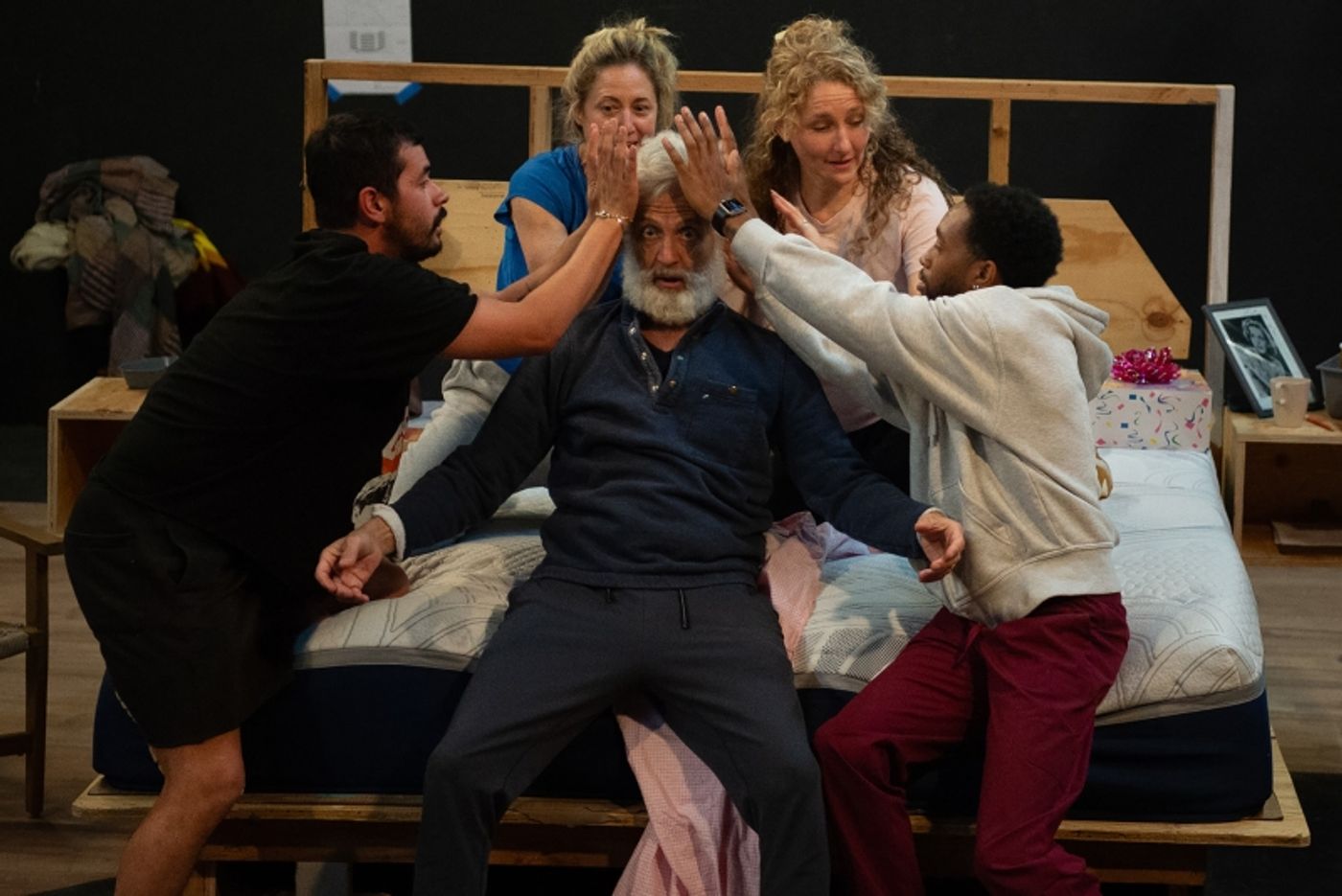
(L-R) Andres Velez, Eve Danzeisen, Jack Stehlin, Jade Sealey and Ahkei Togun
Photo credit: Cooper Bates
Do you or have you always felt a deeper connection to Lear since you also have three daughters, now all young adults?
Absolutely. Being a father to three daughters has deeply influenced my connection to Lear. The parallels between my own life and Lear’s circumstances have been both inspiring and motivating as I explore the role. I have wonderful relationships with all three of my daughters, and I’d like to think I’ve avoided some of the mistakes Lear made.
But I recognize that a core issue in Lear is his inability to offer love and support, maybe not equally to each daughter, but with complete commitment to all of them. That’s a challenging journey because each child is an individual, and the relationship you build with each has its own dynamics. A father must navigate those challenges and find harmony despite the differences. Lear, unfortunately, is unable to do that.
One of the lines that really struck me and deepened my understanding was when Lear calls one of his daughters his favorite, openly in front of the others. That moment is one of the most painful mistakes a father can make, and it reveals just how far Lear is from real, compassionate fatherhood.
I think that’s why Lear remains so important - it’s a cautionary tale for everyone. Not just fathers, but mothers, daughters, brothers, sisters, friends, and partners. Love is universal, and Lear warns against letting ego destroy that love.
The point is, you don’t have to be a father for this story to resonate. The same themes of ego, love, and reconciliation show up in everyday interactions with neighbors, colleagues, our dogs, or anyone we care about. There’s always the opportunity to rise above ego and embrace grace and compassion.

Jack Stehlin and Ensemble
Photo by John Dlugolecki Photography
If you could offer parenting advice to Lear, what would you share with him?
I would encourage Lear to embrace vulnerability and practice humility. His downfall stems from pride and a lack of genuine connection with his daughters. As a father, it's crucial to listen actively and love unconditionally, understanding that each child is unique and deserving of respect.
What do you most admire about adapter, director, and choreographer John Farmanesh–Bocca’s production style?
His bravery stands out. He takes a well-known Shakespearean work and fearlessly rips it apart, then puts it back together in a way that honors the original play while opening it up to explore new themes and discoveries from a modern perspective. It’s a bold approach that challenges both performers and audience, making the story fresh and relevant without losing its timeless power.
Tell me your process of adapting your classic acting style to John’s more movement-based style.
John and I work extremely well together. We built the concepts of Lear Redux collaboratively. I come from a classical background and use Stanislavsky techniques that focus on deep emotional truth and the internal life of the character. This is also the work we do in our Studio at The New American Theatre. John’s choreography connects that inner work to the physical expression, creating a unique theatrical performance that blends movement and classical acting. It’s always an exciting process to merge these approaches and bring something that is fresh and powerful to the story.

Andres Velez, Jack Stehlin, Emily Yetter, Jade Sealey and Ahkei Togun
Photo by John Dlugolecki Photography
To what do you attribute being able to work so closely with your wife, Jeannine Wisnosky Stehlin, on producing plays in which you appear? And how do you keep from taking production tensions home with you?
Jeannine and I met 30 years ago this June. We started as producing partners before we fell in love, so our working relationship has always been the foundation. We know each other inside and out from producing and building our lives together, raising three children who are now magnificent adults. We have this shorthand - sometimes a look or a couple of words is all it takes. Jeannine is not only a producer but a talented artist in her own right. Sometimes I’m in the production, sometimes I’m not, but that never changes how we collaborate. And honestly, it’s really nice to come home after work with the person you love.
Is there anything else you’d like to share about yourself or the production?
I hope that people come see it! Thank you!
Thanks so much! I’m looking forward to seeing you onstage again!
 Performances of Lear Redux take place on Fridays and Satrudays at 8 p.m. & Sundays at 2 p.m. from May 24 through July 13 (dark Friday, July 4). There will be two additional weeknight performances on Wednesday, June 11 and Wednesday, June 25, each at 8 p.m. and followed by a post-performance discussion; there will also be a post-performance discussion on Friday, June 20. Every Friday night is “Wine Night” at the Odyssey: enjoy complimentary wine and snacks and mingle with the cast after the show.
The Odyssey Theatre is located at 2055 S. Sepulveda Blvd., West Los Angeles, 90025. Tickets range from $20 to $43. Onsite parking lot and in the surrounding neighborhood. Please read signs carefully to avoid ticketing and towing. For more information and to purchase tickets, call (310) 477-2055 or go to https://odysseytheatre.com/whats-on/lear-redux/

|
Good Night, Oscar North Coast Repertory (9/16-10/11) |

|
Much Ado About Nothing McCadden Place Theatre (8/07-8/16) |

|
6 Out of 10 Theatre 68 (8/20-8/20) |

|
After the Blast The Broadwater Second Stage (8/05-8/13) |

|
Catch Me If You Can Colony Theatre (9/17-10/18) |

|
Emily Skinner: In Concert Feinstein's at the Nikko (8/14-8/15) |

|
Gershwin and the Golden Age Younes and Soraya Nazarian Center for the Performing Arts (The Soraya) (10/11-10/11) |

|
John Lloyd Young Feinstein's at the Nikko (8/21-8/22) |

|
Love, Loss and What I Wore Sawyer's Playhouse (8/08-8/30) |

|
Our Man in Santiago by Mark Wilding Odyssey Theatre Ensemble (9/10-9/20) |