


Review: Kevin Puts Has Georgia (and Alfred) on His Mind in BRIGHTNESS at NY Philharmonic
Renee Fleming and Rod Gilfry Thrill in Helping Bring Correspondence of Georgia O’Keeffe and Alfred Stieglitz to Musical Life with Conductor Brett Mitchell
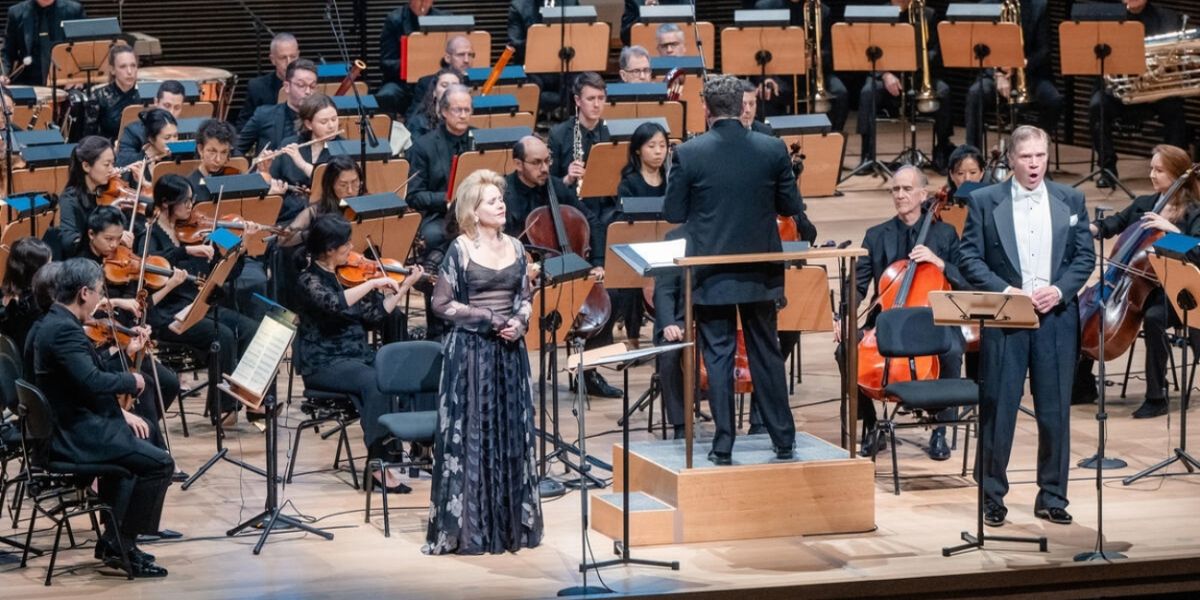
This past weekend, composer Kevin Puts’s BRIGHTNESS OF LIGHT, based on the long, abundant correspondence of artist Georgia O’Keeffe and photographer/gallerist Alfred Stieglitz, had its long overdue New York premiere. The New York Philharmonic gave it a scintillating performance under debuting conductor Brett Mitchell, with soprano Renee Fleming as O’Keeffe and baritone Rod Gilfry as Stieglitz, friends and lovers (marital and otherwise).
Lightening sometimes does strike twice. Puts’s score has been expanded from an earlier piece about O’Keeffe and the addition of another voice has augmented the richness of the musical experience--especially one as mellifluous as Gilfry's--though Fleming remains the center of it. The composer’s use of French horns and oboes, and percussion, for example, play deftly against the voices and geography of their lives. Throughout his varied score, he shows much empathy for the highs and lows of their relationship, digging deeply, with compassion, into the connections between the two on many levels.
This was a larger work in all senses of the word, with visuals of her artwork and the two artists, together and apart, in New York and in and around Taos, NM, thoughtfully designed by Wendall K. Harrington. The text was taken from letters between O’Keeffe and Stieglitz at varying stages of their relationship (though she claims that “words and I are not good friends” her letters don’t seem to bear that out), from the very beginning to the end of his life. Some came from the Georgia O’Keeffe Museum in Santa Fe, some from Yale University’s Collection of American Literature, Beinecke Rare Book and Manuscript Library.
Puts knows how to write for the strengths of Fleming’s voice—she was a force behind THE HOURS at the Met—and she didn’t disappoint, delivering an exquisitely lovely performance. There’s humor, too, as in her song about what she considered her feeble efforts at the violin (“you’ve never heard anything worse,” she writes/sings). Concertmaster Frank Huang did a "wonderfully horrendous" version of her commentary.
The Philharmonic was not left out of Puts’s efforts—not only in the marvelously, intricately orchestrated songs, but in the introduction to the piece as well as with a pair of Orchestral Interludes, “Georgia and Alfred” and “The High Priestess of the Desert”—and conductor Mitchell drew sweep and passion from the orchestra. He was a last-minute substitution on the podium, though he had conducted the work once before. Still, he did a stellar job, as did the ensemble.
The piece started life in 2015 with a commission from the Eastman School of Music to Puts, an eminent alumnus; though they had Fleming in mind, as another graduate of the school, Puts clinched the deal. The work, LETTERS FROM GEORGIA, was a five-song cycle first heard here in Alice Tully Hall in 2016 at a concert by the Eastman Philharmonia as the centerpiece of a program with Prokofiev and Ravel (whose “Daphnis and Chloe” was also on the program this week). Even back then, I found the music intoxicating and Fleming in very good form.
By the time of that concert, Puts told me that he already had a larger piece in mind, with Stieglitz joining O’Keeffe. It seemed natural, since they had a life where art and love entwined. He had left his wife of over 20 years to be with her, though his philandering sometimes got in the way of their relationship and, notably, her discovery of the joys of the Southwest put her far from his life in New York. It had its premiere at Tanglewood in 2019 and has been heard many times before finally reaching New York this week.
Filling out the program was Ravel’s “Daphnis et Chloe (Choreographic Symphony in Three Parts),” which had been written by the composer for the Ballets Russes in 1912. It ran from the rhapsodic to the anarchic and back again, and was exciting to hear even if it's not among Ravel's most frequently played works.
Again, Mitchell didn’t have much time with the orchestra when he was parachuted in to replace Juanjo Mena, who was a last-minute cancellation, but the performance nonetheless ran smoothly. (Mena announced early onset Alzheimer’s earlier this year.) The New York Philharmonic Chorus, under Malcolm Merriweather, added greatly to the overall effect of the people, becoming one more element of the orchestra.
Caption: Renee Fleming and Rod Gilfry with New York Philharmonic under Brett Mitchell
Credit: Brandon Patoc

Reader Reviews
To post a comment, you must register and login.