


Chinese Composer Yue Chen Premieres Spring View at Carnegie Hall, Bridging Eastern and Western Musical Worlds
Yue Chen is recognized as one of today’s leading Chinese composers.
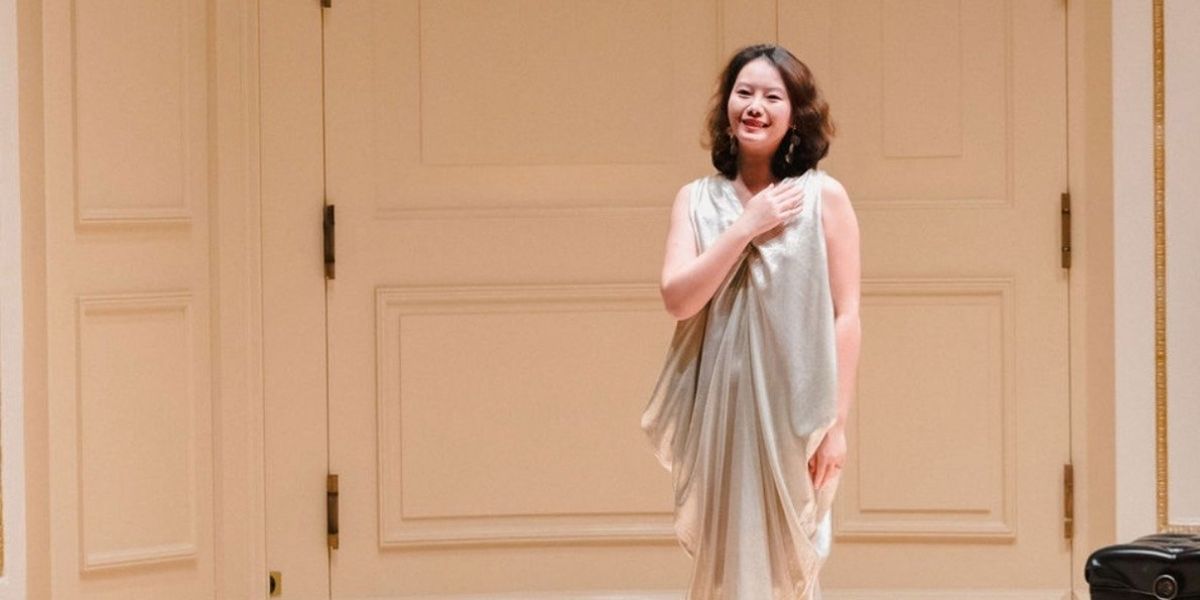
Written by: Tom White
In October 2025, Carnegie Hall in New York presented a distinctive concert of Chinese art songs inspired by classical Chinese poetry. The program reimagined ancient verse through a contemporary compositional lens, offering audiences a rare fusion of language, history, and modern sound. Among the highlights was the world premiere of Spring View (Chun Wang) by composer Yue Chen — the only newly commissioned work of the evening. The piece stood out for its bold structural design and its sensitive integration of Eastern aesthetics with Western techniques, earning enthusiastic praise from both audience and critics.
Recognized as one of today’s leading Chinese composers, Yue Chen has long pursued an organic synthesis of Eastern philosophy, aesthetics, and performance traditions with Western compositional thought. Her music crosses cultural and disciplinary boundaries, shaping a voice that is at once rigorous and deeply humane. Through her distinctive cross-cultural idiom, Chen broadens the field of contemporary classical music while addressing universal human experiences — mental health, illness, and marginalized existence — transforming complex emotions into lucid, resonant sound worlds.
In Spring View, Chen reinterprets a famous poem by Du Fu, reflecting on war, loss, and the endurance of beauty. Departing from the conventional linear form of traditional Chinese art song, the work opens with piano clusters in the extreme low and high registers, establishing sonic space rather than tonal hierarchy. This soundscape captures the desolation of the poem’s opening line, “The nation broken, yet mountains and rivers remain.” When the voices enter, Chen anchors the texture with clear harmonic pillars and singable melodic contours, keeping the text intelligible and emotionally immediate within a modern harmonic framework.
“Chinese poetry is metrically precise and phonetically rich,” Chen notes. “If one were to impose a completely atonal or freely structured system on it, the natural tension of the language would be lost.” She adds that writing for two voices poses its own challenge: maintaining dramatic balance between soprano and bass-baritone without relegating one to accompaniment or resorting to unison doubling. In Spring View, Chen achieves this equilibrium by subtly altering rhythm and accent whenever poetic lines recur, allowing the voices to trade leadership and build cumulative dramatic energy.
The piano serves as a narrative force, employing word painting — a technique dating back to Monteverdi — to translate imagery into sound. Through shifts in rhythm and texture, Chen evokes the flare of war signals in Du Fu’s line “Beacons blaze for three months on end.” Frequent modulations and chromatic harmonies create what she calls a “stability within drift,” a metaphor for emotional uncertainty and the restless inner life of wartime.
The premiere featured bass-baritone Ziliang Hao, soprano Lu Huang, and pianist Jonathan C. Kelly (an artist of the Metropolitan Opera). Their refined interplay and expressive sensitivity brought Chen’s multidimensional score vividly to life, balancing poetry, music, and drama in equal measure.
As the only world premiere of the evening, Spring View not only showcased Yue Chen’s technical mastery and cross-cultural vision but also reaffirmed her role as a vital creative voice in today’s international music scene. Through her synthesis of Eastern lyricism and Western modernism, Chen continues to redefine the contours of contemporary music — offering listeners a deeply human bridge between cultures, histories, and sound.
Photo Credit: Yue Chen
Prefer BroadwayWorld in Google Search?
|
Celebrate Beethoven!: Turning the Key Alice Tully Hall (9/17-9/17) |
|
American Composers Orchestra: New Virtuoso: Low End Theory at Carnegie Hall Carnegie Hall (3/18-3/18) |
|
Carnegie Hall Presents: Santiago Cañón-Valencia and Victor Santiago Asuncion Carnegie Hall (11/10-11/10) |
|
American Composers Orchestra: Hello, America: We Gather Here at Carnegie Hall Carnegie Hall (10/27-10/27) |