


Review: A Brave Take on WHO'S AFRAID OF VIRGINIA WOOLF? at Everyman in Baltimore
Edward Albee's Groundbreaking Drama Grips Audiences Through April 20, 2025
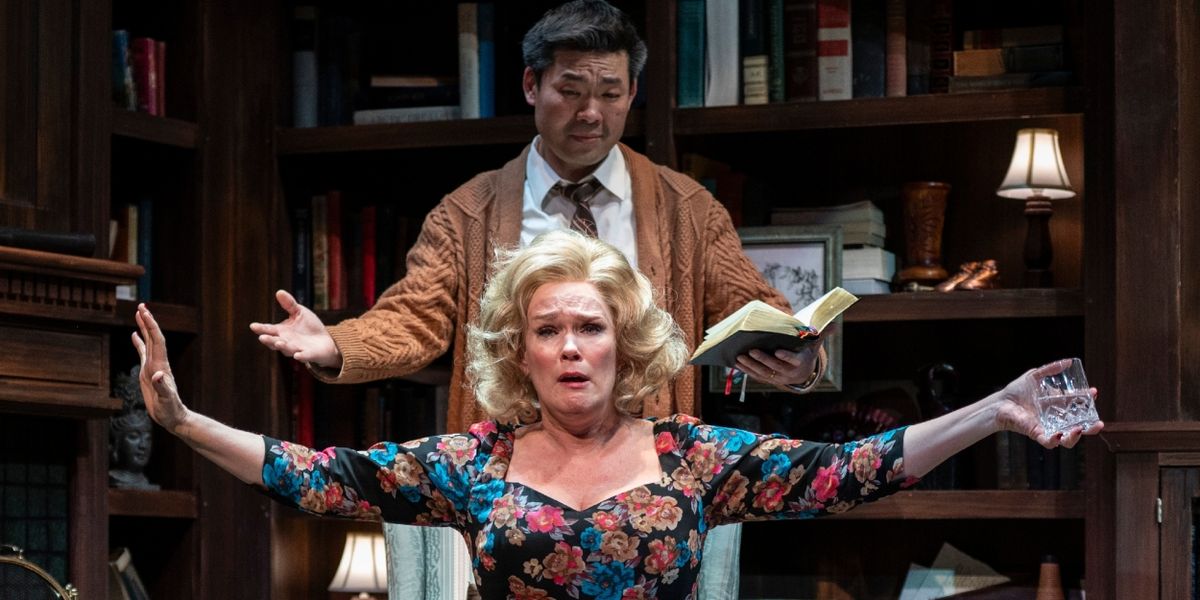
Who’s afraid of the Big Bad Wolf, the Big Bad Wolf, the Big Bad Wolf? And who IS Virginia Woolf? Edward Albee’s 1962 play doesn’t answer these questions, or really, ANY of the questions it provokes. It’s the sort of thing that either tickles or annoys people, depending on what one likes. A great many adults of theatre-going age may be unaware of the origin of either reference.
Edward Albee said of the title that it’s meant to reference being afraid to live without false illusions. Woolf’s work is full of introspection, some fanciful, some prosaic, and some self-aware. People who like Albee like Albee. People who don’t, really don’t. I confess to liking Albee. I like the way his dialogue flows, I like the snappy overeducated semi-reality of it. I like Albee’s characters, though many are somewhat despicable. Who's Afraid of Virginia Woolf? has been one of my favorites for a long time, but I've not seen it live before, nor the famous movie of the same title. It doesn't have a plot so much as a premise: A contentious couple who return from a faculty party that has lasted past midnight spitefully host young guests for (additional) drinks in their campus-adjacent home. It's awful, funny, entertaining, a different sort of awful, and finally, both perplexing and satisfying.
Actually watching the show for the first time, at Everyman, directed by the amazing Vincent M. Lancisi, is a delight. It’s a commitment, coming in at three hours and twenty minutes- with two intermissions, mind- for contemporary audiences, but those who appreciate slower moving classics will enjoy this rendition very much. Because I’d accidentally memorized a great deal of the dialogue in the ‘80s, when I first read, (and re-read, repeatedly), the show, I am troubled by not seeing a particular scene, which I discover later was deleted by the author in 2006. Ten years later, Edward Albee died, without restoring those 7 pages to the show.
Seating is on staggered risers, and the seats are comfortable but not cushy. Noise reverberates, especially if you drop a pen, (it clatters on the wooden riser) and since the audience is still as a cat watching molasses, one- a reviewer, perhaps- can be very self-conscious about that.
Tony Nam and Beth Hylton play our main characters, George and Martha. Hannah Kelly and Zack Powell play the young couple who has been invited for drinks following a party at the university president’s residence. The dialogue never references the names of the young guests, though the man calls the woman “honey.” No one speaks the name of the young man. This is thematically significant. The actual identities of the younger people are not important to the nearly plotless drama of the show.
All four actors are Everyman Theatre Resident Company members and are impressively masterful in each role. As Martha, Beth Hylton is nothing short of magnificent. Her impeccable timing combined with vocal, physical and facial expressiveness which by turns deny and reinforce the viciousness of her words. Tony Nam playing George is like a spring wound too tightly at the beginning of the show. As he unwinds, he becomes, moment by moment, more unpredictable until his final move in a game the guests don’t realize they are playing becomes inevitable. Zack Powell as the new handsome young professor who is not in the Math Department is by turns naive and vulgar, and his absurd bid to Martha to lie on his behalf in Act III encapsulates the whole play with astonishing simplicity. His wife, whom he calls Honey, is played by Hannah Kelly, a brilliant physical comedian, who imbues Albee’s dialogue with personality beyond the print. When she is onstage, Director Vincent M. Lancisi reels in the loose ends of other performers to give Kelly space for physical and verbal unbalanced teetering which is hilarious even as it’s nearly disastrous. All four actors are fascinating to watch unfolding machinations which de to this evening’s brutal collision.
The set is fascinating. Though there are three acts, there’s no scene change: like many Albee shows, the action happens all in the same place. Scenic Designer Emily Lotz places the audience outside a home with large windows enclosing a traditional library or den in a house not unique to, but particularly common around a college such as Loyola or Johns Hopkins, or someplace in New England. We observe some details through the large panes. As the show opens, the windows part like a curtain to reveal the set fully. It is fascinatingly full of detail, but the really interesting thing about the details of the set is that the longer one looks at them, the less interesting they become, which is probably metaphoric or perhaps reflective of the show’s ethos.
Costume Designer Kathleen Geldard gives to the characters outfits that could be worn without comment tomorrow, but also look like 1960-something, a time in which having a party after a party and drinking until 4 or 5 AM was something not limited to the student body on campus, but prevailed across the whole culture.
Sound Designer Kathy Ruvuna runs a very subtle ship. My companion notices things that escape my ears, but I am aware of something almost, not quite, inaudible, that creates atmosphere and builds tension. This is a bit of stage magic beyond clarity of actor dialogue and precision of sound effects, both of which are also impeccable.
Lewis Shaw, who choreographs Fights & Intimacy in this production, lands both with precision. Certain sequences which could have been the wrong amount of awkward were exactly the correct amount of awkward. Even brilliant actors serve a show better when paired with excellent choreography and coaching.
I love the language of the script, and although the characters say some truly terrible things to one another, it’s satisfying to be privy to domestic drama that is not one’s own, and possibly more horrific than what actually IS what’s going on in your own home. If you know the show, you likely already know whether you like it. If you don’t, here’s my take: if you're fond of language and fly-on-the-wall theater, if you love details and intrigue, this show is probably for you. If you’re up for an extended theatrical experience, you’ll be rewarded with a deep, rich experience and possibly post-curtain shell-shock. It's an Experience, painstakingly, gorgeously crafted. Don’t deprive yourself of this show.
The parking garage across the street suits me just fine, now that I’ve mostly gotten over my attachment to cash. You’ll need your ticket with you to re-enter the building and pay before returning to your vehicle.
Photo: Tony Nam and Beth Hylton as George and Martha
Photo Credit: Teresa Castracane Photography
Edward Albee's Who's Afraid of Virginia Woolf?, directed by Vincent M. Lancisi runs March 23 - April 20, 2025, 7 PM evening showtime, due to the length of the show. Saturday /Sunday /Wednesday matinees are at 1:00 PM.
See Who's Afraid of Virginia Woolf? at Everyman Theatre , 315 West Fayette Street, Baltimore, Maryland 21201
The Box Office is open Mondays- Fridays: 12pm – 5PM, and 2 hours prior to every performance. Email: boxoffice@everymantheatre.org, phone 410-752-2208 or purchase tickets online. Ticket prices range from $63- $92; however, Everyman’s Pay-What-You-Choose (PWYC) program includes 16 seats for each performance, $5- $45, if you’re snappy about acquiring them.
Final Factoid: The movie starring Elizabeth Taylor and Richard Burton was shot in black & white deliberately. Technicolor was available, but director Mike Nichols felt black and white played up raw and dramatic elements of the script/screenplay.
Bonus factoid: The name of the picture Martha is referencing is “Beyond The Forest,” 1949. After Albee wrote it into …Virginia Woolf? and Elizabeth Taylor said it in the 1966 film, it became Bette Davis’ tagline.
|
Bocking Baltimore Center Stage (8/14-9/06) |
|
SIX (Boleyn Tour) Hippodrome Theatre- France-Merrick Performing Arts Center (10/25-11/01) |
|
The Importance of Being Earnest New Spire Arts (7/24-8/20) |
|
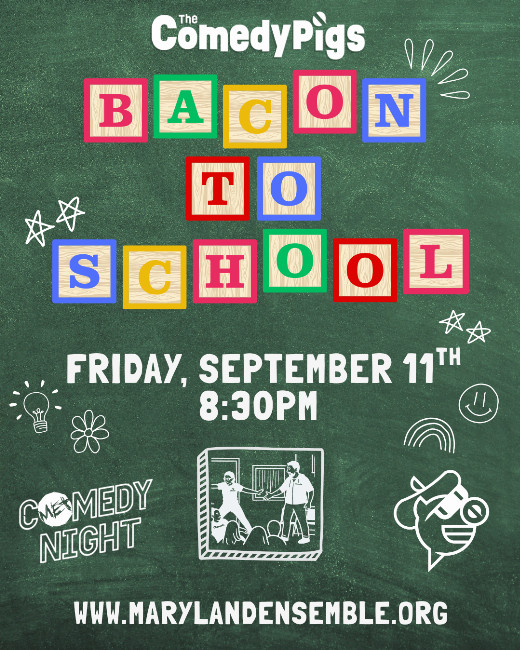
Bacon to School! "The Comedy Pigs" at MET Comedy Night Maryland Ensemble Theatre (9/11-9/11) |
|
The Dinner Detective Murder Mystery Dinner Show The Dinner Detective Baltimore (8/15-8/15) |
|
Hamilton (Angelica Company) Hippodrome Theatre- France-Merrick Performing Arts Center (3/09-3/28) |
|
Classic Theatre of Maryland presents "THE SECRET GARDEN" Classic Theatre of Maryland (7/08-7/25) |
|
MET's Comedy Extravaganza Maryland Ensemble Theatre (8/28-8/29) |
|
A Little Stephen Music: A Sondheim Cabaret Maryland Ensemble Theatre (9/05-9/05) |

|
The Pigeon Gets a Big Time Holiday Extravaganza! Maryland Ensemble Theatre (11/28-12/20) |
Reader Reviews
To post a comment, you must register and login.