


Season 2, Episode 5: Behind every summer is a community that keeps Fire Island alive. This episode explores the history of the beloved Pines Pantry through the eyes of its iconic Pantry Girls, alongside the volunteer firefighters of The Pines and Cherry Grove who protect the island from fires, hurricanes, beach erosion, and an uncertain future.
Review: DRACULA: A COMEDY OF TERRORS at Springer Opera House
An unexpected, offbeat show for Halloween
By: Russell Warne
COLUMBUS, GEORGIA — The best advice I can give to audience members who want to enjoy Dracula: A Comedy of Terrors is to turn off your brain. The production at the Springer Opera House aims for nothing more than to make its audience laugh. That is a legitimate goal for a show, but the predictability and lack of originality result in a forgettable production.
Dracula: A Comedy of Terrors is the loosest adaptation possible of Bram Stoker's original novel. Most of the main characters share names of characters in the novel: Jonathan Harker, Professor Van Helsing, Lucy, Mina, Renfield, and — of course — Count Dracula. But any fan of the original novel will barely recognize them. Jonathan is a mousy coward. Mina is played by a man in drag and is definitely not feminine or desirable. Most notably, Dracula is a bisexual playboy who seeks weak-minded mortals to do his bidding (hedonistic or otherwise). The changes are not a dealbreaker because adaptation usually involves making major changes to stories so that they work better on stage.
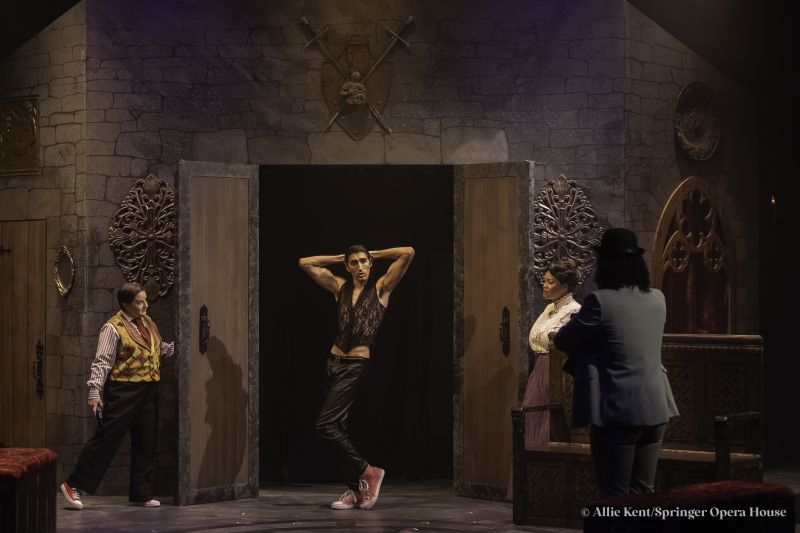
The plot is also mangled nearly beyond recognition. But the plot is not important; it merely serves as a vehicle for playwrights Gordon Greenberg and Steve Rosen to cram as many gags as they can into an evening. Greenberg and Rosen's obvious inspiration for Dracula: A Comedy of Terrors is the stage version of The 39 Steps (a similarity mentioned in the Springer Opera House's marketing). Both plays tell a sprawling and dramatic story with a minimal number of actors and add plenty of humor. But the borrowings are often too evident, such as the methods for having the same actor play multiple characters on stage at the same time. Unfortunately, these were the most successful gags in Dracula: A Comedy of Terrors, which means that the play's best moments were unoriginal. The derivativeness of the play should be no surprise. Even the title is recycled: The Comedy of Terrors is also the name of a 1963 film and an unrelated 2005 play.
Greenberg and Rosen's most original material is the humor, which is mostly crass sexual jokes, obvious punchlines, and repetitive gags that feel tired the first time. A plethora of sexual acts are mentioned or pantomimed, though most of these jokes struggle to rise above the level of a high school locker room. The laughter from the audience is proof that some people enjoy that humor. However, I question the appropriateness of making sexual assault the target of laughs (twice!). I do not know if this is in the script or if it was a directorial choice. Either way, you don't have to be a prude to think that sexual assault is never funny.
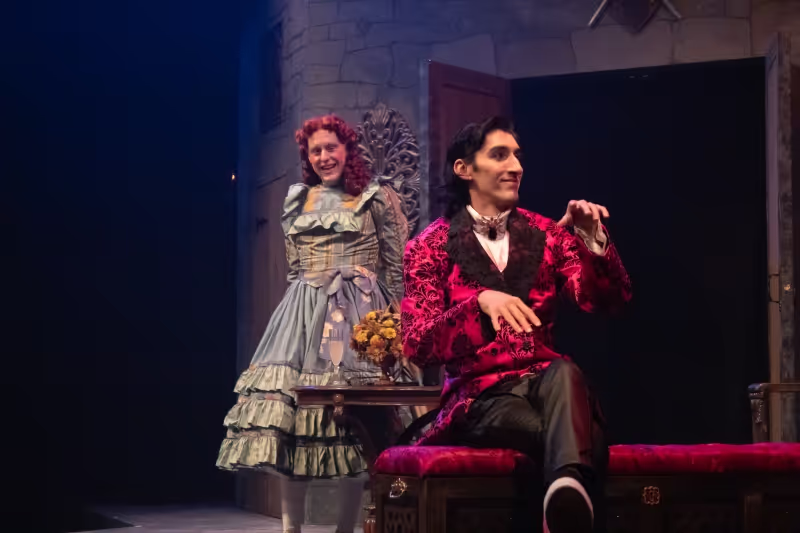
Though the script did not tickle my funny bone, I was impressed by the actors' ability to commit to it. The actors seem to be having a lot of fun in their roles, and that enjoyment is a major reason why the show works to the extent that it does. Heaven knows they don't get any help from the script because none of the actors play real characters. Instead, the actors' main job is to tell the next joke or give enough information to move the plot forward. All five cast members do this well.
Larry Robert Smith III is best at distinguishing his characters from one another. That, along with the change he shows in Jonathan Harker in the second act, demonstrates Smith's performing range. Adam Archer played Mina and Professor Van Helsing (a woman named Jean in this version), and his performance fits comfortably in the long tradition of humor in drag (e.g., Bugs Bunny, Some Like It Hot, Mrs. Doubtfire). Christian Becerra effectively updates the seductive vampire trope for the 21st century, though Becerra never takes his performance as Dracula seriously (which works for this show).
The two female members of the cast both turned in fine performances. Bonner Church was delightfully eccentric as the mentally ill Renfield, and her more formal performance as Dr. Wefeldt (Lucy and Mina's father and the caretaker of the asylum) did the most to keep the play grounded in its source material. Finally, Jamila Curry gave the most realistic performance as Lucy, who is Jonathan's fiancée in this version. Curry shows Lucy as a woman with genuine concern for the strength of her relationship with Jonathan and for her sister's wellbeing. Is the role as funny as the others? No, but the groundedness of Curry's performance helps the humor of the other characters stand out. Curry knows how to do her part to make an ensemble show work.
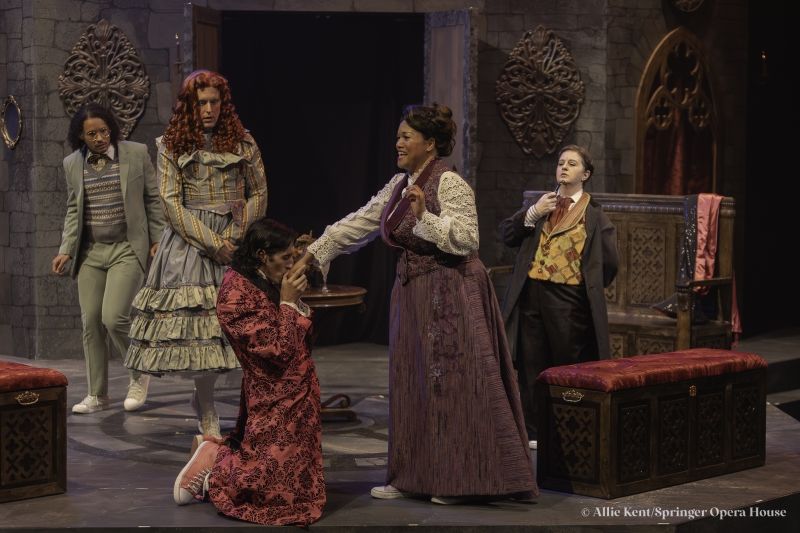
Keith McCoy's direction works well for the style of the script. The pacing is fast, and the transitions to the new scenes were smooth. McCoy's best scenes involve traveling, especially in the second act. I also loved the full use of the space, which allows audience members on all three sides of the thrust stage to enjoy the play completely.
As a theatre critic, I am supposed to engage thoughtfully with every play I review. That means I do not have the luxury of turning off my brain to watch a show. Audience members who want mindless fun and think that pelvic thrusts are funny will enjoy the show much more than I did. The Springer Opera House's production of Dracula: A Comedy of Terrors has its strengths, especially in the acting and the bold choice to mount an offbeat production for the Halloween season. Those strengths do not overcome the pervasive script problems, but they make the show good enough for some audience members.
Broadway news in your inbox
Weekly top stories - unsubscribe anytime.
Weekly top stories - unsubscribe anytime.
Popular episode

|
LIKE FATHER Alliance Theatre (10/08-11/15) |
|
Blind Boys of Alabama at Spivey Hall Spivey Hall (11/21-11/21) |
|
The Clean House Merely Players Presents (4/09-4/25) |
|
Rialto Film Series Presents: School of Rock Rialto Center for the Arts (1/13-1/13) |

|
N - The Story of The Emperor Jones, Charles Gilpin, Eugene O'Neill & A Particular Word: a Play by Adrienne Earle Pender Academy Theatre (10/23-11/08) |

|
Gwen Hughes & Friends: A Christmas Album Release Concert Churchill Grounds (12/08-12/08) |
|
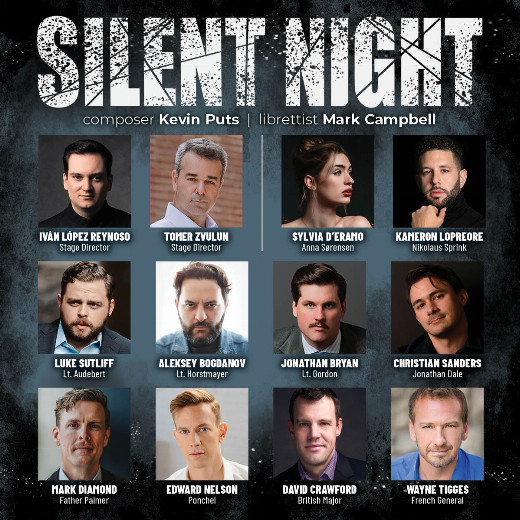
Silent Night Cobb Energy Performing Arts Center (11/07-11/15) |
|
Rialto Film Series Presents: Friday Night Lights Rialto Center for the Arts (11/19-11/19) |

|
Canadian Brass at Rialto Center Rialto Center for the Arts (2/12-2/12) |

|
Rialto Feed Your Senses with Becky Shaw Rialto Center for the Arts (11/18-11/18) |
Reader Reviews
To post a comment, you must register and login.