Zero to Hero: The Musical Evolution of Disney's HERCULES From Screen to Stage
Learn about the history of this Alan Menken musical, now running on the West End.
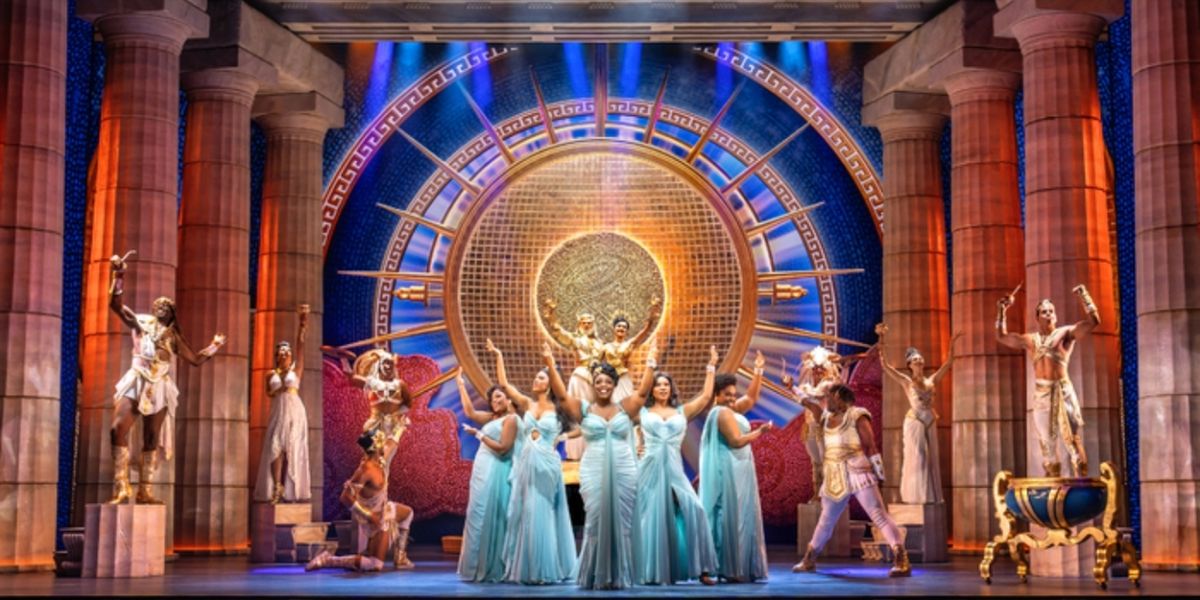
In June of 1997, Disney's Hercules danced its way into theaters. The animated movie musical, based on the Greek legend of Heracles, offered a fresh take on the classic story, complete with cheeky humor, pop culture references, and a musical score unlike any other from the era.
Often known as the Disney Renaissance, this era represented a time of progress for the Walt Disney Company, as filmmakers and animators found creative ways to reimagine something old for modern audiences. In Hercules, these ideals are apparent in both the film's visual style as well as its unique soundtrack.
During this time, Alan Menken had all but become the studio's resident songwriter, having penned the scores for most of its animated musicals throughout the 1990s. As Hercules went into development, it was no surprise that he would return for the latest title, fresh off his work on Pocahontas and The Hunchback of Notre Dame.
Rather than reunite with Tim Rice or Stephen Schwartz for the songs, Menken collaborated with lyricist David Zippel. Though they had never written together, Zippel had seen previous success on Broadway with City of Angels, a musical comedy with music by Cy Coleman and lyrics by Zippel. The original production won several Tony Awards, including Best Original Score.
Menken intended to write a classical-inspired score for Hercules, something akin to Leonard Bernstein's Candide. However, directors John Musker and Ron Clements had a different idea. Rather than a more traditional sound, Musker and Clements convinced the composer to write an R&B and gospel-style score. This was intended to pair well with the epic nature of the story and allow for a sense of lighthearted humor.
From the start, the animated film demonstrates an irreverent tone in its approach to the Greek tale. After a brief opening narration by the commanding Charlton Heston, storytelling duties are quickly taken over by the Muses. These characters serve as a Greek chorus, providing singing for three major numbers (along with several reprises) throughout the movie. Four out of the five performers chosen for the Muses already had Broadway credits at the time of the film, including Cheryl Freeman of The Who’s Tommy, Dreamgirls, and Chicago star Roz Ryan, and Tony winners Lillias White and LaChanze. Their songs, including "Zero to Hero" and "A Star is Born," are the biggest examples of the Gospel sound in Hercules' score.
Apart from the Muses, most of the major characters were given at least one musical number. The soundtrack features a total of six songs (not counting reprises), a number that is on par with most of the other animated films of the era. For the title character, Menken and Zippel wrote a song called “Shooting Star.” The song was a wistful ballad, and more in line with Menken’s plans for a classical score. After the change to a Gospel soundtrack- and the feeling that Hercules’ song needed a bit more optimism- “Go the Distance” was written, ultimately serving as his "I Want" song.
Though the film version was performed by Broadway’s Roger Bart, a single version was also recorded by Michael Bolton, going on to become a hit on the Billboard charts, peaking at number 24 on the Billboard Hot 100. "Shooting Star" was ultimately cut from the film, but Boyzone recorded a pop cover of the song, released later that year.
Hercules' sidekick Phil, played by Danny DeVito, was given the song “One Last Hope." DeVito speaks-sings the number, utilizing a technique sometimes used in musical theater songs, including Rex Harrison in My Fair Lady. According to Alan Menken, this style was used because when DeVito sang the song in full voice, listeners “didn’t quite get the full Danny DeVito quality.”
Following her Tony-nominated performance as Belle in Disney’s Beauty and the Beast on Broadway, actress Susan Egan was cast as the character of Megara, the love interest and foil for Hercules. For her song, "I Won't Say (I'm in Love)," Menken incorporated doo-wop, R&B, and pop sounds, borrowing from his previous work in Little Shop of Horrors. Like he had for Hercules, Menken also wrote a ballad for the character that was cut from the film. The song, titled “I Can’t Believe My Heart," was later recorded by Egan for her 2004 album, Coffee House.
Like many other Disney/Menken musicals (The Little Mermaid, Aladdin, and The Hunchback of Notre Dame, to name a few), Hercules has seen several iterations of the musical come to the stage in the years since. The first version of the stage adaptation debuted in 2019 at New York’s outdoor Delacorte Theater in Central Park with a book by Kristoffer Diaz.
As is always the case for animated-to-stage adaptations, the songwriters wrote new musical numbers to properly flesh out the story and fulfill the needs of a book musical. For the stage version, almost all of the main characters are given new songs, including Hercules and Meg.
The pair now shares the duet number, "Forget About It," in addition to their solo songs from the animated film. Meg's cut song “I Can’t Believe My Heart” has been reinstated into the score, as has Hercules' "Shooting Star." Menken and Zippel also wrote a new song for Hercules called "To Be Human." The number serves as an expanded scene for the character later in the show as he decides whether to become a god or remain mortal and stay with Meg, a moment not fully explored in the film.
Another major change was a villain song for Hades. For the character, Menken and Zippel debuted the brand-new number “A Cool Day in Hell," which was always a longtime goal for the composer. Roger Bart, who provided the singing voice of Hercules in the 1997 film, played the temperamental villain in the 2019 stage production.
Following its debut off-Broadway, Kristoffer Diaz's book was revised by Kwame Kwei-Armah and Robert Horn for productions at Milburn's Paper Mill Playhouse and the West End. Though the script was changed, many of the songs from the previous iterations remained. However, some new numbers replaced previously written songs, such as "Getting Even," the new villain song for Hades, which is sung alongside henchman characters Bob and Charles (they replace Pain and Panic from the film).
The latest version of the musical is currently playing at the West End's Theatre Royal Drury Lane, with a cast that includes Luke Brady as Hercules, Mae Ann Jorolan as Meg, Trevor Dion Nicholas as Phil, and Stephen Carlile as Hades.
In addition to the musical playing on the West End, an entirely different production is currently in rehearsals in Toronto. The creative team at Disney Cruise Line is hard at work on a shorter stage adaptation that will debut later this year on their new ship, the Disney Destiny. For this version, the songs and score of Hercules have been reorchestrated with new genres to bring a reimagined, modern flair to the familiar soundtrack. Like the West End version, the previously cut song "Shooting Star" has been reinstated, but now reimagined as a duet between Hercules and Meg.
As for the future of the source material, it was previously announced that a live-action remake was in development at Disney. At one point, Guy Ritchie was attached as director, but reports have indicated that he is no longer involved. Joe and Anthony Russo will produce the movie, which may be a reimagining of the story rather than a traditional adaptation.
"There are questions about how you translate it as a musical," Joe Russo said in a previous interview. "Audiences today have been trained by TikTok, right? What is their expectation of what that musical looks like and feels like? That can be a lot of fun and help us push the boundaries a little bit on how you execute a modern musical."
While fans wait for this potential new version on screen, Hercules continues to have a rich life on the stage, both in the West End and in the forthcoming show coming to the Disney Cruise Line later this year.

|
Powered by

|