


Review: FAT HAM at Orlando Shakes
To go or not to go? There's no question. (Go!)
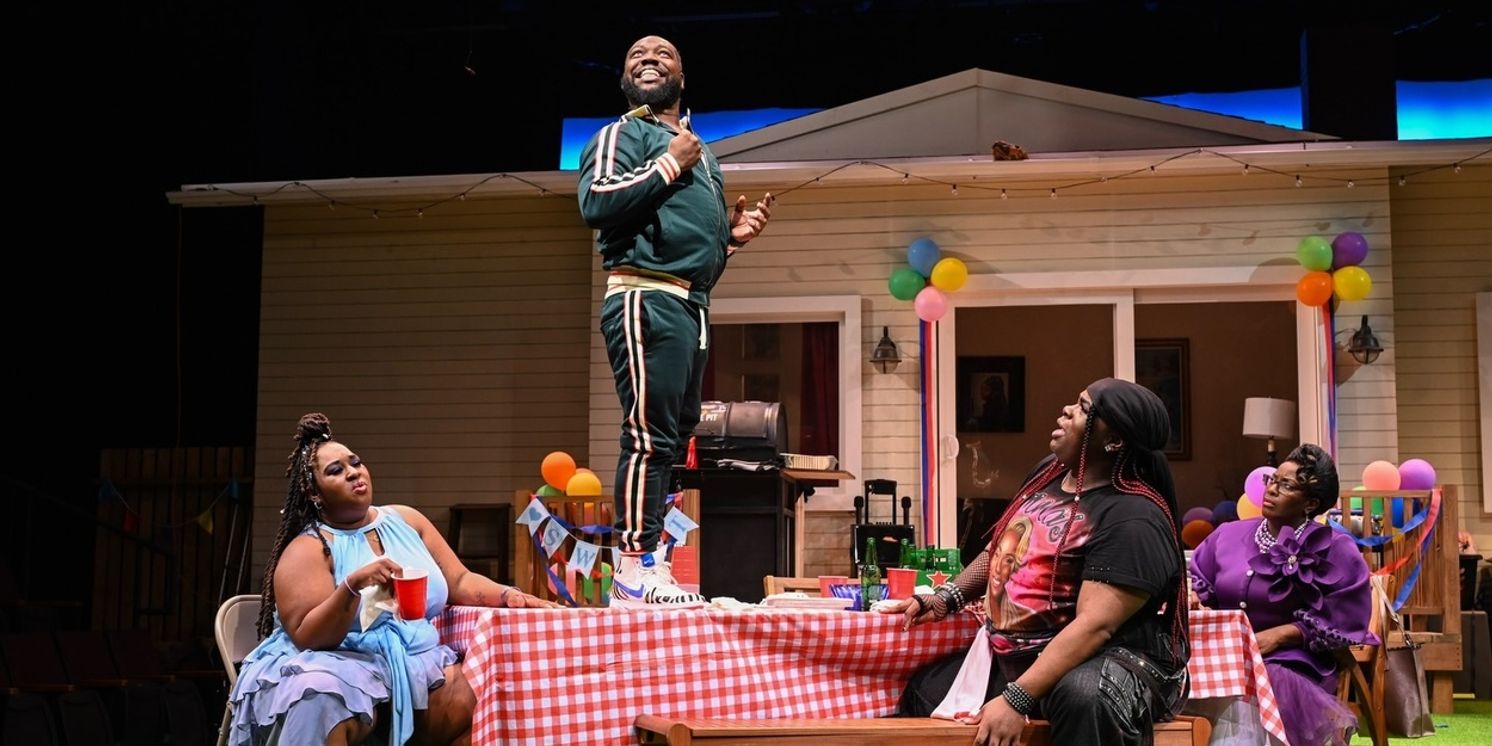
Walking into the Margeson Theatre for FAT HAM is like being one of the first to arrive at a party. The fixings are all there - tables, food, decorations, and music bumping in the background as everyone gathers; all that’s missing is the people. The image we discover upon entry is wonderfully naturalistic; Stephen Jones’ set design is loaded with an incredible amount of depth both in detail and in field of vision. A verdant backyard and porch littered with life’s detritus guides the eye all the way back into a very fully realized interior of the home to which the yard is connected.
It’s hard to overemphasize just how good this production looks. Save a few questionable lighting cues during soliloquies, the set, costumes, and cohesive production design make this play a joy simply to look at. Performing without microphones (for the most part - can’t forget that karaoke sequence), this cast comes across crystal clear on the thrust stage. A persistently creaky section of the porch occasionally obscures a word or two, but the tightening of a bolt can have that audible obstruction sorted in no time. In a delight for all senses, the food served on stage (locally sourced from Pig Floyd’s here in Orlando) fills the theatre with tantalizing smells.
Soon enough, the players arrive; Juicy, a brilliant soul who is being hidden under a bushel by circumstance and by family, is joined by their cousin Tio as they set up for a cookout. Anyone familiar with Shakespeare’s HAMLET knows the setup; Juicy’s father, Pap, is dead, and their uncle, Rev, has married their mother, Tedra. Pap’s ghost appears to Juicy; the ghost tells Juicy that Rev is responsible for Pap’s death, and that he wants Juicy to exact revenge on Rev. This leaves Juicy totally strung out, caught between a vengeful mourning, a dejected longing for a place to belong, and a sense of familial responsibility.
The small cast of seven bring Juicy’s little world to life with vivid specificity. Jos N. Banks pulls double duty both as Costume Designer to the production (which he clearly has a lot of fun with in the last five minutes) and as Larry on stage, producing a handsome and genteel Marine who is stoic and then all at once is thrust into a spotlight he did not seek. Patrece Bloomfield is a fun-loving maternalistic Tedra who appears to be chasing what’s good for her while never taking her eye off of the effect everything has on Juicy. The price of admission is almost worth it simply to see Lee Kelly’s Tio deliver an absolutely asbsurd and insanely earnest monologue about gingerbread men in the latter half of the play; his ability to appear bewildered by the words coming out of his own mouth match our own astonishment, which makes it all incredibly funny. Nyeshia Naomi brings a hysterical indifference and fire to Opal, who is transformed from a long-anguishing love interest (Ophelia in HAMLET) to a headstrong and commiserating Best Friend to Juicy. Jade L. Jones’ born-again church-going Rabby holds her convictions so deeply and so earnestly that it is eye-wateringly funny to watch her feel the spirit while praise is being said before dinner; watching her reconcile those convictions with her familial reality is deeply emotional. Essex O’Brien also pulls double duty, both as Juicy’s dead father Pap and as their uncle Rev. O’Brien brings a wonderfully sinister paternalism to Rev that puts you at ease up until the moment that he lets his hidden evil burst forth.
Je’Shaun Jackson, as Juicy, does something fascinating - in serving several moments of overacting, they conversely reinforce their characterization, which is something rarely seen, but which works with astonishing economy here. Jackson’s acting style is different than the rest of the cast here. It’s larger, more over-the-top, and broadly more absurd; but that’s Juicy. It’s a choice that further distances them from the others, crafting a seemingly established distance between Juicy and their family without spelling it out; rather, this performance shows that distance simply by allowing Juicy to be who they are.
As unapologetically Black as this play is, it is also loudly and proudly queer. Jackson’s nonbinary identity grafts seamlessly onto Juicy, and in fact informs it deeply. Juicy is consistently othered by family as “soft” and endures the never-ending microagression of apparent misgendering from everyone around them, despite best intentions from most of those involved. Whether intentional or not, it reads as such, giving Juicy’s plight an additional depth. Queerness is treated with a tenderness in this production that exemplifies a piercing understanding from everyone involved of not only the queer experience, but the queer Black experience.
As a gay writer who has taken in decades of queer tragedies on stage and screen (the “Kill Your Gays” trope is called so for a reason), it was tantamount to a deep breath of fresh air to experience the refreshing change of pace with which this play ends. Broadly, James Ijames’ script plays in tandem with and against the source material, utilizing our own expectations both of Shakespeare’s play and of the cultural context - again, Black cultural context - to surprise and delight us. Weaving in winks and nudges (“Ah, there’s the rub!”) as well as full-blown soliloquies from HAMLET allows the audience to remember that this is A VERY OLD story, but also forces us to see the contrast with which it is being told and to meet this production where it’s at.
Roberta Emerson’s direction allows the actors to bring a great deal of themselves to the roles and the story, resulting in something that is uniquely genuine. She also gets her cast to really rip into scenes of conflict, keeping the pace breakneck, the volume high, and the silences intentional. As someone who is—to borrow Rabby’s phrasing—decidedly 'translucent,' this reviewer’s personal experience with Black cookouts is limited to a sample size of one. However, one simply must believe that Emerson and her troupe have successfully captured that essence and are serving it up on a platter. It's a warm, welcoming joy.
FAT HAM poses a different query than Shakespeare did so long ago. Rather than the broad theory of existence, this production sets a familiar stage and then ponders:
To be what others expect, or not?
Now that’s the question.
—
FAT HAM runs at the Orlando Shakes through March 29. or tickets, visit the link below or call the box office at (407) 447-1700.
Photos courtesy of Orlando Shakes.
Reader Reviews
Videos