


Programming Set For 2026 Biennale Teatro Festival in Venice
Director Willem Dafoe revealed the full lineup.
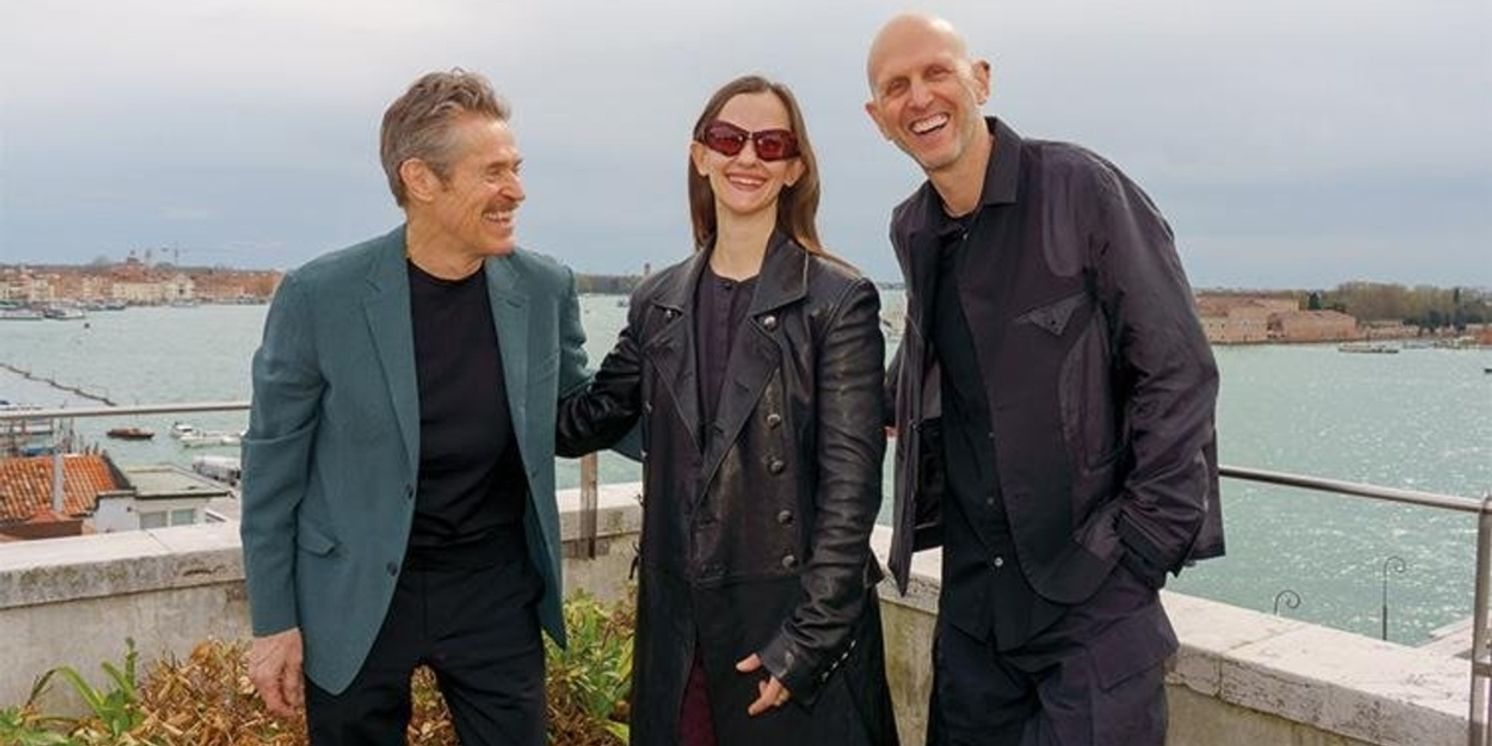
On stage from 7 to 21 June 2026, the 54th International Theatre Festival will bring to Venice over 200 artists for 55 events, including 11 productions and co-productions, 10 world premieres, 2 European and 4 Italian premieres. 610 applications were submitted for Biennale College Teatro.
“For this year’s edition – stated the Director Willem Dafoe – we chose the title ALTERNATIVE, or more precisely ALTER NATIVE. There is no specific meaning, because etymology can be vague or evocative. The idea is to think of ALTER as a change and NATIVE as one’s personal nature. Or ALTER as other and NATIVE as the culture of origin”.
The 54th International Theatre Festival spans all the continents, casting light on different alphabets, cultures and traditions, which do not faithfully reproduce themselves, but open new pathways, offering alternative ways of seeing and understanding the world.
The journey begins at the living origin of theatre, from the Greece of Christos Stergioglou and Alexandros Drakos Ktistakis with their concert-performance Cries, “inspired by the refugee’s thinking of poet Giorgos Seferis, by Hecuba’s lament in Euripides’ The Trojan Women, and by the cries of all those who have endured slavery, uprooting and migration across the centuries”. Texts and words from a collective memory flow continuously together to the original music of Alexandros Drakos Ktistakis, on stage with his ensemble accompanied by the voices of baritone Georgios Iatrou and Stergioglou himself. A director and actor in theatre as well as cinema (he starred in Dogtooth by Yorgos Lanthimos and won the Best Actor award at the Berlin Film Festival for The Eternal Return of Antonis Paraskevas by Elina Psykou), Christos Stergioglou comes to Italy for the first time.
An exponent of new Greek theatre, Mario Banushi, winner of the Silver Lion, brings to the festival the trilogy that brought him instant fame, Romance familiare. Ragada, Good Bye Lindita, Taverna Miresia are the chapters in a landscape of memory that delves its roots in ancestral rites and traditions tied to Banushi’s childhood in Albania, a landscape built of poetic visions, evocative images suspended between dream and reality, charged with an emotional intensity that transforms intimate personal themes – relationships and affections, sense of loss and grief, nostalgia – into universal poetry. Mario Banushi’s trilogy will be presented by La Biennale di Venezia as a co-production of the Fondation Cartier pour l’art contemporain.
From Mediterranean Europe to the Far East, where for over thirty years Satoshi Myiagi, the student and heir of the master of Japanese experimental theatre Tadashi Suzuki, takes on the cornerstones of the Western theatre tradition, from Greek tragedy to Shakespearian drama (extraordinary his Antigone by Sophocles with which he inaugurated the Festival d’Avignon 2017), through the lens of traditional Japanese theatre, making them resonate in a new way. Thus Mugen Noh Othello, which he will bring to Biennale Teatro, reinvents Shakespeare in light of the ritual of Mugen-Noh theatre. One of the different categories of Noh theatre, dating back to the thirteenth century, Mugen-Noh conceives plays as the recreation of a dream or illusion within a unitary horizon in which the living and dead coexist. Myiagi transforms the tragedy of the Moor of Venice into a rêverie interpreted by the ghost of Desdemona, who relives the original cause of her suffering and shifts the fulcrum of the tragedy. A reinvention that brings tension to the distance between bodies and voices, between gesture and narration, entrusting each character to a dual performer.
From Southeast Asia, and more precisely from Java, comes an original form of dance, music and song that draws from a traditional complex of martial arts, known as Silat, recognized in 2019 as an intangible heritage of humanity. The Bumi Purnati Indonesia company from Jakarta will present two productions: Under the Volcano directed by Yusrli Katil, inspired by the terrible eruption of the Krakatoa in 1883, and Hikayat Perahu / The tale of Boat directed by Sri Qadariatin, formerly an actress for Bob Wilson in I La Galigo and Persephone.
Inspired by the poem Lampung Karam, composed in the traditional Malaysian poetry form syair by Muhammad Saleh, a poet and religious scholar from Sumatra and eyewitness to the terrible event, Under the Volcano conveys a powerful and moving plot with simple stage props such as eight wooden sets of stairs used to recreate mountains, valleys and markets, as well as a montage of film clips and still images of fire, lava, rock. Hikayat Perahu / The tale of Boat is inspired by a fundamental text in Malaysian literature, Syair Perahu, by the mystic Sufi poet Hamzah Fansuri, who lived between the sixteenth and seventeenth centuries. In the story of a boat that sails the Ocean the poet symbolises life and the spiritual journey the spirit undertakes toward God.
From India a performance art with a rigorous vocabulary, steeped in spirituality and refined eroticism, that has come down to us through the centuries: it is the Odissi dance of choreographer and dancer Sharmila Biswas from Kolkata, a student of the legendary master Kelucharan Mohapatra, before herself becoming a great internationally-renowned performer. In Venice, she will present Mischief dance: A Journey Through Rhythm and Spirit. Of the many different forms of Indian classical dance, Odissi arose as a devotional practice in the eastern central area of the country, and is danced to music that blends the Carnatic tradition of the south with the Hindustani tradition of northern India, alternating with dramatic texts drawn prevalently from the poem Gita Govinda.
Ancestral imagery consisting of earth and air, water and fire, inhabited by gods and men, provides the foundation for the visionary creations of Samoan artist Lemi Ponifasio, one of New Zealand’s major directors and choreographers, who draws from the aboriginal cultures of the Pacific – from the Maori of New Zealand to the Kiribati of Micronesia – as well as from South America to create, like a shaman, new symbols that also speak of our present, merging ceremonies, performative culture and contemporary theatre. Thus Star Returning: Venice, Ponifasio’s new work, is a way to listen to the earth, the ancestors and the shared myths of the Yi people from the mountainous region of Chinese Daliangshan, their cosmology, their origins and their deep bonds with nature, their ancestors and the spirituality innate in this culture.
The writer, actor, dancer and director from Rwanda Dorcy Rugamba has also worked with Peter Brook’s company, with Milo Rau and with Abderrahmane Sissako, the director of Timbuktu. Dorcy Rugamba will present the Italian premiere of Hewa Rwanda – Letter to the Absent, following its debut at the Théâtre des Bouffes du Nord and the Festival d’Automne, and a tour through the United States and Australia. Adapted from the eponymous work written by Rugamba in 2024 and translated around the world, Hera Rwanda – Letter to the Absent is a memoir to his own children, an eyewitness account of the genocide of the Tutsi perpetrated in 1994, which determined his story as a man and as an artist. On stage will be Rugamba himself with all the colours of the music by the eccentric and talented Senegalese polyinstrumentalist Majnun. “While Hewa Rwanda, Letter to the Absent addresses the genocide, questions of mourning and a family that was nearly annihilated, I primarily wanted it not to be a commemorative text but a hymn to life, so the tone of the text deliberately embraces lightness, humour, poetry, music and life in all its aspects”.
A world music celebrity, the singer Angelique Kidjo will be at Biennale Musica for a duo concert with pianist Thierry Vaton. Originally from Benin, but based for many years in France, Angélique Kidjo has created a common language between different cultures based on the legacy of western African traditions to incorporate elements from genres such as funk, jazz, soul, and influences from Europe and Latin America.
Turning the focus back on Italy, Emma Dante, the most celebrated Italian director of theatre and opera and the Golden Lion for Lifetime Achievement of this year’s Biennale Teatro, will present the world premiere of I fantasmi di Basile, taking on the visionary Baroque world of the Neapolitan writer Giambattista Basile, whose plays La scortecata, Pupo di zucchero and Re Chicchinella she had already directed. “I have always intercepted something real and contemporary in his tales, something that belongs to us – stated Emma Dante. Therefore, what I like about Basile is the truth. Despite the extraordinary architecture he builds through language, he always maintains something strongly realistic. In I fantasmi di Basile there are several fragments from our trilogy, which evoke the ghosts in the story”.
Following the critical and audience acclaim of his unorthodox Pinocchio, constructed with the “diverse” bodies of the kids from the Scuola Elementare del Teatro company in Naples, Davide Iodice returns to Biennale Teatro with Promemoria, a work in which he addresses the theme of memory, focusing on the stories and the lives of the elderly living in care facilities. Following a working method centred on the person and human frailties, Promemoria was conceived at the end of an intensive workshop titled L’enciclopedia delle Emozioni, which took place from 29 May to 2 June 2025, in the structures that care for the elderly in Venice. “An invitation to explore the transformative power of theatre and human relation, and to become part of a collective creative process addressed directly to the community” says Iodice. The outcome of this long process is Promemoria, a performance that will take place at the Venetian Public Assistance Institutions in San Giobbe.
Attention to new creativity finds space at the festival in the consolidated activity of Biennale College, which once again this year presents a director and two playwrights under 30, selected through national calls and following several phases of evaluation. This year Alberto Colombo Sormani was selected to make his debut on the Festival stage with Imago Vocis | spacetime in-between, which weaves together his vocation for theatre with the study of astrophysics – he is a researcher in this field at the National Institute of Nuclear Physics of the Università La Sapienza di Roma – attention to new technologies and the language of the body. “A rare mix of ambiguity and daring. A far-sighted project” as Willem Dafoe defined it when selecting it.
Davide Pascarella and Bruna Bonanno are the winners of the two-year call dedicated to new dramaturgy. Bacio Sogno Autodistruzione, defined by its author as “the public performance of an intimate and private journey”, will be presented as a staged reading by Alessandro Businaro, who had previously participated at the Biennale with the production titled George II and was recently appointed junior artistic director of the Teatro Stabile del Veneto. “In its probing self-examination, in addressing the contemporary malaise gripping a generation, the work hints at a potential for growth that deserves maximum attention” – the motivation reads.
Aka Jolly Roger by Bruna Bonanno is a “pirate play” according to Motus, who in an exceptional departure from their artistic pratice, will author the mise en lecture of the text, drawn by the affinity they found in the “libertarian content and in the light that radiates from the text, in the very insistence (though the end seems ever closer) to imagine new forms of alliance/coagulation among resistant cells. But we are also fascinated by the “aquatic” structure of the writing, the idea of looking at our land from the sea: we embark on a pirate galleon, we sew its flag (a new variation of the hundreds of Jolly Rogers scattered around the world) to sabotage the very mechanisms of the mise-en-scene”.
Following its debut in the form of a staged reading last year, Tacet by Jacopo Giacomoni, the play that won Biennale College Dramaturgia 2024-25 and the Riccione Prize 2025, has been brought to completion and will premiere under the direction of Silvia Costa. A text inspired with originality by philosophy, metaphysics and mathematics, thinking of the last secular rite which is the minute of silence, that plays with the metronome in search of what it means to stand together in silence, inside a minute, inside a theatre”.
In the spirit of Biennale College, cultivating the relationship between young artists and mentors, the Schools of Theatre Project returns for a second year, with Biennale Teatro open its doors to three academies:
The Civica Scuola di Teatro Paolo Grassi, with the actors in their third year, will stage a classic by Brecht, Santa Giovanna dei Macelli, directed by Marco Plini, to understand how imbalances, inequalities and mechanisms of financial market manipulations change, shifting “the paradigm of conflict in an age that has superseded the concept of class struggle”.
The Accademia Teatrale Carlo Goldoni of the Teatro Stabile del Veneto – Teatro Nazionale, with the director Giorgio Sangati and the graduates of the acting course, presents Comeradovera. Weaving together stories, points of view, details, states of mind, times and memories, public and private experiences, around the fire that burned down the Teatro La Fenice thirty years ago, the work questions the relationship between the life of an individual or a community and the traumatic experience of loss.
Finally the Scuola Teatro di Napoli – Teatro Nazionale, with the director Arturo Cirillo and the young second-year actors, pays tribute to Enzo Moscato, a fundamental figure of Neapolitan dramaturgy who passed away two years ago, combining two plays from the 1980s, Festa al celeste e nubile santuario and Ragazze sole con qualche esperienza, which in the new production become Quindici ragazze con qualche esperienza.
Finally a new college for actors was introduced this year by director Willem Dafoe: the eleven performers under 30 selected from a list of 440 applicants will participate in a residency project in Venice, to take place over the span of four weeks – from 25 May to 21 June 2026. A series of workshops with, in addition to Dafoe, Evangelia and Mary Randou, Simon McBurney of the Théâtre de Complicité and Silvia Costa.
The mentor for the workshop organised for the first applicants selected for the new playwriting call of Biennale College will be the poet and playwright Fabrizio Sinisi.
There will also be a theatre criticism workshop, in collaboration with the teacher and critic Roberta Ferraresi and Massimo Milella; conversations, encounters, roundtable discussions with the artists will be conducted by Maddalena Giovanelli and Andrea Porcheddu, journalists and theatre critics.
A tribute to Bob Wilson will be on display in Sala delle Colonne at Ca’ Giustinian for the entire duration of the festival, exhibiting materials collected and preserved at ASAC, the Historical Archive of the Contemporary Arts of La Biennale di Venezia.
Ricevi le notizie di Broadway su WhatsApp
Ricevi gli ultimi aggiornamenti, notizie e contenuti esclusivi direttamente nell’app.

Videos