


Interview: Richard Maltby Jr. of ABOUT TIME at Marjorie Dean Little Theater
A third installment that continues Maltby's lifelong exploration of love, time, and the emotional architecture of a life
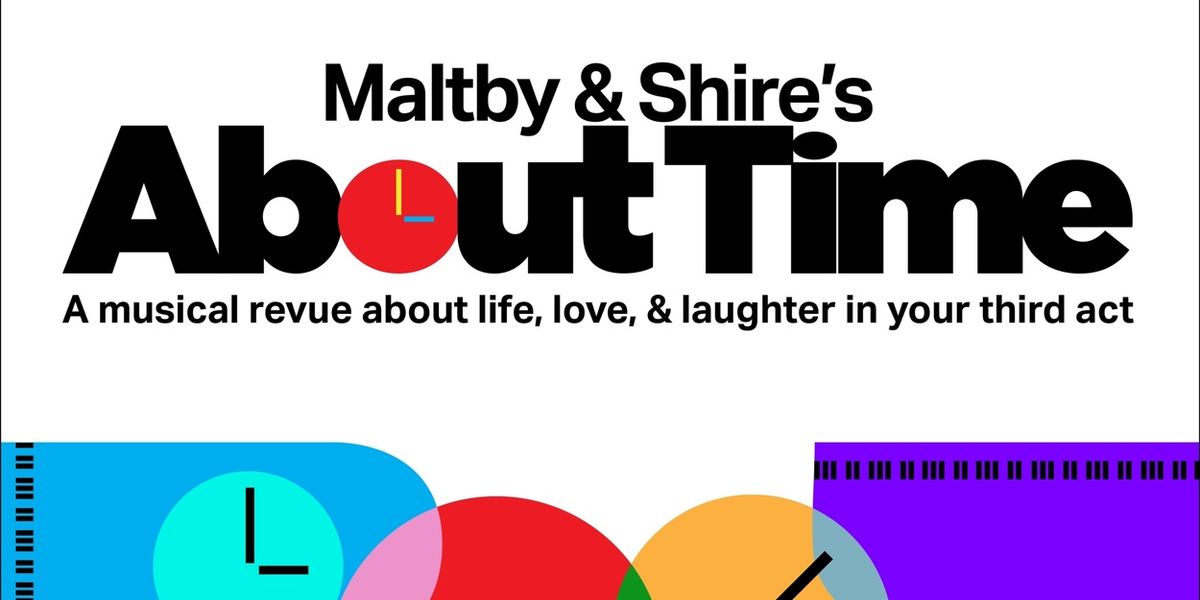

Richard Maltby Jr. on Life, Music, and the Third Act
Few figures in American musical theatre have shaped the modern songbook as profoundly as Richard Maltby Jr. A Tony Award–winning director and lyricist, Maltby is best known for his long-standing collaboration with composer David Shire, which produced the landmark musical revues Starting Here, Starting Now and Closer Than Ever.
Now, Maltby returns with a brand-new musical revue opening next week in New York City at the Marjorie Dean Theater — a third installment that continues his lifelong exploration of love, time, and the emotional architecture of a life.
How are preparations coming for the show?
Well, we lost a day of load-in due the to blizzard. And we have two understudies — one covering the three men and one covering the three women. One understudy was among the many who got COVID, and then another woman in the cast got sick, so, you know, never a dull moment.
When we did Big at the York Theatre, one night the actor playing MacMillan simply didn’t show up. The show was about to start, and I said, “Well, give me a script — highlighted.” So I went on. And I was fabulous!
Previously, the same thing happened when the York did Closer Than Ever. One of the guys got sick, so I went on and did the solo numbers. John Weidman said afterward, “If anybody gets sick in a Maltby show, don’t stand between him and the stage!”
I really enjoyed Closer Than Ever at the York.
I enjoyed it a lot — it was a really good production. Now I look back and think, boy, those performances were wonderful.
I’ve had this conversation with David in the past: when you see that particular show stripped down that way, it really works because it brings the songs front and center.
Peter, it’s all we’ve got. We’ve got the people who appreciate it — who know and love us for it — and who love the manipulation of the language, the manipulation of the music, the emotional complexity of it all. But there are a lot of people out there who may like it but don’t quite know what to do with it.
It’s basically familiarity. If you can get someone to hear it three or four times, it becomes totally accessible. But for some, the first time through, they may wonder, “Where are the melodies?”
David’s bête noire is interviews that say the score isn’t tuneful. That kills him, I’m sure, because it’s very tuneful — and it’s incredibly joyful.

You’ve always been a notch higher than most on the musical sophistication scale.
Having said that, the score in this show is spectacular — some of David’s finest work yet. Not all of it was written specifically for this project; there were a number of melodies David had written earlier that I used. But you can hear the Shire genius all the way through it, and I think people are going to be dazzled.
Do you generally start with the melody?
The melodies are usually the springboard for me because David’s quirky harmonic turns always contain dialogue for me. When his melodies dip down or veer off and have three extra notes, those extra notes are like an apology for the sentence that came before — or some other subtle human gesture. His music behaves like speech.

What made you decide that now was the right time for Volume 3 of the revue format?
People have often said — and I quote this all the time — that if you took the songs from Starting Here, Starting Now and Closer Than Ever and arranged them in chronological order — the chronological order of a life — they would tell a biography. They would tell a life story that’s kind of universal. All lives go through these processes.
We’ve written many songs since the last show, and I suddenly thought maybe we could construct a third piece that would complete the picture. I thought we’d call it Life: The Musical. If you experienced all three shows — six acts total — it would feel almost like a book musical. A trilogy. A triptych.
And?
We did an evening at 54 Below with a group of those songs. It went very well — but it was clear it didn’t quite hold together.
I realized the first two shows had very specific identities. Starting Here, Starting Now was about young love. Closer Than Ever was about the second time around — marriage, commitment, and the complexities of adult life.
This third one would be everything else.
After you’ve done some living — when you have children growing up, when life grows more layered and complicated — that’s where these songs live. This time, the theme preceded the songs.
We spend most of our lives in the future. We’re always thinking about tomorrow — planning for tomorrow and the day after. We hardly live in the present at all. Occasionally, we have a moment where we truly inhabit the present — but it disappears immediately.
After spending a lifetime living in the future, at a certain age you suddenly see the whole arc of your life. And it changes everything.
It’s not really about age — it’s about life. What constitutes a life? What do you learn from it? And how do you deal with the elephant on the coffee table — that life is finite?
We don’t want to think about that. So we keep plowing forward. And that makes everything more complex.
There’s always a subtext — sometimes a beautiful one — built into every thought once you pass, say, sixty-five. Whether you want it or not.
We realized that if we wanted to sail this ship forward, we were going to have to write new material. And we did. Now the show is almost entirely new.

That was my next question — what percentage of the score is new, and what are you reusing?
Almost all of it is new. Some of the melodies are what we call “trunk songs” — things David wrote that hadn’t yet found a home.
Our musical director, Dennis Cordell, is also something of a librarian for our work. He knows where everything is. He’ll say, “You know, you wrote a song for that project that never happened?” He played one for me and I thought, “I have no memory of this melody.” And it was gorgeous.
It became the most powerful song in the show — “What Do I Tell the Children?”
Clearly you’re still inspired by the creative process.
I’m very lucky. The hallmark is still the same: David writes a melody and I have to get out of my chair.
If I care enough to stand up, we know he’s hit one out of the park.

And after spending time with Richard Maltby Jr., it becomes clear that the impulse to stand — to respond physically, emotionally, instinctively to a melody — may be the truest metaphor for his body of work.
From Starting Here, Starting Now to Closer Than Ever, and now to this new chapter, Maltby and Shire have never chased trends or spectacle. Instead, they have trusted something quieter and more enduring: the intelligence of an audience willing to lean in.
This third revue does not merely revisit familiar terrain — it expands it. It reflects the arc of a life honestly observed, without sentimentality but with enormous heart. Youthful longing, adult compromise, parental reckoning, the awareness of time — all of it rendered with that unmistakable Maltby-Shire blend of wit, sophistication, and emotional clarity.
If the earlier revues taught us how to fall in love and how to stay in love, this one asks the larger question: what does it mean to live fully, knowing that life is finite?
Performances begin next week at the Marjorie Dean Theater in New York City. For longtime admirers, this new musical review promises the next chapter in a singular theatrical conversation. For newcomers, it offers something rare on today’s stages: songs that assume you are listening closely.
And if, somewhere during the performance, you feel compelled to sit a little straighter — or even stand — you’ll know exactly why.
Tickets are now on sale.
About Time
Marjorie S. Deane Little Theater @ The West Side Y. 10 West 64th Street, New York, NY
Directed by Richard Maltby Jr.
Cast includes Allyson Kaye Daniel, Darius de Haas, Daniel Jenkins, Eddie Korbich, Sally Wilfert, Lynne Wintersteller
book: Richard Maltby, Jr. music: David Shire lyrics: Richard Maltby, Jr.
Sign up for all the news on the Fall season, discounts & more...

.png?format=auto&width=365)




