
Interview: Hershey Felder of THE PIANO AND ME at TheatreWorks Silicon Valley
The world premiere of Felder's autobiographical work runs January 17th to February 8th in Mountain View
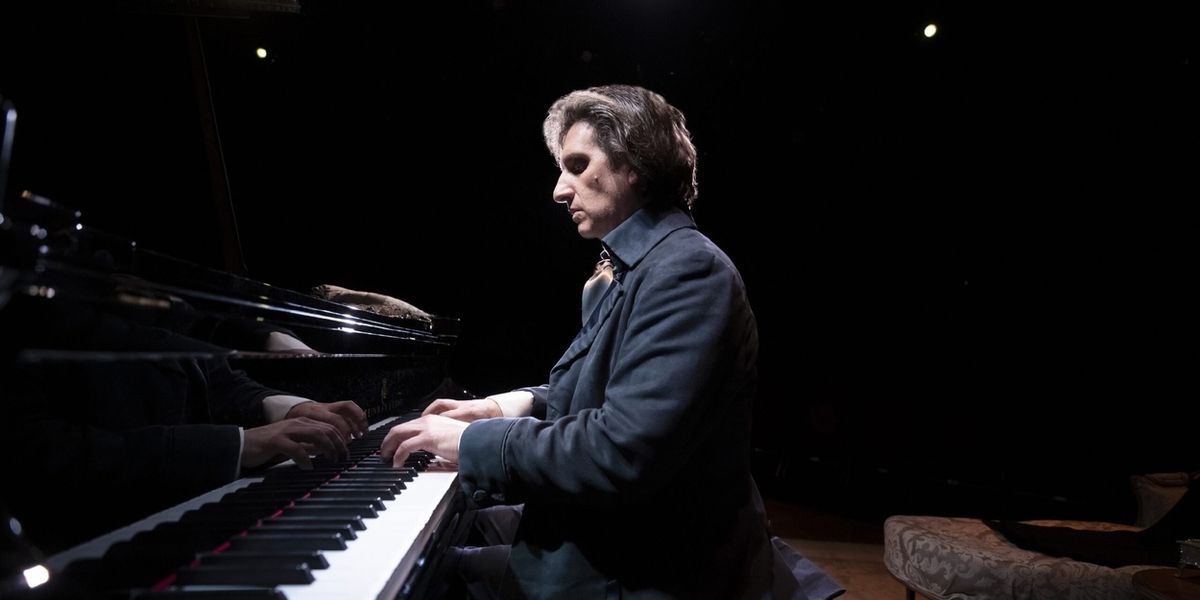
Given that Hershey Felder has been playing the piano for almost as long as he can remember, the partnership he enjoys with the instrument is arguably the most enduring relationship in his life. Even so, as the child of Polish and Hungarian immigrants growing up in Montreal, Canada, he could never have imagined the sui generis career it would lead him to find. Exactly how that happened is the subject of his latest music-infused play, Hershey Felder: The Piano and Me, enjoying its world premiere at TheatreWorks Silicon Valley. Having crafted portraits of 16 iconic composers in some 6,000 live performances and 18 films, the virtuoso pianist-actor-writer has now decided it’s time to tell his own story.
The Piano and Me isn’t one of those self-congratulatory “And then I wrote…” affairs, because Felder says he has no interest in doing that kind of show. What he does promise is an evening of entertaining tales laced with humor, heartbreak and backstage insanity, plus large doses of some of the greatest music ever written. As accomplished as Felder is as a pianist and actor, his superpower may be his uncanny ability to connect with audiences as he takes them on an emotional journey. The music and the story resonate with each other in a much deeper way than if he were only playing the piano or acting out scenes. This explains why he’s long been a favorite of TheatreWorks’ audiences, breaking box office records there in shows such as Our Great Tchaikovsky; Hershey Felder as Irving Berlin and Hershey Felder: Beethoven. When TheatreWorks was in dire straits during COVID and the long tail of its aftermath, Felder stepped in to offer livestreams and in-person benefit performances that raised critical funds for the company.
Though born and raised in Canada (and – fun fact – is married to its only female former prime minister), a number of years ago he chose to make Florence, Italy his primary residence, having been besotted by that city ever since he was a teenager. But it only makes sense that he would live in the city where the piano was invented over three centuries ago. There is an aspect of Felder that always seems slightly out of time, as if part of him exists in some distant past. In Florence, he serves as artistic director of two theaters, Teatro Niccolini (Florence’s oldest theater) and the newly restored Teatro Nazzionale / Della Signoria, both within a stone’s throw of the Duomo. In his “spare” time, he also composes operas, such as Il Quarto Uomo which premiered at the Roman amphitheater in Fiesole as part of the 2023 Maggio Musicale Fiorentino.
I caught up with Felder by phone recently from his home in Italy. I’ve had the pleasure of chatting with him more than a dozen times in recent years, and he’s always a fun and interesting interview, offering up new insights and anecdotes every time. In this case, apropos of his new show, I learned how the piano came to be invented in his adopted hometown of Florence and his unlikely introduction to the instrument as a tiny tot. We also talked about how he approached crafting a story about his own life for a change and what’s it’s like to sit down at the piano day after day for so many years. As always, our conversation was relaxed and free-flowing, with Felder apt to poke gentle fun and offer corrections in his intrinsically musical syntax. The following has been condensed and edited for clarity.
The Piano and Me is a departure from the kind of thing you’re most known for. Is it something that’s been gestating for quite some time?
Well, gestating is a good word, but living it is more [apropos] …. It’s the story of 30 years ago, not the story of where I am now. It’s stuff that some people know, but what’s interesting is I was rehearsing with one of my staff who’s worked with me for 20 years, and even they said there’s so much they didn’t know - and we’re together all the time, doing shows and with family and friends and so on. Also, he said to me, “It’s larger than what it is.” Which is the hope when you do a show. Whether it will be interesting to other people, I hope so. It seems to be something that might just resonate because of the scope of it and what happened. And it’s not an “And then I wrote…” story by any means.
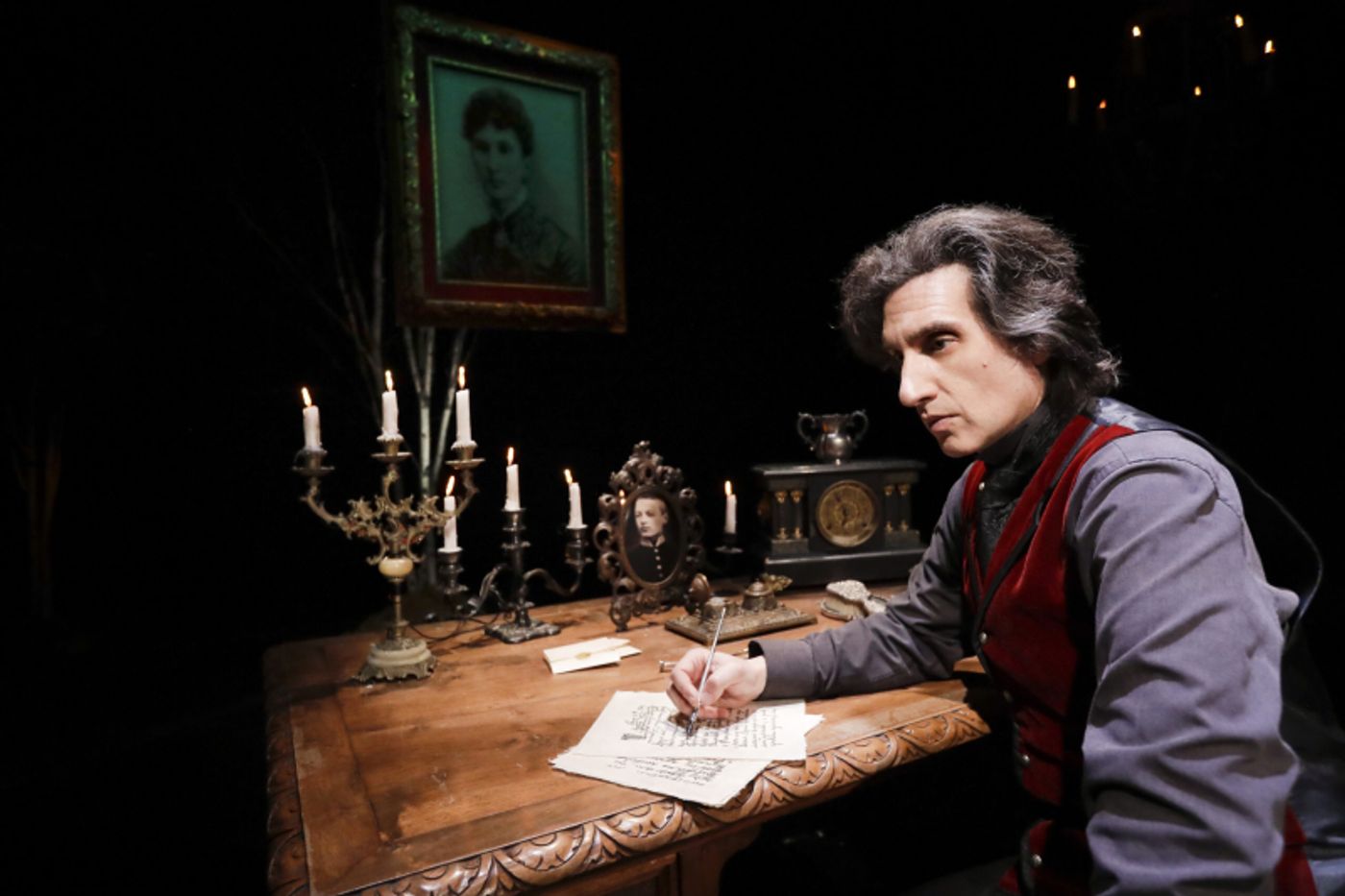
(photo courtesy of Hershey Felder Presents)
How did you go about crafting your own story into a piece of theater?
I believe that a story should resonate on its own, but I don’t write it to resonate, if you know what I mean. I’m telling a truthful story, this happened. It’s also about, in this kind of case, the theatrical structuring and the economy of it. Because if you put me on a stage – you’ve seen me do the questions and answers [at the end of a performance] – it’s kind of like flip the light on, push the button and I’m going. But here, I have to tell the story in the cleanest and most direct way so that people will stay engaged with it, hopefully, and that takes a lot of work. It’s less about throwing everything in there and oh-I’m-gonna-ramble, than it is about finding the most economical way to make a point. And to share the music and why that music is being shared. There’s a lot of “why” in there – why this music and why that story. But I don’t ever say, “Well, this is why I’m telling you…” I share a story and hopefully the puzzle is put together at the end.
How do you manage to find the right puzzle pieces?
That’s trial and error. The original script was three hours long, then I started paring down and reading it in front of small, choice groups - not just friends or people who know me, but also invited guests. I’ve been doing it onstage in Italy, gathering 20 people at a time and saying, “Okay, some of you sorta know me, some of you know me from seeing my work, some of you know me from being an artistic director. What do you think of this?”
And you find two things. One: what the audience responds to, because they’re in front of you. And two: your own sense of being in front of an audience. I have 30 years at this point in front of an audience, so the air in the room and my body tells me if something is working or not. It’s immediate. If I am physically uncomfortable in getting through a story, if I’m uncomfortable where it’s going and how it’s resonating, my body tells me. I know. And then comes figuring out “Okay, well that’s not quite the right thing. What is?”
I have the luxury of being a writer-performer. Every time I launch into this, I go “God, how do I do this?” And then I go, “You know how to do this.” That doesn’t mean you have all the answers as to how to tell a story. But what I do know is, if something is not working, how to deal with that. I don’t have all the solutions when I begin, but I do know how to find the problems. And finding those problems allows me to go in the direction of the solutions.
I love the title of the piece, The Piano and Me. The economy of those four simple words elegantly conveys the intimacy of a long-term relationship. Did you bat around any other titles before coming up with that one?
I tend not to. Some people, I’ve been told, will try out a lot of titles, but it doesn’t work like that for me. I never really figure out the title until I have a draft of the piece and know what I want to say. I kind of ask myself, “What is this? What’s going on here?” You know, “George Gershwin Alone.” There ya go! Or “Monsieur Chopin.” It tells you so much and it’s based on what the story is. “The Piano and Me” came earlier [than usual], because I already knew what story I wanted to tell. But people love it cause it rolls off the tongue. There’s just something about it, like “Oh, you’re doing your Piano and Me.”
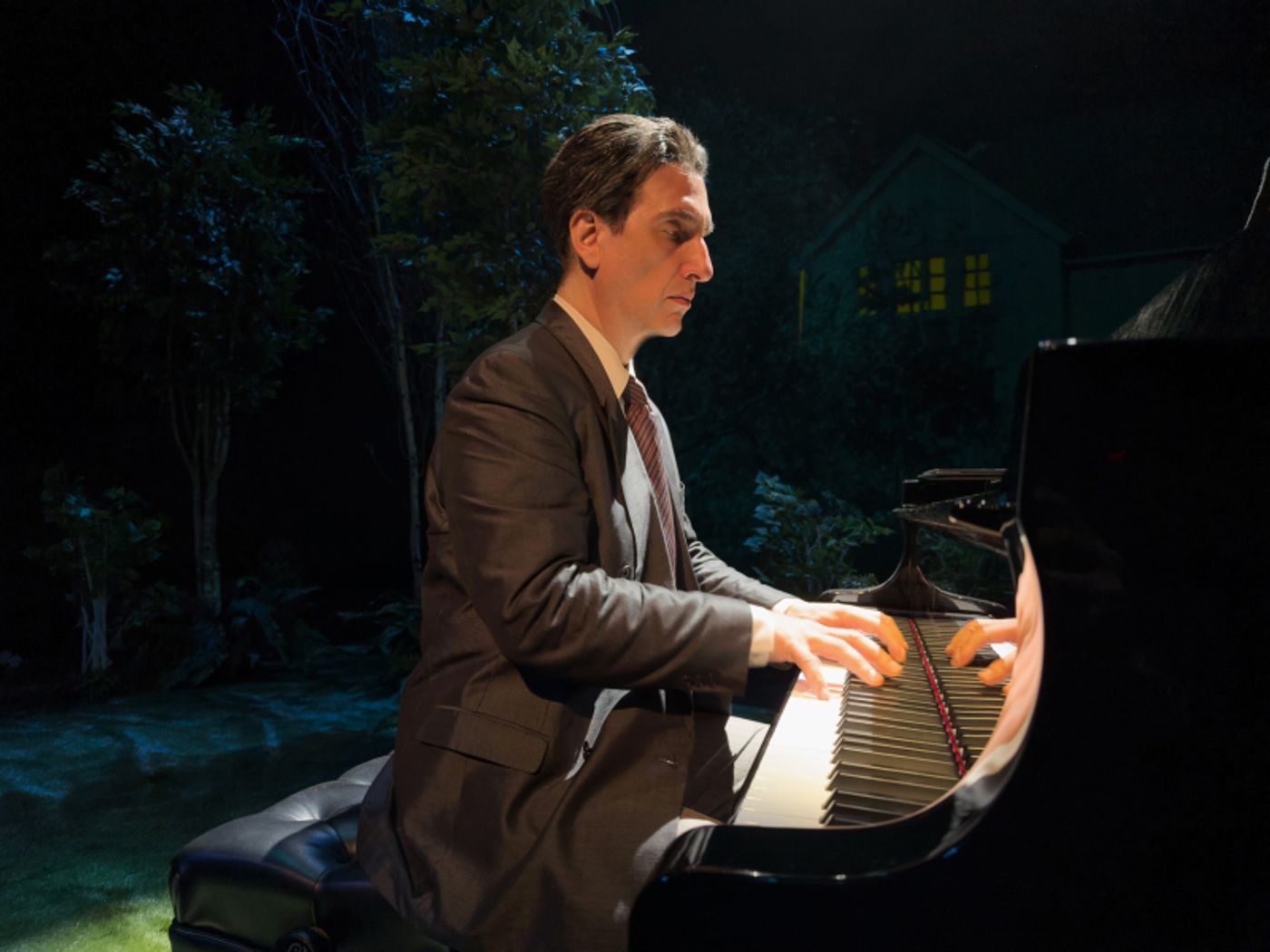
(photo by Stefano DeCarli)
The first time we ever spoke, you happened to mention that the piano had been invented in Florence. How did that come about?
Bartolomeo Cristofori was an inventor working for the Medici and the town because they had to have the best of everything, and it was in 1700, so earlier than one would imagine. He had a workshop here at the Uffizi, which is now a museum, but in those days was a museum and workshops. He was workshopping these concepts of getting away from the harpsichord and making something that will do piano and forte, play loud and soft. He developed the escapement, which is where the hammer hits the string and doesn’t pluck it, otherwise the string wouldn’t resonate, right? If it’s just a hammer that hits a string, it would stop the string and it would go dead. So he had to figure out how to make it click up and then click back and yet be able to play again. It is very clever, when you think of it, the genius of these dudes, they’re really something.
And P.S. – it happened across the street from my theater [Teatro Niccolini], built in 1648. It was standing and was an operational theater when the piano was invented so just think about that. It is likely that Cristofori would have been in my theater and would have probably played an early piano there in some form. That’s really cool - not sorta cool – that’s like really cool! To actually develop this show on a stage where the piano itself would probably have had one of its premieres in the world? [laughs with glee] There is something magical about that.
You’ve been playing the piano ever since you were a small boy in Montreal. Do you have any memory of the first time you sat down at the instrument and what drew you to it?
Of course I do! As a three-year-old, I was fascinated by these black and white keys that seemed to produce sound, and I was at my grandmother’s old-age home bashing away on the piano there. I mean literally bashing away, just creating noise. And one of the ladies stood up and screamed, “Either give him piano lessons or kill him, one or the other!”
Ha! She must have known something. So fast-forward to today and it’s still just you and those same 88 keys and 3 pedals, so -
Not always three. In Europe, it’s only two.
I did not know that.
It depends on the piano. I don’t remember who invented the pedal in the middle – it might be Steinway - but that’s later and you know the piano went through lots of pedals at some point to give it different kinds of funky sounds. You have standard pianos with just two pedals, which is enough, but most Steinways have three, as you say. And so your question was… it’s 88 keys and me alone?
Yes. So how do you keep the relationship between the two of you fresh? I mean, how many tens of thousands of times have you sat down at a piano?
Almost every day for my entire life.
Exactly.
Well… it’s not something that actually comes into the realm of not being fresh, because it’s exciting every time. I mean, you know, if it’s you sitting in front of the typewriter – I don’t know what you use, if you write by hand or -
I’m usually at my computer every day.
Right. And so you look at those keys and you say, “This is inanimate. It does nothing on its own.” And yet, you can make magic when you commit to it. So why do you have to keep it fresh? It’s always new, it’s always different, it’s always invention. You speak to it and it speaks back, you know? To me, there’s nothing to keep fresh; it just is.
But as with any long-term relationship, you must have had your ups and downs. Do you ever have days where you look at the piano and think “I’ve had it with you. I want a divorce!”?
No! I can’t afford it. [laughs]
[laughs] Not unlike certain marriages, huh?
But no, I don’t want a divorce. It’s a beloved partner. There are days which I don’t feel like playing, but that has nothing to do with the piano or being a musician - it’s just that you’re tired. You need some time away, you need to sleep or you need not to work your fingers. And it’s hard work. Playing is always fun; practicing is rough because it’s work. But the idea is not to practice ten hours a day – cause as Horowitz said, “then all you do is practice onstage,” you don’t give concerts. You have to have something to say.
So it’s about knowing how to practice, what you need to accomplish, and finding the most economical way to do it. And that’s not laziness, that takes a lot of work to figure out how to do that. Where the big practicing comes, oddly, and many pianists who perform a lot will tell you this, is away from the instrument. You have to think about what you want to accomplish and how you want to accomplish it, and then you go to the instrument and work what you thought through. You don’t go there and sort of fidget and hope for the best.
You’ve had such a truly singular life and career. Have you ever considered writing an autobiography or memoir?
I’ve been told I should, and maybe I will before I die (which hopefully won’t be for a long, long time), because I have tons of stories that didn’t make it into this specific narrative. But yeah, I will because there’s a lot of fun, crazy-ass things, so the memoir will be there at some point. It’s a lot of funny stuff. Heartbreaking stuff, too.
You always have so many different irons on the fire. What’s in the works for 2026 beyond The Piano and Me?
It’s always something, you know? We’re filming the exteriors of my new Chopin movie in Poland and Paris in February and March, and that will be released next summer. And then I’m working on a new opera. Plus, I’m running two theaters in Florence so it’s not like I have a whole lot of free time to sleep. But - it’s just the way life is.
Well, that’s how your life is anyway! [laughs]
Nobody will accuse me of being lazy. They’ll accuse me of a lot of other things, but lazy is not one of ‘em.
(header photo courtesy of Hershey Felder Presents)
---
Hershey Felder: The Piano and Me will perform January 17 – February 8, 2026 at Mountain View Center for the Performing Arts, 500 Castro Street. For more tickets and additional information, visit TheatreWorks.org or call 877-662-8978.

|
The Secret Garden Warren Theater at Sonoma State University (6/12-6/28) |
|
|
West Side Story—Film with Live Orchestra Davies Symphony Hall (7/09-7/10) |

|
The Still Point: An Immersive Experience SOMArts Cultural Center (7/16-7/25) |
|
The Tragedy of Hamlet, Prince of Denmark SPARC (7/03-7/26) |

|
Private Lives by Noel Coward Santa Cruz Shakespeare (9/04-10/04) |

|
Comedy Oakland at Quinn's Lighthouse Sat July 18 7pm Quinn's Lighthouse (7/18-7/18) |
|
Jagged Little Pill Paper Wing Theatre (7/17-8/09) |

|
Therapist Zero Potrero Stage (8/01-8/03) |

|
Hamilton (Angelica Company) San Jose Center for the Performing Arts (7/07-7/18) |

|
Comedy Oakland at Elbo Room Thu July 16 8pm Elbo Room Jack London (7/16-7/16) |