Interview: Frank Wildhorn on His Global Career: 'Music, Like Love, Knows No Borders'
Wildhorn discusses his projects including Chimney Town, Death Note, his new symphony 'Vienna' and more!
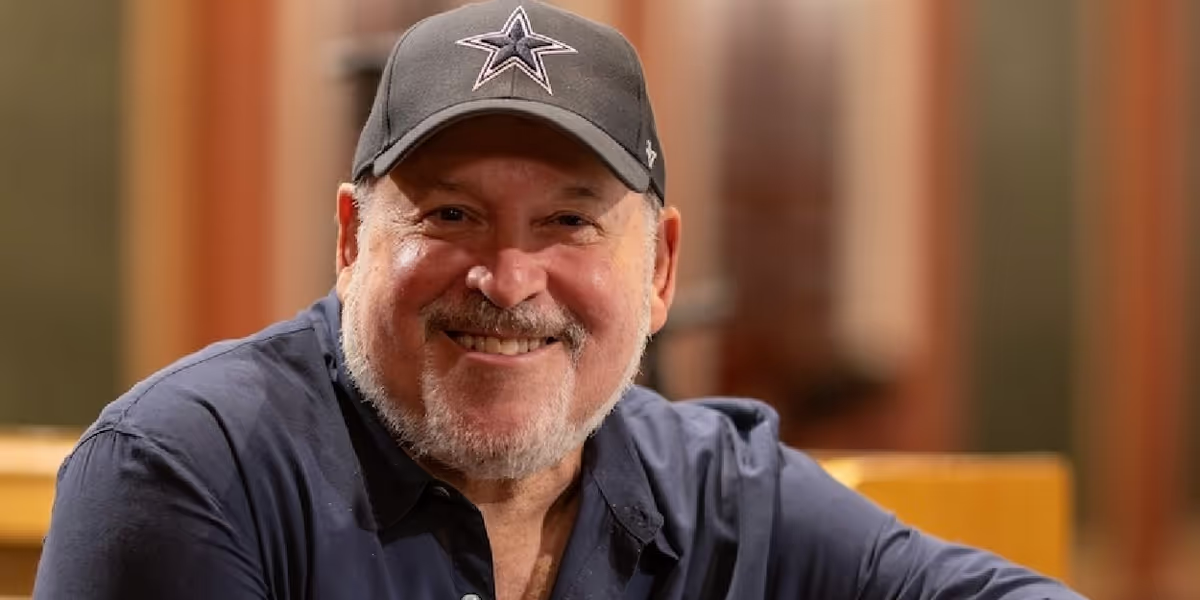
Frank Wildhorn has a list of works and accomplishments so outstanding and far-reaching that it's almost impossible to list them all. A global success, the multi-Grammy, Tony, and Emmy Award nominated composer/producer can be found at any moment working on a musical, an album, a symphony, or as is currently the case, many, many of them all at the same time.
Wildhorn is the composer of the Broadway musicals Jekyll & Hyde, The Scarlet Pimpernel, The Civil War, Bonnie & Clyde, Dracula, Victor/Victoria, Wonderland, and the revival of Jekyll & Hyde. His West End productions include Bonnie & Clyde, Your Lie In April, Death Note the Musical in Concert, and Your Lie In April the Musical in Concert. His career has had massive global reach, with international stage credits including Beau Brummell: A Man Too Beautiful, Carmen, Camille Claudel, Casanova, Cyrano, Death Note, Einstein: A Matter of Time, Fist of the North Star, and many more. He is also the composer of the symphonies 'Odessa' and the 'Donau Symphonie', recorded with the Vienna Symphony Orchestra, and he began his career as a pop composer, penning hits like Whitney Houston #1 hit "Where Do Broken Hearts Go?".
Wildhorn is currently writing the score for Chimney Town the Musical, the theatrical adaptation of Akihiro Nishino book-turned-anime film; his third symphony entitled Vienna, multiple jazz records, and much more.
BroadwayWorld spoke with Frank Wildhorn to discuss his wide-ranging international career and his excitement for Chimney Town the Musical, his success across Asia and Europe, his writing process, and much more. Read the full interview here!
I am especially excited to talk to you about Chimney Town the Musical!
Yeah! It’s one of a number of things we’re doing that is moving very quickly. I guess I’m the godfather of Japanese manga, with Death Note, and Your Lie in April, and Fist of the North Star. And even though Chimney Town is not a manga in the traditional sense, it still has all the qualities of manga. And in fact, Aki [Akihiro Nishino], who created all of this, he’s right now filming Chimney Town 2. That’s how big of a success it was for him.
How did Chimney Town the Musical first come onto your radar, and what made you want to say yes to this project?
Chimney Town was already a work that was being developed. I read the original graphic novel and saw the movie. I have quite a history now in Asia, I love that world. I love the world of the source material there. When people ask me about this manga world, I always say it’s like if you didn’t know until right now what Greek mythology was, or what Norse mythology was, and then all of a sudden all this giant storytelling, and bigger than life characters came into your life, but from this Asian, Eastern perspective, which is a different angle of looking at life, and love, and all the things we look at.
I got so turned on by it from the very beginning, starting with Death Note. And Chimney Town has all of those things. It’s incredibly unique, it’s for the family, it’s funny, but it’s also got great heart. I want bigger than life characters in bigger than life situations. You’ve got a character who’s a monster made out of garbage in Chimney Town! Of course I want to write for that!
It checked so many boxes in my life for the reasons I do things in the first place. So, I can’t give away too much more than that, but you will be getting it all very shortly in the beginning of the year. It’s moving beautifully, and you’re going to hear of everybody else involved very soon. And I’m optimistic that this is one of the few biggies that’s going to be as international as I would like them to be.
Your projects have really resonated in Asia!
This next year in Japan, we’re going to have a Wildhorn celebration, celebrating 25 shows in 25 years, with concerts, and documentaries. And we’re hotter in Seoul. Jekyll & Hyde is the longest-running American show in history there, we just finished 20 years this year. And I have many shows there that have really long runs!
Was it that this part of the world responded to your work and then you focused there? Or was it by accident?
Is anything really an accident? I don’t know whether it’s an accident, or meant to be, or fate. And it’s really no different than in Europe for me! I have, like, 45 shows in the world right now out there, and maybe nine or ten commissions on the piano as I speak to you, of great new projects and titles! And I’m not even focusing on theatre these days, I’m really focusing on my symphonic career! Next year will be the debut of my third symphony with the Vienna Symphony Orchestra, called ‘Vienna’. We’ve already done in the last few years the Odessa Symphonie and the Donau Symphonie, and this kind of classical life has jumped on me, maybe by accident or by fate! And I’m a self-taught jazz, soul, blues player! I don’t know how all this happened, it just happened! [laughs]. I don’t take it for granted, I’m so lucky, and humbled, and grateful for it all.
I am married to Yōka Wao, who is a very important Japanese star, she’s kick-ass. So we have our life there. I feel very comfortable and at home there. The truth is, European tastes and Asian tastes are quite similar: melody. They want a lot of melody that they can take with them, and understand, and make part of their lives. I write these big tour-de-forces for everybody. I’m kind of different when it comes to my approach to all of this, because I always go back to my days working for a publisher as a pop composer, where if I wasn’t writing hits for big artists, my kids were not going to eat! It’s as simple as that! So whether it’s Whitney Houston, or Natalie Cole, or Patti LaBelle, or Kenny Rogers, whoever it was I was writing for at the time, if I wasn’t successful doing that, I wasn’t going to have a successful life! And so I carry that with me in my theatre adventures.
And what that’s done is, after all these years, and all the success, Asia, Europe, Broadway, and a few West Ends, you become friends with those artists who are doing your stuff, who then want you to produce their albums or write for their careers. A Wildhorn project involves the concert version, now it involves the symphonic concert version, it involves taking the rights and doing things with it all over the place, it’s not five blocks in New York City and then the rest of the world, whatever.
This international adventure that I’m on is beyond anything I thought about, dreamed about, it wasn’t on the radar! And now, after all of these years, to have these wonderful, long-term relationships with artists and producers around the world in all these different cultures and different languages, my life is proof of my own philosophy, which is: Music, like love, knows no borders.
I’m curious about your writing process! Going back to Chimney Town for a moment, it’s based on a book and a movie, and I was curious how that influenced the score. Where did you start with it? What inspired you?
First of all, I never stop hearing melodies in my head. It’s a double-edged sword because sometimes it makes me a little nuts, and I’m hearing melodies for one thing when I’m supposed to be working on another thing, and I have to stop and record it really fast and save it [laughs]. I am bombarded from somewhere, I don’t know where or by who, of melody, most of my life. And thank God for that, I hope that faucet never shuts off.
But in the case of Chimney Town, this is a very unique world. This is a world that doesn’t believe there is a sky, because the chimneys, of which there are thousands, have poured out so much junk, and soot, that nobody for a couple hundred years has seen the sky! And yet, there is a legend that it exists. And so, this boy, he’s going to go find it, and he’s going to have this amazing adventure with this garbage monster, and some of his family and friends, and they’re going to go search for the sky. What a beautiful, simple thing that is. In a way it’s like London in the '20s and '30s in the industrial revolution when you couldn’t see the sky in London. Aki, wrote this beautiful piece! You asked me what I’m inspired by, I’m inspired by the environment itself, just this place. I am inspired always by the very simple thought of, ‘Let’s go discover the sky! What’s out there? What is it?’
Once in a while, I do a piece and there’s a few of them, where I feel like someone else is writing it, like I’m just the vessel that they’re writing it through. And this is one of these pieces. I probably have written 70 to 100 songs already for it, which we’ll pick 25. But that’s not unusual for me. I get up, I go to the piano, and the first thing I do, is I shut off my brain. I don’t want my brain to have anything to do with any of this. Soulful is my favorite word.
I’m not one of those guys who’s trying to show you how clever I am. I could do that, but what do I want to do that for? I want to move you. I want you to leave and remember this stuff. I want you to have a visceral feeling, no matter what that means. It could be sad, it could be joyful. So, I basically turn off my brain, and try to feel where I am, and who I’m with, and then try to make a musical tapestry of that. And that’s my process, that’s what I do! I don’t angst about this stuff, I’m not neurotic about it, I don’t need to see a shrink to know if I’m okay, I just write.
Is it typical for you to have 70 songs you write for one piece and then have to scale it back?
I would say 50% of the time, starting with Jekyll. My mentor, and my teacher, and my guide in my life was the great, great Leslie Bricusse. And Leslie Bricusse wrote Goldfinger, and You Only Live Twice, Pure Imagination... he wrote Feeling Good for a show in 1963 and then Nina Simone recorded it, and I think last year it made millions of dollars, a song he wrote in 1963! His music, he never apologized for writing great songs in a show. And so, I’m weaned on that. I know if there’s nine other Broadway composers, I am the opposite, believe me, I know that! I’m not going to apologize for writing This is the Moment that was used for everything in the world, to the point where in my family we call it This is the Mortgage! [laughs]. I’m not going to apologize for Somone Like You and A New Life!
Leslie's got one of the most amazing catalog's ever, and I was so fortunate that he took me under his wing in 1988, the same year a very beautiful, tall girl won star search, named Linda Eder. And the combination of those things, started me out. And my other mentor in my life is Don Black, and we wrote Bonnie & Clyde together, but he’s written these amazing, timeless songs that will be around forever. And between Leslie and Don, I’m not going to lie to you, that’s where I tried to live. That’s where I want to live, that’s my joy! I just want to move you! I want you to feel good! Feel! Feel, feel, feel!
You have so many projects going on at all times, and in a bunch of different genres, do you approach all of them the same way? When you sit down to write songs, do you find that how you start them is the same?
I think a couple things can be true at the same time. I think the thing that is always the same is that it’s always a sensual exercise for me. It’s like fishing, the fish are there, and it’s my job to go catch them. And on a good day I can catch some, a lot, a couple big ones, and on a bad day you catch shit [laughs], but you keep fishing because you love it, and you love the zen of it all. I think 50% of it is that visceral, zen thing that I try to always do, and be consistent with. That’s joyful to me.
So, that’s part of it. The other part is craft. The other part is the responsibility I have to each piece, to my collaborators in each piece. From the book writer, lyricist, director, etc. and then trying to serve their needs as a composer, without ever letting go of the truth of the first part. I think there are multiple things that can be true at the same time, and I think those are the things that are true. At the end of the day there’s got to be craft, right? You’re giving different characters different musical vocabularies and points of view, sometimes the music is moving things ahead, sometimes it’s giving you insight into someone’s heart, their desires, their fears, etc. So you try to musicalize all of that and try to use good craft to do it with, without ever letting go of the joyful inspiration that got me started in that particular project in the first place.
What would you say that you’re most looking forward to audiences hearing of yours in 2026?
You’re going to hear some amazing, huge news soon about Death Note. But Death Note to the next extreme is something I’m really excited about. Last week, Death Note was playing in Tokyo, it's still playing, Soeul, and we did the symphonic version in Taiwan with a 70-piece orchestra that Jason Howland arranged and conducted. And now, I see Death Note as this total international, breaking the glass ceiling of what manga can be musically, around the world.
Number two is my third symphony, which I couldn’t be more excited about or more scared of! And the jazz albums I’m making, I’m doing all these jazz projects with the great Jane Monheit, and Aimie Atkinson, Natalie Paris.
I can’t wait for you to hear my new jazz, I cant wait for you to hear my new symphony, and I cant wait for you to hear the new shows! It’s this musical life that I’m so lucky I get to be a part of every day.
Sign up for all the news on the Fall season, discounts & more...
.jpg?format=auto&width=300)