Exclusive: Patrick Page Unpacks THE GILDED AGE Episode 5 Twist
The new episode of The Gilded Age is now streaming on HBO Max.
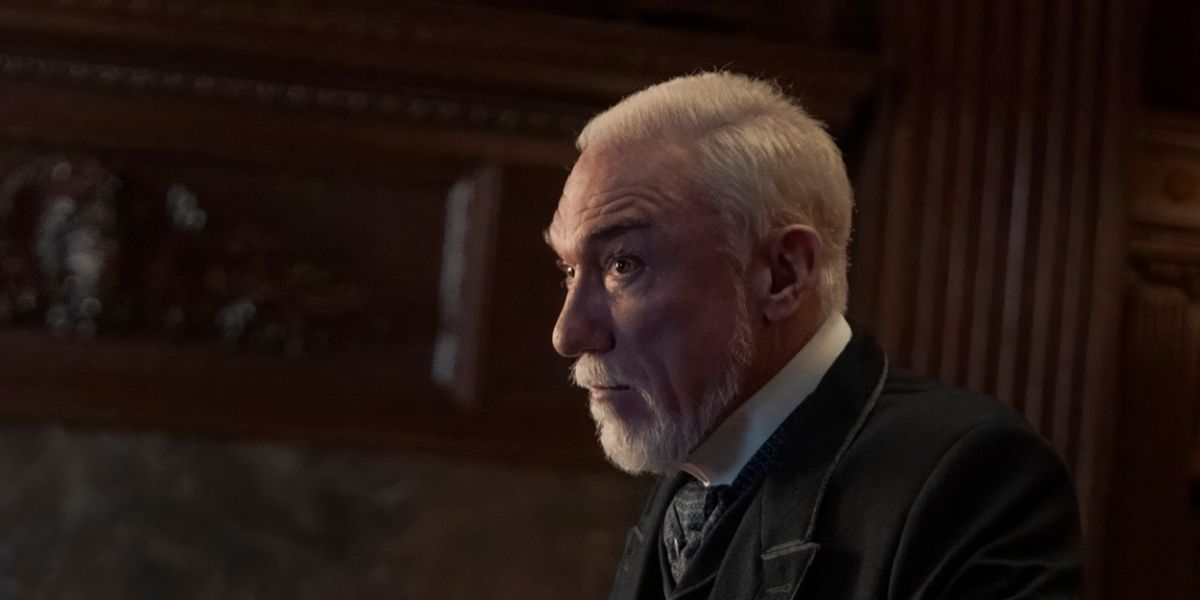
Warning: Spoilers ahead for The Gilded Age Season 3 Episode 5
Patrick Page has made a career playing villains. With his deep, resonant voice and commanding presence, Page brings an unmistakable gravitas to every role he plays, both on stage and screen. It's no surprise has brought to life such characters as Hades, Frollo, and Jacob Marley, among many others.
What might have come as a surprise, however, was seeing Page's Richard Clay fired by George Russell in the most recent episode of The Gilded Age. There Clay stood, a longtime partner and so-called "friend" to George, as the railroad tycoon tore into the man for failing to help him attain what he desired.
This development didn't come out of thin air. As viewers have seen throughout this season, George has faced business and financial pressures that have at times felt insurmountable. Clay has frequently found himself in the middle of these dealings, attempting to offer wise counsel to George, even if it seems to fall on deaf ears.
Throughout the series, Clay could certainly be described as villainous for his ruthless and often inhumane dealings, particularly with George's employees. Last season, he had no hesitation in shooting down the striking workers. Now, with Clay's loyalities up in the air, there's no knowing where the character will go next.
To mark this major moment of Episode 5, BroadwayWorld dove into this storyline with Patrick Page himself, who offered insight into Clay's psyche, his motives, and what the character might do next.
This interview has been condensed for clarity and length.
Looking back to the beginning of this season, Clay says something to the effect of "Mr. Russell is a one-man band and the rest of us are disposable." In hindsight, that line feels like foreshadowing. How do you interpret that moment now? Was Clay preparing himself for the possibility of being let go, or do you think he was blindsided?
It's so interesting. We film the episodes out of order, and you might, in one day, film a scene from episode two and then another from episode six. That has always been a wonderful thing for us on this show because it allows many of us who are doing other work to participate in The Gilded Age, as they can consolidate our time and utilize us very efficiently. I can't remember what order we shot in, but when I shot that scene, I believe I already knew the arc of the character.
The way I thought of that moment when I played it was that I was fishing. What I wanted was for George to say, "Oh no, Clay, you are indispensable." I shot Morgan Specter a look to that extent, and there was a wonderful, uncomfortable pause between us of George looking at me and not picking up the bait that I had passed to him.
I think I want to think of myself as indispensable, certainly. And I think of the friendship as probably much greater than George thinks. I always am a bit chuffed, both as an actor and as a character, when there are these great big events for the Russell family, and Clay is not invited.
George Russell is keeping me out of affairs like his daughter's wedding. Earlier, there had been a script where I was in the early Easter service scene with the Russells, and then I was taken out of those scenes. I thought that was very interesting. I thought that I would probably try to go to the same church as George and socialize as much as I could. And so the fact that Clay is never invited to those things has always rubbed him the wrong way, I think.
It certainly reveals a lot about George's character. And it makes me wonder if Clay underestimated how fragile his position was because of his closeness to power and how he had the inside look at everything.
Yes, and I think the fracture probably started back at the mill when I was so disappointed with George for not firing on the striking workers. I think that was likely the moment when George began to think, "I don't know if this relationship is going to last."
In my view and Clay's view, George likes to think of himself as a humane person and a good guy. I'(M) Willing to take the heat and be the bad guy for him and allow him to sort of shine. I know it gets under his skin when he's painted as a bad person. There was an episode where he was very upset with the headlines he was getting. I'm happy to take that on, just as Henry Clay Frick was willing to take that on for Andrew Carnegie. I think George likes to think of himself as a very humane person, and maybe I remind him too much of the dirty side of things.
Do you think Clay also sees himself as a humane person? When playing a "villain" like this, what is your approach?
I play him from his point of view. For those striking workers, George and Clay, as his emissaries, had created work that was never there. All of these men had work because of us. Clay himself works 18-hour days, and they were asking to work 8-hour days. As Clay, I thought that was ridiculous.
I came from nothing. I didn't grow up with money. I got to where I am on my own, and I expect them to do the same. So from his point of view, he's in the right. I think he's unashamed of his position because he thinks they're building America. He thinks they're on the right side of history. He thinks that they're seizing a moment in time and building the industry of tomorrow. And that requires, as all great feats do, sacrifice, struggle, conflict. I'(M) Willing to face it head-on, and I think George wants to hide from it a bit.
In the episode, George says something about how he doesn't think Clay is acting in his best interests. Do you think that's true? Do you think Clay is acting in George's best interest?
Absolutely. I think I am. My point of view is J.P. Morgan's point of view: you are being reckless with your fortune. You are going to bring down not only yourself and your family, but everyone around you, because all of this money is invested and shared with banks and all sorts of different people. A couple of banks have already gone down, and I'm trying to head off catastrophe. I absolutely think I'm in the right, and I still do.
How might this firing fuel Clay moving forward? Do you think this is a turning point in his career or his philosophy about the world of business and the world of business relationships?
If it were me writing it, I would say that I would double down. I think I'm an incredibly savvy business person with connections in every part of the business world. I think I hope to become a very dangerous adversary for Mr. Russell. I think this is not a person you want to get on the wrong side of.
What has surprised you most about the journey of playing Clay across the three seasons?
I don't think I've been surprised per se, because many of these people are based either on real people or combinations of real people. The Henry Clay Frick comparison was kind of there from the beginning. The surprise, I suppose, given that that was the model, was how subservient he remained. It was always a difficult tightrope walk because he's not a servant. He's not like one of the downstairs people. I'm sure in his own home, he keeps his own servants and he has his own place in society. So finding where he fits in that social hierarchy, I think, is the difficulty.
And that's one of the attractive things about the character as a viewer. He doesn't really fit into the upstairs or downstairs dynamics. We only see him in relation to George. We don't really know so far what kind of person he is with his family or anything else.
That's right. And that's kind of wonderful in a way because it leaves a lot of open canvas that you can fill with wonderful stuff. For all we know, he lives in a little place all by himself like Ebenezer Scrooge. We haven't been told. George has never asked about his wife or daughter. It's been absolute business, business, business. I'm very interested to see where that goes.
I'm hopeful for a fourth season. I know nothing has been announced, but I'm hopeful that we do see more of Clay.
Yes, I would love that. It's really getting interesting.
New episodes of The Gilded Age air on Sundays at 9:00 p.m. ET/PT on HBO and HBO Max. The show is created, written, and executive produced by Julian Fellowes (Downton Abbey) and stars many Broadway and theater performers, including Audra McDonald, Kelli O'Hara, Donna Murphy, Nathan Lane, and more.
This season, more Broadway alums join the series, including Victoria Clark, Brian Stokes Mitchell, Phylicia Rashad, Kate Baldwin, and Andrea Martin, to name a few. Take a look here to learn about all of the Broadway stars this season and check out BroadwayWorld's exclusive conversation about Episode 4 with actor Douglas Sills, who plays Borden in the series.