Exclusive: Ben Ahlers on Jack’s Big Break in THE GILDED AGE, Musical Theater Hopes, & More
Episode 7 of The Gilded Age is now streaming on HBO Max.
 Click for Tickets
Warning: Spoilers ahead for The Gilded Age Season 3 Episode 7
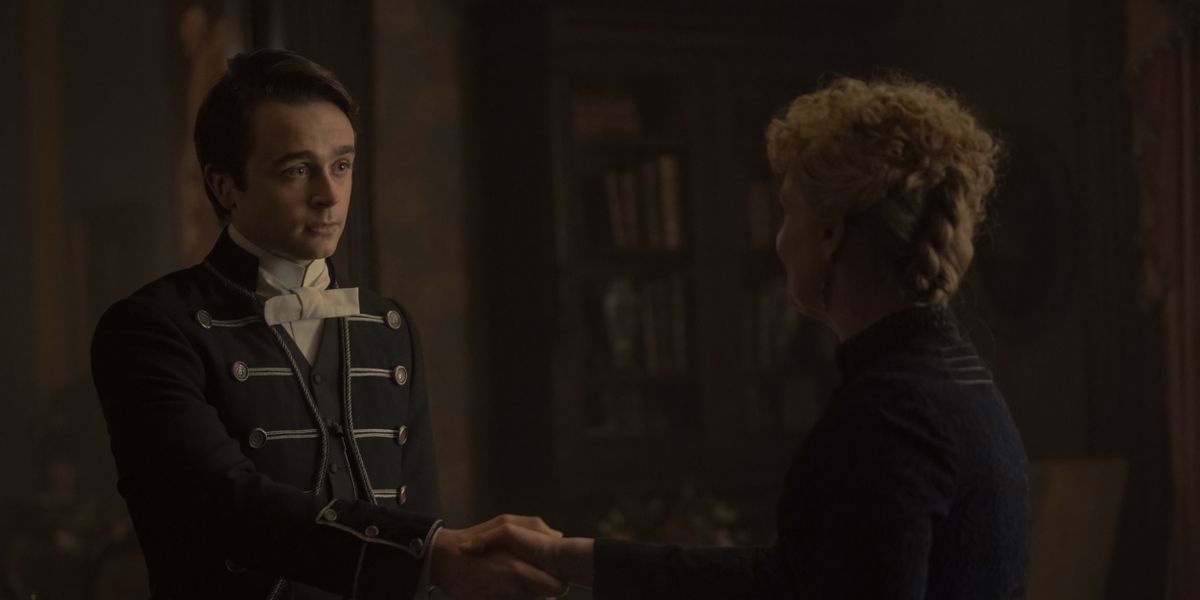
At this moment in The Gilded Age, our favorite footman Jack Trotter is at the precipice of a major transition. He has upended his social status, rising from the ranks of footman to an independently wealthy businessman overnight, thanks to his entrepreneurial spirit and the help of Larry Russell.
Change is hard, especially in a society that holds dear to its defined rules and hierarchical structures. Now that he has sold his clock patent, Jack is entering an unknown world and, with it, leaving behind the only family he has ever known. But progress moves ever onward, and he is ready to meet the moment.
In the latest episode, we see the character make a step in that direction as he settles on a home, breaking away from his place in the Brook household. Now, he will have his own staff and a new place in society. As Jack charts his bright future, we caught up with actor Ben Ahlers, who shed light on portraying this latest arc, unpacked what might be next in store for the character, and discussed both the current and past complications of living in New York City.
Note: This conversation took place before the series was renewed for a fourth season.
This interview has been condensed for clarity and length.
First of all, I wanted to congratulate you because the last few episodes of Season 3 have broken viewership records. More people are tuning into the show than ever before. Have you sensed that shift at all?
Yeah, completely. I think we always had a very loyal fan base in those first couple of seasons, and they really made themselves known online. Depending on the part of the city that I was in, I would occasionally run into people. But then after that Emmy nomination for Season 2 and the continued development of all of these juicy and, in some ways, really provocative storylines, I can definitely feel it as a part of a cultural moment that is exciting. The online engagement has certainly been noticeable, as well as just day-to-day life. It has started to spread, and that's so exciting because everybody in the show is just such a big fan of what we get to do. We're really proud of it.
Your character is so unique in the show because he's the only person we've seen make this leap from downstairs to upstairs. I'm curious what your reaction was when you first learned that Jack would sell his patent and then leave his role as a footman.
I always had this sense that Jack was destined for bigger things. There's something so uniquely American about it, especially in that time in our history when the American dream began to reveal itself. And then once it actually started to manifest itself, I became so proud of him. But he's also very frightened. The only family that he's ever really known is his work staff, his coworkers, and Agnes and Ada upstairs. There's a lot of sacrifice involved with pursuing a dream and going out on your own. But, as you see in episode six, it's time. Ada tells him that staying would be "not quite wrong, but not quite honest either." And she's right. At a certain point, you have to leave the nest.
In this episode, Jack buys a house and says to the real estate agent something about how crazy it is to think about a staff because he was staff himself. I was thinking about how he represents a new generation of the upper class- one that might be able to correct past wrongs, if he chooses. Do you think there is anything about his experience as a footman that will influence how he treats his employees? What do you think that dynamic will look like for him?
I've also thought of Jack's potential as a character to represent this new link in the chain of our progress. I feel like our generation today has that opportunity, and hopefully, we're continuing to build upon the good work that's been done as well as rectifying the wrongs and the ignorance. To me, that's much more hopeful, and Jack does represent hope in a way. He recognizes the humanity of the people that he's worked with, and so I think it'll be impossible for him to ignore that in his staff.
I love how Jack is both fascinated by high society and also pokes fun at it. I think he has this opportunity to define his own version of wealth. To me, hopefully, that involves a family, because he's been seeking that since his mother died. He's definitely romantically inclined, and now he and Bridget seem to be connecting in a really interesting way.
I do think it'll be a weird negotiation, similar to when he was serving food to a woman who he was richer than. The status shifts are still going to be very present. He's paying these people's wages, so there's going to be some hierarchy there. I don't know how he's going to feel about that, to be honest. I'm excited to see what they give me.
Some interesting dynamics are going on in the series right now, and not just because of Jack’s new financial situation. There is also a tension between his business partner, Larry, and his friend Marion. Do you feel that his relationship with either of them could complicate his relationship with the other?
Yeah, totally. There were several moments throughout the first couple of seasons where you saw Jack and Marian's respect and care for each other. Marian was so supportive of Jack throughout the entire patent process. But then, Larry, beyond his financial and network support, does treat Jack very well. There's a bit of friction at the beginning of this season because, again, those class distinctions don't go away. I think Larry was risking a lot, bringing in a junior footman.
Especially in the scene with his own footman who pours the coffee for Jack.
Completely. Those etiquette laws were baked in. I think Larry showed a great deal of awareness and care, and courage to bring Jack into the fold the way that he did. He has two benevolent people in his life, and I also find him to be such an openhearted, empathetic person. I could see him not only feeling caught between the two but also feeling quite distressed about watching this match made. He just wants them to be happy and set the record straight, which is why he says what he says to Marian. He shows up for Larry in a way that's still respectful of her feelings.
And Marian shows up for him, too. She's the one who goes with him to pick out the house in this episode. It seems to me that she is also not all that interested in the class differences, either. She just wants to be a nice person.
We're both outsiders in a way, and I think they bond over that. If there was an ultimatum, I don't really know which way he would go, to be honest.
I think viewers are very happy for Jack, but I imagine a lot of us are going to miss some of those interactions with the other staff and the van Rhijns as well. As an actor, is there a dynamic or relationship that you're going to miss now that he has moved out of the house?
Our downstairs staff has really bonded as a family in such a way that I think it will be difficult for me, Ben, to say goodbye. In that goodbye scene in episode six, it didn't take much work on my end to open my heart. Our first table read was March 2020, right before the pandemic, and we were forged in the fires of that time together. There's so much love there.
I'm going to really miss Deb Monk. She wrote and originated Pump Boys and Dinettes on Broadway in the 1990s and played Prudie. My late mother also played Prudie in a production in a small town in Iowa. She passed last year, and the Christmas before, Debra had been clearing out her memorabilia and trinkets from her career, and she gave me a Prudie necklace that she had worn in the original Broadway company, and I gave that to my mom for Christmas. She's one of the nicest and most talented people that I know, so I'll miss that and Kristine Nielsen and Simon [Jones] and everybody.
I will say, in addition to that, I got my master's degree in theater history and performance by pouring tea in the back of every significant scene that was held in that Brook house drawing room. Nathan Lane would come through, and Donna Murphy and Robert Sean Leonard all last season. Watching them work from Action to Cut, but also sitting in the green room for hours on end and listening to them talk, made me feel comfortable on set, and it fertilized my brain in this crazy way. I'm so indebted to all of their generosity and spirit, and I hope that, however Jack navigates the future scenes, there are still opportunities to be around such genius and history we get to have in the show.
People talk a lot about the Broadway and theater talent and people in this show, and I know you've done quite a bit of regional and off-Broadway theater. Is Broadway itself something you are hoping to explore in the future? Do you enjoy hopping between the mediums of TV and theater?
The last two projects I'd done before my current movie were plays. I produced an off-Broadway play last fall with Victoria Pedretti, and then I did the John Wilkes Booth play in Baltimore. I've never felt more challenged. You go into that for a few months, and you come out a completely different person and artist. I love that transformation and going up every night, continuing to mine the material and listening to the audience. There's something so alive about live theater, and I want to do it as much as humanly possible.
I haven't done a musical professionally since summer stock in college. I went to the University of Michigan for musical theater and then basically just did straight theater. So I shudder at that challenge in the best way. It feels like such a steep mountain, but that's how all of this started: doing community theater with my mom back in Iowa. I feel there is a responsibility for me to honor that. I have so much respect for the effort and the discipline that it takes to operate at that level. I'm still getting my sea legs in that regard, but I'm eager for the challenge.
So much has changed in New York and the world since the Gilded Age era. What do you think this show captures about New York that's still true today?
We're such a paradoxical and complicated city. It's so hard to live here. There are so many rules, and the culture is so self-contained. There's literally no place like New York in a way that's very, very difficult. But on the other side of that coin is a richness and vibrancy and dynamism that is, in some ways, addictive and in other ways meaningful.
I've been here now for seven years this fall, and I've seen my favorite restaurants go under, and I've seen my favorite view get blocked by a new building. This thing is constantly upending itself and creating new rules and new forms, and I think clearly in the 1880s that was happening. But somewhere through all of that mess, there's a throughline of walking through Central Park or walking through older neighborhoods and still feeling like you're a part of this lineage, this history, and these shoulders that we stand on.
To get to live in the present, in this radically changing time, and then to get to play pretend in that experience in the 1880s tethers those two worlds so beautifully. It really was not that long ago in human history. They're just our aunts and uncles relative to the rest of the timeline.
New episodes of The Gilded Age air on Sundays at 9:00 p.m. ET/PT on HBO and HBO Max. The show is created, written, and executive produced by Julian Fellowes (Downton Abbey) and stars many Broadway and theater performers, including Audra McDonald, Kelli O'Hara, Donna Murphy, Nathan Lane, and more.
This season, more Broadway alums join the series, including Victoria Clark, Brian Stokes Mitchell, Phylicia Rashad, Kate Baldwin, and Andrea Martin, to name a few. Take a look here to learn about all of the Broadway stars this season and check out BroadwayWorld's exclusive conversation about Episode 4 with actor Patrick Page, who plays Clay in the series.