


Review: THE MERRY WIDOW, Opera Holland Park
No pop, all corn: a lazy adaptation is rescued by dreamy aesthetics
 On the face of it, three celebrated opera companies joining forces is, without doubt, A Good Thing. This adaptation of Franz Lehar’s The Merry Widow, on the other hand, decidedly Not A Great Thing.
The idea that “success has many fathers, failure is an orphan” is turned on its head here as this operetta co-produced by Opera Holland Park, Scottish Opera and D’Oyly Carte Opera manages to just about hold its head above water thanks to some superlative singing and the supremely charming staging.
%20in%20The%20Merry%20Widow_%20Credit%20Mihaela%20Bodlovic_.jpg?format=auto&width=1400)
Adolf Hitler was apparently a huge fan of the original 1905 operetta; what he would think of this updated outing is anyone’s guess. Looking on the official webpage for this production, there are curiously no clues whatsoever to its Mafia-themed direction or the changes to character names (St Brioche, for example is now Sam Briochi). John Savournin directs this romance which starts off at Don Zeta’s 50th birthday party in 1950s New York before jumping across the Atlantic to a Sicilian villa then back again to a Manhattan nightclub.
Co-written by Savournin and David Eaton, the original libretto by Viktor Léon and Leo Stein has been radically altered. In what could have been subtitled “Three Hours Of Wise Guys Saying Dumb Things”, the writing goes considerably out of its way to make sure there is no cliché left unturned. Whether your mafia reference point is The Godfather or The Sopranos, there is plenty to raise an eyebrow at.
%20in%20The%20Merry%20Widow_%20Credit%20Mihaela%20Bodlovic_%20(2).jpg?format=auto&width=1400)
Numerous people (including a family member who has suffered an accidental death) are reported to be “swimming with the fishes”. An offer is made by Don Zeta that “can’t be refused” (and which is then immediately refused with no consequences). Goons who sound like they are fresh off the boat from the old country boast about the quality of their “chicken parm”. As a birthday gift, the Don is given a cement mixer tied in a bow which he then takes with him to Sicily. And so on. And so forth.
And then there’s the language. Or should that be languages? When not mangling French (“You are so cruelle”) or English (“I am positively shaking with the suspense”), characters walk around randomly throwing in Italian words and phrases (“put a sock nella tua bocca”). These “aren’t foreigners rather funny?” gags that were common in Seventies comedies like Mind Your Language might have maybe passed muster in 2025 if they were genuinely funny and been carried off with a certain amount of self-irony. Alas, the hammy script often veers between pure “Carry On” and tired carrion.
%20in%20Scottish%20Opera's%20production%20of%20The%20Merry%20Widow_%20Credit%20Mihaela%20Bodlovic_%20(2).jpg?format=auto&width=1400)
What should be an invigorating musical that switches from comedic elements to romantic ones is let down by a wordy script that dilutes the effect of both. The physically dynamic Matthew Kellett (playing Nicky Negus) is underused and could have pepped up the more static scenes. Even in the chorus-boosted numbers or when the passion between Danilo and Hanna finally bursts into life, it still feels like a Ferrari being driven with the handbrake on.
The raw emotion of Lehar’s masterpiece is muted by having almost all the singing happen from the back of the polo-shaped stage. That distance adds a metaphorical fifth wall to the proceedings, dulling the impact of the performers (especially Paula Sides’ gorgeous soprano voice as the “merry widow” Hanna Glawari and, opposite her, baritone Alex Otterburn in his fantastic turn as the consigliere Danilo) and Kally Lloyd-Jones’s elegant choreography.
%20in%20The%20Merry%20Widow_%20Credit%20Mihaela%20Bodlovic_.jpg?format=auto&width=1400)
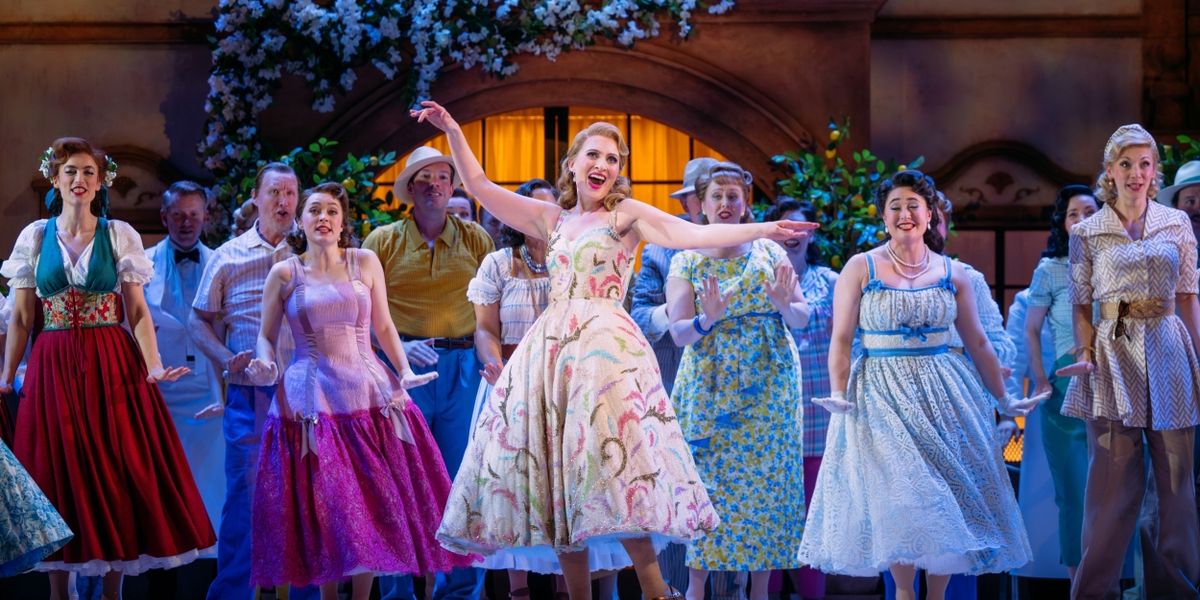
Thankfully, takis knows how to raise any production up a notch or six. His gloriously detailed sets effortlessly immerse us in the Fifties period, whether it is a partying penthouse, a Sicilian lemon plantation or a Manhattan nightspot. The pinstriped suits are classy while the Dior-like dresses positively glow especially on Sides and Rhian Lois (as Valentina). The colours jump and pop out even more as the sun sets behind this unique venue.
Down in the pit, Stuart Stratford juices up the score with panache. It may be almost 120 years old but it still sounds refreshing in his hands. The waltz that leads us into the interval is a particular delight.
This isn’t the first opera to cosy up to the Cosa Nostra for inspiration: Jonathan Miller’s take on Verdi’s Rigoletto famously set itself in the world of gangsters and molls. That version debuted in 1982 and was staged at the ENO as recently as last autumn. Will Savournin’s The Merry Widow have that kind of longevity or will it be given the cement shoes treatment?
The Merry Widow continues until 28 June.
Photo credit: Mihaela Bodlovic





Reader Reviews
To post a comment, you must register and login.