


Review Roundup: Billy Crudup and Denise Gough in HIGH NOON
The stage adaptation of the classic Western is now open at the Harold Pinter Theatre
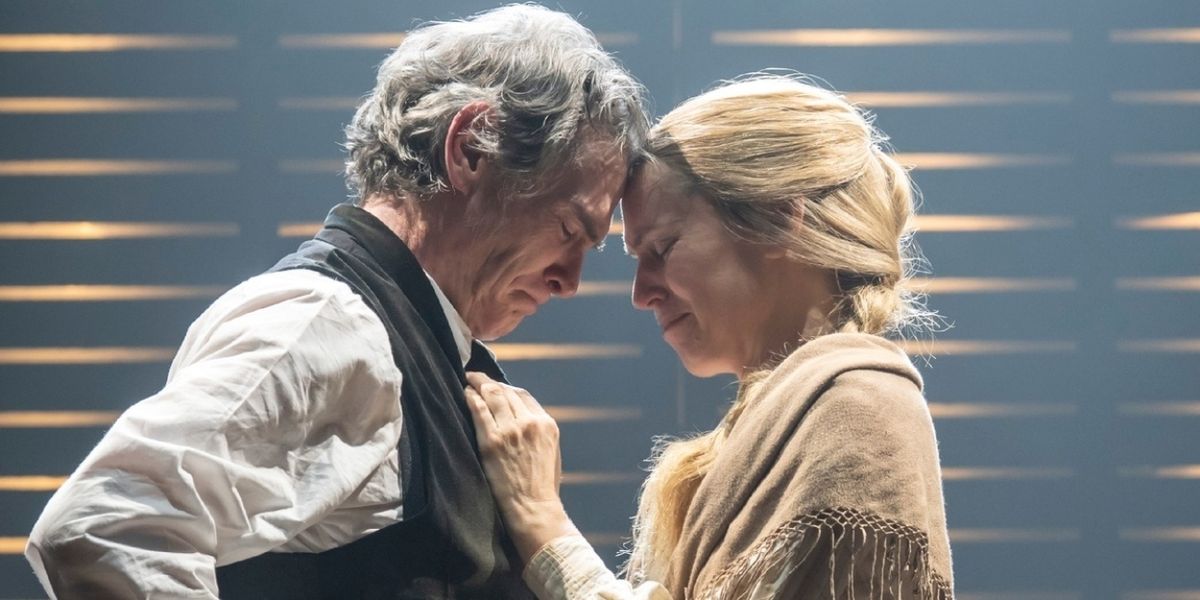
Once a searing allegory of Hollywood’s blacklist, High Noon now explodes onto the stage in an unmissable new version that speaks urgently to the world today.
Set in the American West of the 1800s, High Noon rides on themes as relevant now as they were then. Courage vs. Cowardice. Justice vs. Peace. Duty vs. Desire. And at its heart, is the bond between Will Kane and Amy Fowler – a love tested by impossible choices as the clock ticks down to the return of deadly outlaw Frank Miller on the high noon train.
What did the critics think?
High Noon at the Harold Pinter Theatre until 6 March
Photo Credit: Johan Persson
 Gary Naylor, BroadwayWorld: The emotional weight of the play is, in another surprise for me, carried by the two women in his life, his new wife Amy and his ex-lover, Mrs Ramirez. Denise Gough is wonderful as Mrs Kane, a title she disowns so swiftly after its acquisition. She skilfully manages the transition from a giddy newlywed instantly plunged into the kind of ethical question that is best left to an ethics seminar, but this time with the stakes sky-high. It is the very presence of such strong convictions that sends the shiver down our backs, Gough pressing on those buttons without ever indulging in anachronistic histrionics.
Arifa Akbar, The Guardian: It seems like a reluctant musical at times, the songs short and thin but the percussive music and sound design are always arresting, as is the lighting, designed by Neil Austin, which brings emotional clarity and intrigue. A clock is central to Tim Hatley’s set design, counting down to the train’s thrilling arrival and the subsequent showdown, which manages to contain tension and drama, despite the difficulty of staging a cross-town shootout. For all its early stiffness, it builds in momentum and there are moving moments. Ultimately, the political message speaks loudest, harnessing the McCarthyist fear of then and the Trumpian terror of today.
 Julia Rank, London Theatre: Crudup brings gravitas and quiet dignity to the role, as well as a touch of delicacy (he could have been ruthless in his approach, but he wasn’t), though he lacks a big stirring speech to bring everything together. As Amy, Gough conveys her quiet strength in a relatively underwritten part. Despite being terrified of being made a widow on her wedding day, she won’t unquestioningly “stand by her man” because that’s what’s expected, and she has the chance to showcase her singing ability with songs by Bruce Springsteen and others.
Nick Curtis, The Standard: I’m not sure why veteran screenwriter Roth, who won an Oscar for Forrest Gump, thought the world needed this onstage horse opera, here and now. Nor why he and director Thea Sharrock stud the action with snatches of songs by Bruce Springsteen and others, plus occasional bits of square dancing. It shows how far we’ve gone through the political looking glass, though, that a hymn to American individualism, starring the ferociously right-wing Cooper, here becomes an anti-Trump parable. Miller is a lying demagogue as well as a criminal and the townsfolk’s reluctance to support Kane is a failure of collective action.
Sarah Crompton, WhatsOnStage: Gough, such an intelligent actress, doesn’t have quite enough to do with Amy, whose principles mean she opposes any kind of violence, though she sings beautifully in the contemporary songs by Bruce Springsteen and others that punctuate the scenes. That’s partly because the central debates of the film, the agonised wrestling with what is truly right, are slightly muted here as the play tracks Kane’s quest for support from various groups of townspeople. Crudup, deprived of Gary Cooper’s pensive close-ups, needs one great speech to outline his position. He keeps saying he must do what he must do, but the moral thrust of the film is somehow missing.
Sam Marlowe, The Stage: Neil Austin’s elegantly shifting lighting, trickling through the wooden slats of Hatley’s set, helps establish the passing of the hours from morning to afternoon. But there’s still woefully little tension to engage here. Kate Waters’ fight scenes, as well as the ultimate denouement, are unconvincing and lack firepower. There are heavy-handed references to the gung-ho cowboy attitude of Trump’s America: “Something is rotten here, this whole damn country,” mutters Kane; they replace the film’s controversial subtextual critique of McCarthyism but feel too on-the-nose to compensate. As the hands on that clock finally approach 12, what you’re chiefly left thinking is, what a waste of talent – and what a waste of time.
Clive Davis, The Times: Tim Hatley’s set design, with its sliding wooden-slat walls, evokes a fragile, dusty township. But while a clock hanging above the stage ticks away as we wait for the villainous Frank Miller to arrive on the noon train, the climactic shoot-out looks perfunctory. Still, the lines that Roth has added about morality and confronting rule-breakers take on new force at the start of a year when the world seems to be in meltdown.
Average Rating: 65.7%
Prefer BroadwayWorld in Google Search?
Add us as a preferred source so our stories show up more often in Top Stories and Google’s AI answers — for you.
- To read more reviews, click here!
- Discuss the show on the BroadwayWorld Forum
Sign up for all the news on the Fall season, discounts & more...
|
Powered by

|
.jpg?format=auto&width=300)





Reader Reviews
To post a comment, you must register and login.