


Review: MILES, Southwark Playhouse
This Edinburgh Fringe hit makes its London debut

 The opening tableau of Miles is one of the most memorable I have seen or will see this year: a shirtless man writhes atop a piano, as though something primitive and long-dormant within him is being woken up. Similar convulsions crop up throughout the show, conveying a man simultaneously at one with his music and at war with it.
The musician in question is a suitably raspy Benjamin Akintuyosi as Miles Davis, who in Oliver Kaderbhai’s script is something of an ageless figure. He’s on the cusp of recording his genre-defining 1959 album Kind of Blue, but also appearing ghostlike in 2026 to Jay, a jazz musician and expectant father (portrayed by real-life jazz star Jay Phelps), who’s signed a precarious record deal of his own.
From this premise, a lesser script might turn Davis into a wise, avuncular figure doling out advice. Instead, despite the intervening decades, this version of Davis doesn’t quite have it figured out just yet. The most pertinent questions from his career – what did it take to make Kind of Blue, and who ought to get the credit – are raised, but that doesn’t mean we get any satisfactory answers.
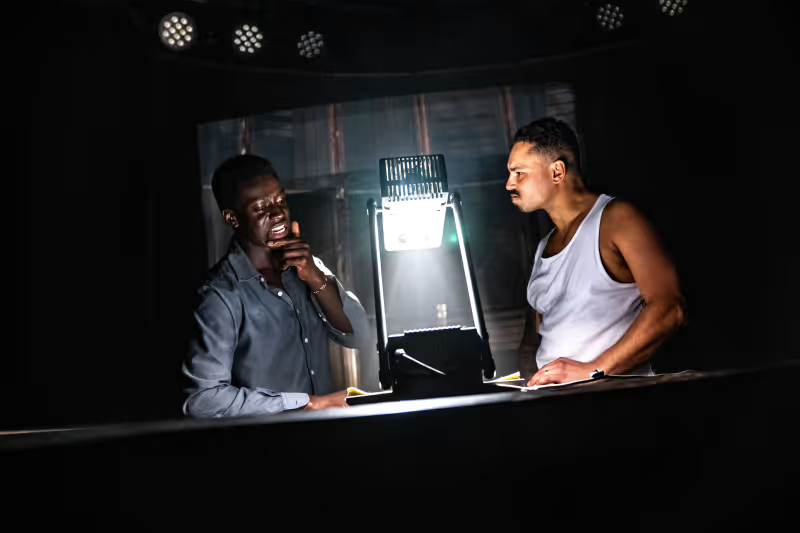
Photo credit: Colin J Smith
As he looks back on the album he still regards as a “failed experiment”, and the lessons on creativity, racial identity and fatherhood that came with it, Akintuyosi’s performance is infused with wisdom and self-reflection, but also with a certain youthful belligerence, honed over his time in the boxing ring. He gently pushes back on any lofty statement about his own genius with wry self-deprecation (in the 2020s, Davis declares, “jazz is dead, let’s keep it that way”).
Of course, it is only fitting that the music be the show’s beating heart. Phelps’s trumpet interludes nail Davis’s clear, subtle articulation, and the monologues about Davis’s diverse influences (including, apparently, tap dance) will convert even the most hardened jazz sceptic. Phelps also proves himself to have decent acting chops, flitting effortlessly in his playing between cautious timidity and breezy self-confidence, as Jay grows into himself as a musician.
Inevitably, this type of story does sometimes fall back on cliches of the music biopic genre. The flashbacks to Davis’s youth feel weaker than his conversations with Jay, as they rely too heavily on generic rags-to-riches tropes and fetishised struggles with drug abuse and racial violence (and that cardinal biopic sin of quoting a year when an event takes place). The sporadic, superficially nostalgic projections of period photographs and memorabilia on the back wall don’t help matters, and disrupt some otherwise striking lighting sequences (by Alex Lewer).
Most of the time, though, Kaderbhai allows Davis to be an incomplete, inconclusive picture. Much like jazz itself, this production is constantly in conversation with the past, building on existing work without trying to neatly resolve it. Rather than a museum piece or a fable, in promising newcomer Akintuyosi’s hands Miles Davis is still very much undergoing the trials that led to his greatest work.
Miles plays at Southwark Playhouse Borough until 7 March
Photo credits: Colin J Smith
Prefer BroadwayWorld in Google Search?
Add us as a preferred source so our stories show up more often in Top Stories and Google’s AI answers — for you.
Sign up for all the news on the Summer season, discounts & more...
.jpg?format=auto&width=365)





Reader Reviews
To post a comment, you must register and login.