
Review: Spooky Action Theater's THE DRAGON a Stunning Contemporary Fairy Tale
Director and Co-Adaptor Elizabeth Dinkova has created a thrilling and thought-provoking production that is true to Schvarts’ vision.
 Click for Tickets
While the rest of the world shakes their heads and wonders what’s become of us, the fierce company of Spooky Action Theater has upped the ante for D.C. theatre-goers with a production of one of Russia’s most beloved cautionary tales—“The Dragon,” by Russian playwright Evgeny Schvarts. Director and Co-Adaptor Elizabeth Dinkova has created a thrilling and thought-provoking production that is true to Schvarts’ vision, and could not be more timely or necessary.
As the title suggests, the play begins outwardly as a fairy tale with a typical dragon demanding a typical virgin sacrifice; along comes a brave roving knight to the rescue. There’s a catch, however; Schvarts wrote it when the totalitarian regime of Russia’s notorious Communist dictator, Josef Stalin, was at its height. Stalin sensed, rightly, that the play was directed at him, and so “The Dragon” was officially banned, only resurfacing after his death.
Under the cover of a children’s show, Schvarts weaves a tale of brave Lancelot, who arrives determined to save his beloved Elsa, a damsel-in-distress, only to discover that the village is used to the dragon and can’t imagine life without him. Dinkova, a Bulgarian-American, grew up with Schvarts’s subversive stories behind the Iron Curtain, and fully understands the mind-set of those who are simply content to allow atrocities to occur all around them, just so that they are left in peace. As the specter of dictatorship looms large over all of us, she has made the bold decision to set this production in our own time and place, throwing the mirror up to all of us, with truly soul-searching results.
Instead of some cock-eyed fairy tale kingdom, we begin in an ICE detention cell where a journalist, Sofia, is forcibly imprisoned (she had only come to interview the detainees). Now trapped, she discovers that one of her cellmates, Diya, is in labor. With no doctors, and with the ICE agents unsurprisingly absent, Sofia and another cellmate, Lina, try to use stories to help Diya take her mind off of her painful ordeal.
And this becomes the haunting, all too contemporary setting for Schvarts’ timeless, and timelessly subversive, story. Which is now set in a new country, facing remarkably similar challenges to the ones he himself endured.
Dinkova uses an imaginative combination of high-tech and low-tech props, as the three women proceed to act out the story. ICE’s triple-camera surveillance device soon morphs into the three heads of the Dragon, and the ICE agents fill in as both the Dragon as well as two petty officials who owe their power to the monster. Cardboard ‘mattresses’ are employed to create walls with peep-holes and a small cardboard town, cobbled together by the inmates, sits nearby.
Dinkova’s cast fills the stage with an irrepressible energy, telling a story that should resonate with all of us. There are standout performances all around—led by Fran Tapia, who enters as the journalist Sofia but whose turn as Lancelot the knight-errant fills the house with her exuberance and optimism. As young and pregnant Diya, and then as Lancelot’s damsel-in-distress Elsa in the fairy tale, Surasree Das embodies the innocence and wariness of a young woman doomed, in the tale and in our own time, by the men around her. And as cellmate Lina, who also serves as Elsa’s fairy-tale mother Isabella, Raghad Makhlouf offers the pragmatism and gravitas of the subdued subject, powerless to save the people around her.
Ryan Sellers and Gabriel Alejandro begin the evening as heavies—the ICE agents responsible for these women’s incarceration—but then provide effective comic relief as the ultimately toothless Dragon (yeah, they manage the 3 heads together), and also as the Mayor and his son Henry, whose power of course derives from their pathetic subservience to the monster. The climactic battle between Lancelot and Dragon is handled effectively through Johnna Presby’s puppetry, aided by Robert Bowen Smith’s choreography (it’s fun to watch, no more need be said).
Virtue, in Schvarts’ fairy-tale kingdom, is hardly rewarded; even after Lancelot kills the dragon, it becomes clear that the villagers would rather live under some variation of the old system. The Mayor takes credit for Lancelot’s hard work, and prepares to wed Elsa, who of course was originally supposed to be sacrificed. Lancelot’s return on their wedding day complicates matters, because he was supposed to be dead and hence unable to set the record straight. A little more mayhem ensues.
What’s so unnerving to me about Schvarts’ play is that he not only skewers the authorities, he also points an accusatory finger at his audience. He was unnervingly prophetic about what would happen after Stalin’s death, and after the fall of Communism in Russia. Vladimir Putin has become the new dragon, with massive human sacrifices now a daily occurrence in Ukraine and elsewhere. And then there’s the small matter of how we, as Americans, choose to respond to the ravages of ICE raids in our own neighborhoods. None of us are innocent, all of us are complicit.
The theater artists I know who visited Moscow during the Soviet Years, recounted how they would go to a children’s theater show, only to discover that it wasn’t really for kids after all. “The Dragon” stands out for its mordant wit and its none-too-subtle digs at the Stalinist regime as well as its willing victims. Only after Stalin’s time could his fans see his stories on the stage as originally intended.
That Schvarts’ plays could finally be staged after Stalin’s death was a gift not just to Russia but also to the rest of the world, because it is a master class in artistic expression under extreme pressure. But it also serves as a warning, that we too could become as docile and fearful as the villagers in this little children’s fantasy.
Running Time: 2 hours and 15 minutes, including one intermission.
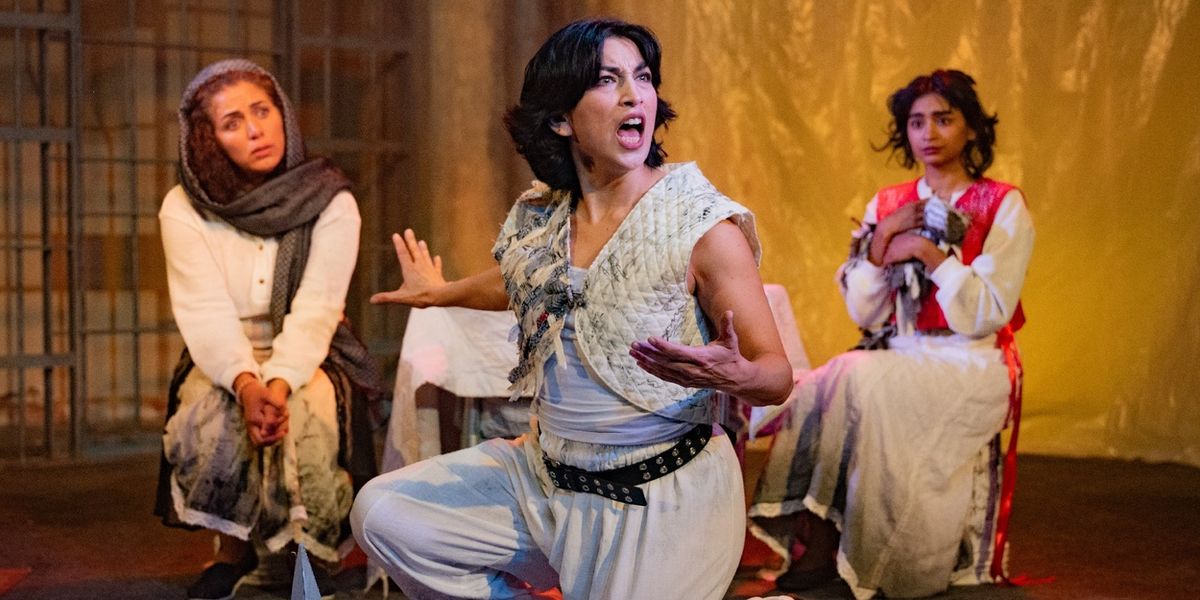
Production Photo, left to right: Raghad Makkhlouf, Fran Tapia, and Surasree Das in Evgeny Schvarts' "The Dragon." Photo by DJ Corey Photography.
MASKING POLICY: Spooky Action Theater does not require proof of vaccination, but has set aside October 9 as a masks-required performance.
All performances are at the Spooky Action Theater, 1810 16th Street NW, Washington, D.C. 20009.
Tickets begin at $17. For more information
For information and tickets please visit here.

|
Coming to America: An Immigrant Cabaret ExPats Theatre (9/30-10/18) |

|
Misery Aldie Mill Historic Park (8/20-8/30) |

|
Stonewall's Bust The Writers Center (10/09-10/25) |
|
Victorian Lyric Opera Company presents "Pirates of Penzance" F. Scott Fitzgerald Theatre (6/11-6/20) |

|
Mamma Mia! National Theatre (10/27-11/15) |

|
Doja Cat at Capital One Arena Capital One Arena (11/11-12/11) |
|
Interplay Orchestra presents "Time of Our Lives" F. Scott Fitzgerald Theatre (10/07-10/07) |

|
The Dinner Detective Murder Mystery Dinner Show The Dinner Detective Washington DC (9/12-9/12) |
|
Philadelphia Ballet Stars and Stripes Forever! Wolf Trap (9/10-9/10) |
|
Hamilton (Angelica Company) National Theatre (12/15-2/07) |
Reader Reviews
To post a comment, you must register and login.