


Review: ANDY WARHOL IN IRAN at Mosaic Theater
Great acting and timely questions through July 7
Andy Warhol really did go to Iran. In 1976, the Shah's wife, Farah Pahlavi, arranged to sit for Polaroid photos which Warhol would then use as a basecoat for a series of prints, and Andrew Cohen reproduces Warhol's image of her as a permanently present part of his set design. Warhol also could really order reasonably priced caviar from his hotel's room service. But playwright Brent Askari has not written a documentary. Rather, he's found a way to use facts to explore, enlighten, entertain; Andy Warhol in Iran places an interesting set of "what if" questions in the middle of what really happened in and to the 2500 year old civilization now called Iran.
Thirty years into his profitable and successful career as an artist, Andy Warhol had a global reputation as a prominent modern painter/filmmaker/printmaker. Farah Pahlavi's husband aspired to fully modernize Iran; she herself would open a museum of modern art in Tehran a year after Warhol's visit. Askari wonders what if someone as famous as Warhol could be leveraged to benefit those Iranians who were resisting the Shah's brand of modernization. The bellhop who delivers the room service caviar turns out to be one of those Iranians. What if he took Andy Warhol hostage?
When Warhol, famously reclusive when it came to casual contact with the general public, must converse with a threatening, total stranger, he learns of the discontent among ordinary Iranians about the secret police that help the Shah (his art patron's husband, remember) implement his policies by force. And Farhad, the kidnapping bellhop, has to learn that just because an artist is famous does not automatically mean that he will be useful to a political movement. Art and politics may indeed be connected, but the connection is neither obvious nor facile. If that sounds like an insoluble situation, well, that's what theatre's for--Chekhov said so when he stated that an artist's role is to ask questions, not to answer them.
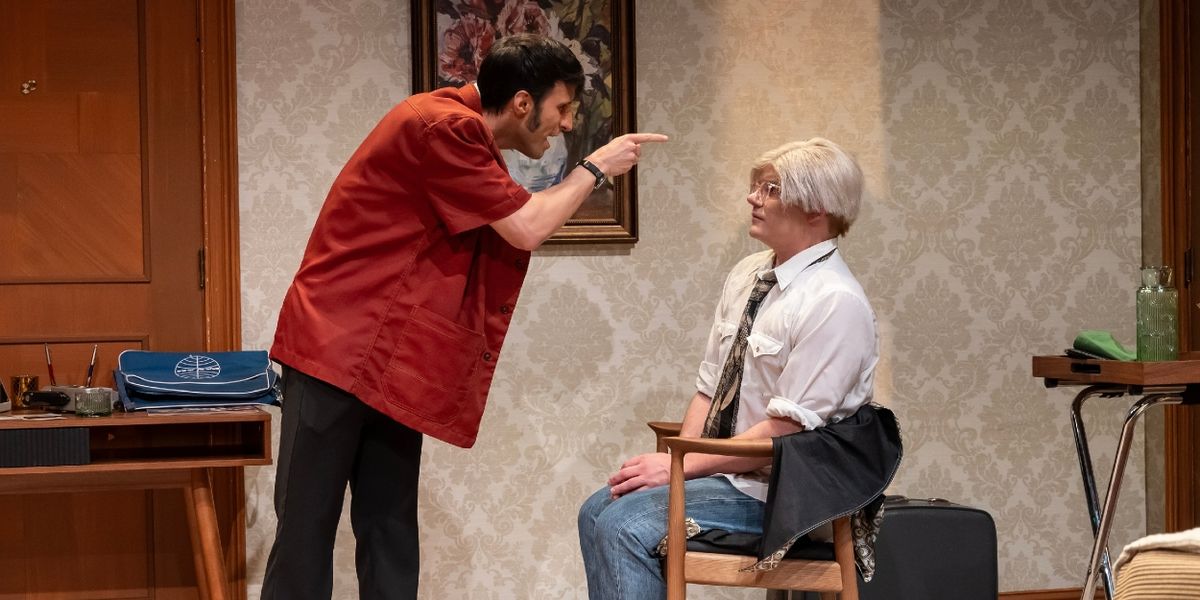
No questions are involved regarding the quality of this production. Director Serge Seiden unifies the wildly disparate events going on in that hotel room--suspense, slapstick, surprise, danger, comedy, and the greatest of these is realism--so that 90 minutes fly, and intermission never occurs to anyone. In addition to the great mural, Cohen has designed an utterly dull hotel room which is just perfect. Mona Kasra's absolutely outstanding projections constitute the documentary portion of the production. Swiftly and vividly, the stills and footage provide mini-classes on Warhol's art and on Iran's descent into government-by-religious-fundamentalism; her photo choices are spot on, and she edits like a filmmaker. As Farhad, Nathan Mohebbi sustains the nervous energy driving his scheme without undermining the emotionally riveting moments when he recalls being tortured by SAVAK, the Shah's secret police. Alex Mills' Andy captures Warhol's quirks and tics and then reveals the generous and thoughtful man beneath the public persona. Together, they spar, argue, play power games, share intimate stories, help each other, annoy each other. Neither the actors nor the characters they inhabit plays a zero-sum game, and this is excellent to watch.
(Photo of Nathan Mohebbi as Farhad and Alex Mills as Andy Warhol by Chris Banks)

|
Misery Aldie Mill Historic Park (8/20-8/30) |

|
Little Shop of Horrors 40th Anniversary Tour with Ellen Greene (the Original Audrey) Lincoln Theatre (9/25-9/25) |

|
Natural History Mosaic Theater Company (1/21-2/07) |
|
Harry Potter and the Sorcerer's Stone in Concert Wolf Trap (8/27-8/27) |

|
Interplay Orchestra presents "Time of Our Lives" F. Scott Fitzgerald Theatre (10/07-10/07) |

|
Come From Away Ford's Theatre (9/10-10/18) |
|
The 25th Annual Putnam County Spelling Bee Ford's Theatre (3/12-5/15) |

|
Josh Johnson DAR Constitution Hall (10/02-10/02) |

|
Beethoven’s Ninth Symphony Wolf Trap (8/14-8/14) |
|
Dupont Investigations: Flight of the Fallen Nocturne Hall (9/01-11/11) |
Reader Reviews
To post a comment, you must register and login.