


Review: SHEDDING A SKIN at Buddies In Bad Times
Vanessa Sears shines even when boxed in
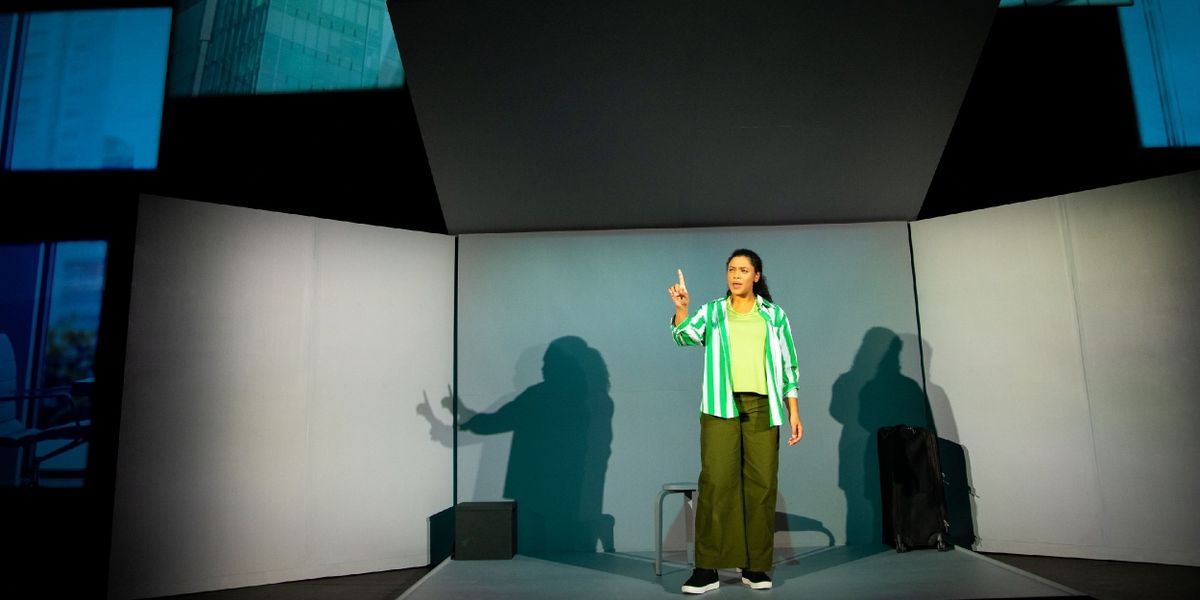
Within the larger space of Buddies in Bad Times’ Chamber, set designer Jung-Hye Kim’s constrained, small box of a playing space looks like it could be either a present or a trap, a Kinder Egg of theatre housing Vanessa Sears’ luminous solo performance.
Kim’s box represents the suffocating limits under which Millennial Londoner Myah operates. The new job she hates has called her in to be one of its faces of diversity in an ad campaign designed to address accusations of racism -- not because she excels at her position or has any friends at work, but because they have only three faces from which to choose. Rent in England’s largest city has forced her to live on a houseboat with a partner to whom she might not have otherwise committed so definitively, and Myah’s solidly middle-class parents expect more from their university-educated daughter than the aimless wandering through life she seems to be doing.
By the end of the first 15 minutes of the 100-minute show, Myah’s shocking and destructive depth charges to her life have left her at square one, forcing her to move to a room in a small flat with an imperious, elderly Jamaican social worker named Mildred (“Mrs. T” to most) who immediately makes her question not only her life choices but her very identity as a Black woman. On the other hand, having her life reduced to a single room may be the catalyst Myah needs to push outward.
Nightwood Theatre’s production of Amanda Wilkin’s Verity Bargate Award-winning play, under Cherissa Richards’ direction, might instead be called The Unboxing, as Sears gradually pushes out the creases of her miniaturized world to set herself free. Vanessa Sears gives an impressive performance in a story about our need for connection with others that sharply draws several unique and fascinating characters. While the woman at the heart of it all never fully defines who she wants to be after she emerges, the complex emotional origami of unfolding might make you shed a tear while Myah sheds a skin.
Wilkin’s deliciously wordy script is precise and detailed as it takes Myah through the joys and pitfalls of resistance, sketching an expansive inner and outer landscape deliberately at odds with the initially small acting space. Above and around Myah’s box, hanging screens fan outward to project details (projections by Laura Warren) that give a visual impression of, for example, Mildred’s apartment building without trying to show the whole thing. It’s an effective way to get us to fill the rest in from Myah’s words.
The screens also activate in the interstitial moments that try to give the story greater significance, descriptions of moments of kindness between strangers with a listed distance from our main character that gets smaller each time. These moments are heartwarming, but aren’t needed to bolster a theme of the need for connection that’s already quite clear. One of Myah and Mildred’s largest bones of contention is the role of smartphones and the internet in distancing ourselves from others under the guise of increasing connection, and the moments belie this argument; we’re already so connected to Myah and her pain that they feel like Facebook feel-good human interest stories in comparison, to be digested, smiled at, and scrolled past.
One small incongruous element about SHEDDING A SKIN is that, for all its messaging about being kind, reaching out to others, and not judging the people around us via kneejerk or superficial means based on broad categorization, it asks us to root for a main character who also does this often without fully interrogating what that means. Among other things, Myah quickly dismisses her partner with a comment about his hairstyle and what instrument he plays, makes fun of people for daring to use the washroom during the workday, and pillories her friends for a perceived lack of support while seeming completely uninterested in what’s going on in their lives and their children in return.
Sears’ winning performance almost works against the text here—she’s so charming that it’s not entirely obvious whether we’re supposed to be laughing with her, or examining biases as an impediment to connection and personal growth. The rest of the play examines intersectional issues of race, gender, and class very carefully and with grace; for example, Myah realizes that one of her compatriots in the ill-fated corporate diversity photo was actually thrilled to be acknowledged, and had his day ruined by her “defense” of his honour. Therefore, these other moments stick out more than they would in a less thoughtful script.
What does soar is Wilkin’s exploration of the angst and anxiety that causes people to make themselves small and hesitant, creating a box in their own minds. Donning an oversized striped shirt that deliberately clashes with the rest of her ensemble (costume by Ming Wong) Sears' performance of the awkwardness she feels in every moment of her humanity is painfully, gut-twistingly real; a scene where we get play-by-play mental commentary on each sentence and action during a date rivals the excitement of a Stanley Cup playoff.
“I want to live in the space they inhabit,” says Myah, longing to be a person with confidence and direction, rather than shrinking in the midst of a grief she doesn’t even completely understand. As Myah gradually bonds with Mrs. T and strikes up a tentative friendship with a fellow office worker, we’re treated to a few surprises as both the box and Myah begin to expand to fill the world around her.
Photo of Vanessa Sears by Jeremy Mimnagh



|
Twelfth Night Canadian Stage (7/12-9/06) |

|
Jordan Young People's Theatre (10/16-10/23) |

|
MOZART REQUIEM Meridian Arts Centre (6/19-6/19) |

|
Joseph and the Amazing Technicolor Dreamcoat Theatre Aquarius (11/18-12/20) |

|
A Midsummer Night's Dream Stratford Festival (5/01-9/26) PHOTOS |

|
HYPROV: The Hypnosis & Improv Comedy Experience – Live in Ottawa NATIONAL ARTS CENTRE - SOUTHAM HALL (11/12-11/12) |

|
The Tao of the World Stratford Festival (8/02-9/26) PHOTOS |

|
Not Dead Yet! - John Cleese and the Holy Grail at 50 The Elgin & Winter Garden Theatres (10/02-10/02) |
|
YENSA Festival Betty Oliphant Theatre (8/20-8/23) |

|
HYPROV: Improv Under Hypnosis Starring Colin Mochrie & Asad Mecci – Niagara Falls FALLSVIEW CASINO (8/23-8/23) |
Reader Reviews
To post a comment, you must register and login.