


Interview: Laura Anne Harris and Ronit Rubinstein Talk Toronto Fringe
Shows about grief shape the 2025 Toronto Fringe Festival

They call it “Griefapalooza 2025.”
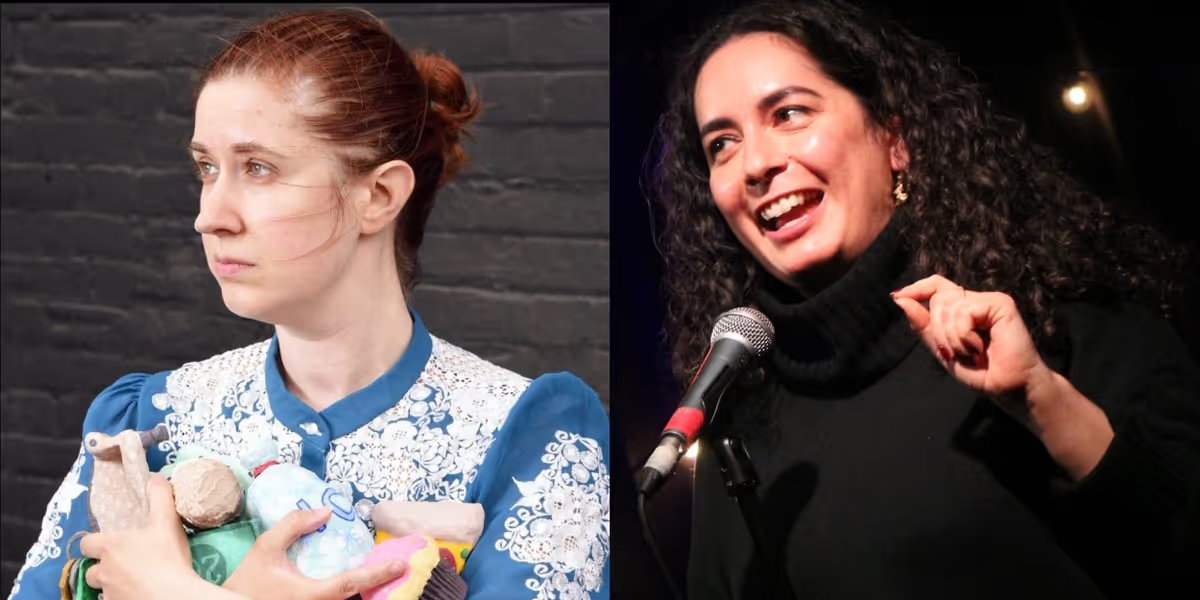
When Laura Anne Harris and Ronit Rubinstein met in a playwriting group a decade ago, they had no idea they’d both be premiering shows about grief in the 2025 Toronto Fringe Festival–in fact, they didn’t know it until both pieces were well into development. Both Fringe veterans, Harris (Pitch Blond; Destiny, USA) and Rubinstein (Sitting in a Tree) discovered a collection of papers kept by a loved one who had died, inspiring them to contemplate the connections we make with others and how memory is preserved in the things we leave behind.
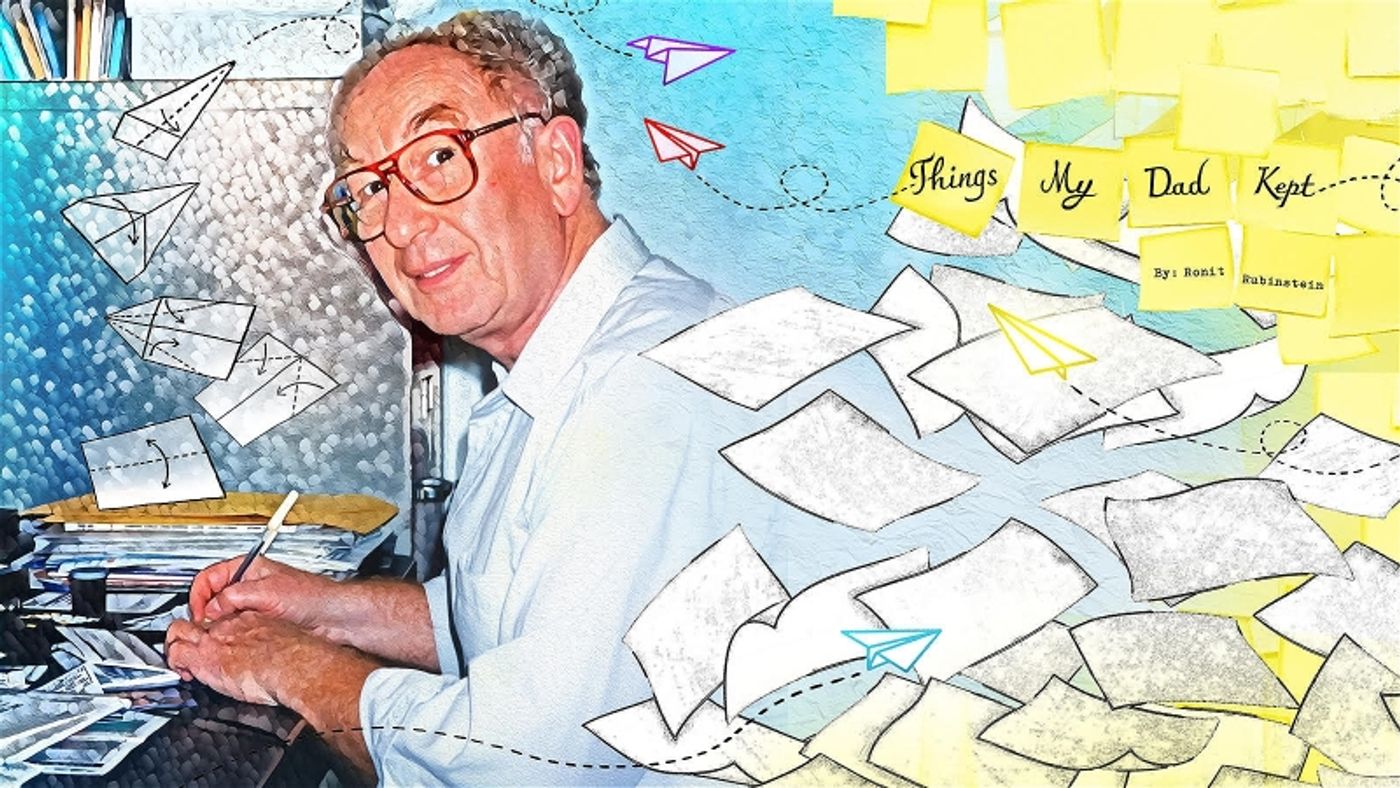
Rubinstein’s THINGS MY DAD KEPT, developed in part within Nightwood Theatre’s Creatryx 3.0 Unit, was inspired by her discovery of the meticulous archive her father kept of her life, 12 years after his passing. Weaving together the story of her father and his family’s escape from the Holocaust with examples of his meticulous record-keeping (in triplicate) and sometimes unintentionally hilarious advice, she examines the unconventional ways we can show our love.
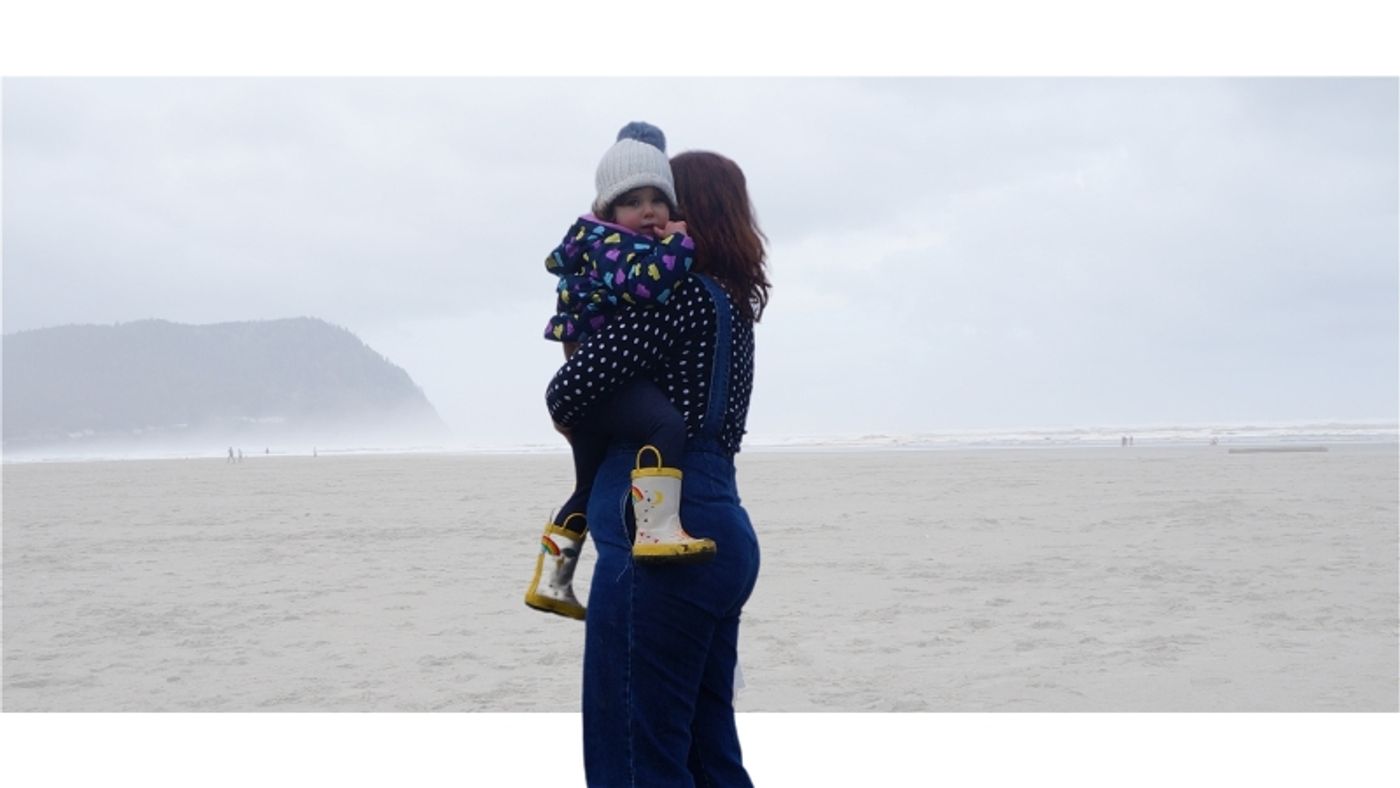
Harris’ HAVE FUN KIDS is about “the quiet, often complicated work of remembrance.” Following the suicide of her friend Jordan Mechano, Harris was given the opportunity to read over 700 pages of writing that the reserved theatre artist had never shared. She intertwines his urgent writing with stories about their friendship and her own experiences with life-shaping loss.
(HAVE FUN KIDS is part of the Next Stage Festival, a curated group of works “ready for their next stage” which has historically occurred in January or October, but this year runs concurrently with the Fringe Festival to benefit from Fringe audiences.)
BroadwayWorld talked to Harris and Rubinstein about why they created shows where the audience determines the order, how we make emotional connections to objects, and what constitutes “good grief.”
BWW: What inspired you to create your show?
HARRIS: The impetus for me was after Jordan died. We discovered a lot of his writing. Jordan in passing would say, “I'm a writer,” and I did ask him at times, can I read some of your work, but he was very private about it. He was always kind of amazed that I would show my new piece to my husband. I remember when I told him I showed him Destiny, USA, he was like, you showed him that? I was like, “Yeah. He gave me notes.”
And he thought that was surprising, that you would do that. So, when we discovered the volume of his work, I was like, oh, he really was a writer. I just didn't know. And in some ways, it's my own fault. I could have sought it out. It was online. But it was surprising, the volume of writing that he left.
That was a jumping-off point, as well as reading his very, very last piece that he was working on with Christopher Lewis and Jessie Fraser. I knew that I wanted to bring that particular piece to life and incorporate a couple other pieces from the larger volume of work, the collection that his sister made after his memorial. He would always say that he wanted his work to be seen, so it did no use sitting in a drawer. Knowing my work, I just like to weave other stories throughout it and add a little bit more texture to the piece.
RUBINSTEIN: So, last year, my mom decided to sell the family house. And I was helping her empty it, and I finally had to go through my dad's file cabinet, which I had been avoiding for 12 years. Because there was a drawer labeled with my name, and I didn't know what was in it, and I was scared to find out.
But then when I finally started going through it, I discovered that my dad had basically created an archive of every moment of my life, significant or insignificant. Things that I would expect him to have, like report cards, but then also things I would never expect him to have seen, like secret admirer notes I wrote to my crush. And in going through it all, I felt like there was a show there.
BWW: So both of your shows start with the discovery of a trove of documents, and how those changed your relationship with the person who was holding them. Laura, what is it about Jordan’s work that made you want to insist that people hear it?
HARRIS: Especially with his last piece, it's just really timely. It's talking about apocalypse, the end of the world. Ways that we can build community with each other during these moments of collapse. And it feels very of now. There's a couple lines in there, especially one about wanting to set fire to the house instead of organizing the clutter and sweeping the floors. That's a touchstone statement for me. It really feels like the Trump administration right now and the world that we're living in. It's a lot of chaos. And so a lot of his insights, even though he wrote this probably 2018-2019, they feel very relevant to today. So, that's one reason.
The other thing is, he was…a little smarty-pants banana, like, he just was a really smart dude. And obviously, I knew that. But, when you read somebody's work and discover it’s actually very deep, with a clear voice, as a writer, that was a really beautiful revelation for me. Jordan downplayed his intelligence quite a bit when I was with him. And I think it was a way that he wanted to relate to people. He wanted to relate to the person where they were at today. But in some ways, I actually wish he had a little bit more of an ego about how smarty-pants banana he was.
BWW: When you shared that line about burning down the house instead of organizing the clutter, it fits with what both of your shows are doing. Both of you are trying to organize the clutter or detritus of life into a picture of who a person was, or Ronit, in your case, what a relationship is. In those documents, Laura, you found out who Jordan was and what he thought about, and Ronit, you found a picture of yourself, as filtered through your father's experience of you. And so, it became a picture of your relationship with him, because you got to see how he saw you.
RUBINSTEIN: Yeah. And what he chose to keep. It's interesting because, in writing a show about my dad, I'm choosing which stories to tell, I'm choosing which impression of him to make on an audience. Because he lived a long and full life; there's a whole alternate show I could have written with totally swapped-out stories.
But at the same time, going through the documents he kept, that was sort of the same thing. It was the version of me that he edited through the stuff that he kept. A lot of the stuff in there, I had forgotten about. There was stuff in there I'd never written in my diaries, and events I forgot about. It was obviously a discovery about him, because my whole life, I had no idea he was secretly doing this. And it was right in my house the whole time. It wasn't like he hid it, you know, I just could have opened that door whenever I felt like it. So right under my nose, he was creating this archive. But it was also a rediscovery of my own childhood.
BWW: You've mentioned this idea of choosing what to tell and what not to tell, and the fact that we could have a completely different show, or a completely different story, if we chose to focus on something else. Both of your shows have elements of chance with audience participation, where the audience determines how the stories are told. Ronit, your show changes the order of its stories, and Laura, the audience chooses which stories we hear and which stories we don’t, and so there will be stories we don’t hear unless we come back—and it’s possible you might do your entire run, and a certain story might never get picked. What led both of you to embrace that element of chance and shake up your shows’ structure?
RUBINSTEIN: My just philosophy of live performance is that you have to give an audience something they could only get at a live performance. Otherwise, everyone could just stay home and stream or listen to a podcast, or watch a movie, right? If they're going to shell out the money and trek across town to go to a live performance, we have to give them something different. And so, for me, making a game with the audience is part of that.
It's really important to me with this show to say I'm telling my specific story of grief that's about my dad, my family, my stories, but it's also everyone's story. Everybody has someone that they loved who is no longer with us. If they're young, and maybe that hasn't happened yet, it will at some point, right?
And so I want the idea of the participation to be a way to say I'm telling the stories that I think contextualize my relationship with my dad, but I hope you leave here and you think about your relationships with the people that you love, and what you will remember 12, 13 years later. Laura talks about this a lot, too, that memories don't come to us chronologically. So it doesn't really make sense to dramatize them as if they do.
HARRIS: For me, it's this non-linear journey of grief, but also, for practical reasons, holistically, we created this show in the way that I think Jordan would have created a show. He never repeated himself. He would do a live art piece, and then he would move on and do something else. Which was frustrating to me, because I felt like you could work on something, and you could try to make it better, but he would just move on.
So, in a very small way, I'm trying to honor his vision of trying to do something new every time. By having a different order of the four pieces that are randomly chosen, it slightly mixes up the experience for the audience, and what they take away thematically.
BWW: There are so many potential different options for which four stories are told in which order. Is there ever a process of discovery for you as well, when you run it in a different order?
HARRIS: Yeah, definitely. There are things that come up, like I have two stories in which I talk about my family and Catholicism, and if I hit both of those stories in the same running time, it suddenly kind of adds this little element of Catholic guilt or spirituality, or questioning of what happens after, and it's just interesting what can come up. I really like that. I like that you can create this new puzzle every time, and there's certain threads that now have new meaning to me. It’s interesting how it can enhance the overall theme of the piece or create these little tiny themes that can run through it. So, it's really fun. It's a huge challenge.
I always try to do something different every time I do a show. I'm not really that interested in repeating the same way I approach work, if that makes sense. I want to try to challenge myself in a new way every time. And that's a huge risk, but I'm so grateful for the Fringe to allow me the opportunity to experiment in this way. I think it's such a great place to be able to experiment beautifully.
RUBINSTEIN: Can I comment on what Laura just said? As someone who has heard most, if not all, of the stories she tells. I hope someday some theater company produces a 90-minute version of her show. So that every audience gets to hear every story, because some of the ones that the audience is going to miss out on are so beautiful and so illuminating.
BWW: Speaking of challenges, Ronit, I know that this is a new challenge for you as well. You’ve had a play in the Fringe before, and in terms of storytelling work, you’ve participated in many storytelling events in the past decade with 10 or 15-minute stories. What are the challenges and discoveries you’ve found in expanding the storytelling format to a full hour?
RUBINSTEIN: For the past decade, I've been standing at a microphone and staying still on tiny stages. And now, there's 60 minutes, and I move around. I'm so used to thinking in the emotional arc of a 10-minute story. There are seven little pieces in the show. You can't really have seven peaks and valleys, or seven climaxes, right? Hitting the right rhythm and emotional trajectory for the audience, especially since the order changes, has been interesting, and is something that I think I'll probably only fully discover while I'm actually in the run of the show and can do it over and over again.
BWW: Both of your shows have the theme of grief tightly woven into them. How do you balance a discussion of very personal grief with providing both a safe and theatrical experience for audiences, so that it’s a performance rather than a raw processing of grief on stage?
HARRIS: That's a really great question. We've made the entire run relaxed, so people can come in and out of the show if they need to. The lights will be up a little bit, and it’s understood that there may be a little bit more sound in the theater, and that's okay. I set up the space in a way that I talk a lot about consent, and that people's consent can change at any point in time, so if they do need to leave the theater at any point in time for any reason, they can. That's part of my work. I work as a teaching associate, and I teach exam technique to medical professionals. I set up my sessions that way because anything can come up.
I don't know what people's life's experience is. I don't know what they're bringing into the room. And so, therefore, I want them to feel safe to have the autonomy to leave if they need to. And I do talk about the fact that I talk about painful stuff, and I don't hide that fact. There are content warnings. I have some techniques for after my show if I need to go somewhere and just, like, shake it off. There is actually a quiet space that's going to be set up at Soulpepper that can be used by patrons, it can be used by volunteers, it can be used by artists.
In the show, I incorporate a grounding strategy that's suggested by psychologists, and so it's actually a thematic touch point in the show as well.
RUBINSTEIN: I think for me, humor is huge. And that, of course, is because I'm Jewish, and that is how we handle sadness, by laughing through it. At the start of my show, I promise the audience, for every sad, there shall be a funny. And I try to deliver on that promise. I think it helps them, and it helps me. I think both Laura and I take a lighter touch with grief, even though there's some heavy stuff in both of our shows. There's more meaning for me in the sad stuff if you can have that release and that break of laughter. And also, it's more real to life. You know, my dad was a hilarious guy. And a lot of our relationship was him being so delightfully funny. I think the grief is there, but it's not a dour, sad time. It's a fun show about grief; come see it.
HARRIS: Even in doing a run-through yesterday for a friend of mine, she really appreciated my more random pieces, because it took you away from sort of some of the more tense moments in the show. And she said, that's a really great psychology technique, to allow yourself a bit of a break, and change the tone.
BWW: I think a lot of people are afraid of sitting with grief for too long. Or even at all. I appreciate that both of your shows incorporate humor in order for us to process the grief, and for us to in some ways better appreciate the grief, because in humor, we see where the loss happens. But they're also not pieces that say, “We're going to look at grief ironically,” or “we’re going to try to distract you from the grief.” I wouldn't describe either piece as being incredibly heavy, but I think that they're both very honest about grief and spending time there, as well as letting people feel the lightness.
I know that it's hard to sell a show about grief. Have you faced challenges in telling people to come see a show that sits in sadness for a little while?
RUBINSTEIN: Well, in a way, we're lucky, because there's so many shows about grief this summer, so it's almost like audiences are forced to. They're going to the Fringe, they're going to hit one of them eventually.
HARRIS: There's 10 shows! There's 10 shows about grief. 10.
RUBINSTEIN: Which we have been calling Griefapalooza 2025.
BWW: We're living in a time of grief. We’re bombarded with so many things every day that are happening in the world, politically, as a distracting technique. I think one of the things that distresses people so much is that they don't have time to process the grief of each thing that's happening. So, yes, it might be Griefapalooza, but do you think it's going to be really cathartic for audiences who have probably spent the past few months, if not years, asking, “What the heck is going on?” To just have a moment to think about their own grief?
RUBINSTEIN: I mean, in some ways, my show is about putting off my own grief for 12 years, right? Until I couldn't anymore, until it smacked me in the face.
BWW: Well, it's really hard. You can’t schedule grief into your Google Calendar, like…4 to 5p.m., grief, 6 to 7, dinner, 7p.m., Wheel of Fortune.
RUBINSTEIN: It's not a bad agenda.
BWW: Your shows use physical items as a kind of trigger for memory. Laura, you have these wonderful sculptures, and Ronit, you've got paper airplanes and a filing cabinet filled with files. How do each of you use those objects to trigger memories and stories, and how do they tie into the feelings about the people who either use them or are connected to them?
HARRIS: Our objects are a big part of our show. We lay them out on a cookie sheet, and we bring them out into the lobby, and we get the audience to choose an object. And from there, they sign a waiver, and we record their voice, introducing the piece in our show. Then, when the objects are revealed, they will be projected on the screen. The objects are really beautiful. They were designed by Merle Harley, and [director] Jessie Fraser brought Merle on because she wanted some handcrafted objects and a tactile and digital version of those objects, so that they would mirror, some interests of Jordan, such as technology. Jordan loved little objects. We were at the art museum in Chicago. And he was like, oh, I love little things.
And I remember there was a show at Harbourfront as well, in which a photographer set up these little tiny flipbooks. And he had a projection on the screen, and so when he flipped through the book, it was like these little silent movies. It was a beautiful piece, and I remember Jordan being so enamored with that as well. These little objects that turn into something bigger play within our show.
RUBINSTEIN: For me, the inclusion of physical files was really important, because a lot of what I think about in the show is the fact that my dad kept all this stuff in paper form. And how it's more convenient and probably better for the environment that now most of us don't do that, but what's lost when we don't do that? When you lose someone and all their files are digital, do you even go through them? And so it felt very important to incorporate a physical file cabinet with physical files.
The paper airplanes, it was really important for me to incorporate those, because I want the audience to have a direct hand in shaping the show, like they do in Laura's. Also, it's just fun. It's just good fun to be a kid and make a paper airplane, and chuck it at the stage. It's important for me to think about having something tactile to connect me to the actual experience of going through my dad's stuff.
BWW: Is there one more thing each one of you would like to say to potential audiences?
HARRIS: I would just say to audiences that they should go see Ronit Rubinstein's show, THINGS MY DAD KEPT. There's so many beautiful shows at the Fringe this year, but I want to just say that I'm really proud of Ronit. As somebody who does solo work, it’s a tough thing to do. It's not easy, and I just commend anybody who does it, and I'm so proud of Ronit.
And I'm excited! To give people a lot of hugs. I hope people hug me. I need the hugs, actually. How could I not? So, if people want to hug me, I'm, like, really into it. If they don't want to hug me, they don't have to. People have been so kind already. We posted that I needed a sandwich board, and somebody just made us one. For free! So nice! People are so kind.
At the Toronto Fringe, go see a show that you've not heard anything about at all. There's so many shows that I'm, like, I don't know who this artist is, I'm going to go. Because why not? Like, I'm never going to see a puppet show on the stages of Mirvish, you know what I mean?
That's the part of Fringe that I love.
Open your hearts to grief, because it's nourishing.
RUBINSTEIN: I want to second being proud of my friend. In some ways, grieving a father is an expected loss. You kind of know it's coming. I think suicide is a real tough one to tackle, and I think Laura just does such a beautiful, beautiful job of telling us about her friendship with Jordan, telling us about what a special person Jordan was, and then also showing us how special she is.
And I think it's really beautiful that two friends who met through playwriting both independently came up with shows about grief that are funny, that involve audience participation, that are about objects, and didn't really know the other was doing all that. And that they're both being presented in the same festival, you know, just down the hall from each other. So I think that's really lovely, and I hope audiences will check them both out, and there's so many shows that sound cool and fun and different and weird that I look forward to seeing, but I especially look forward to seeing HAVE FUN KIDS.
HARRIS: I will say we are doing an unofficial double bill, because pretty much, like, every single show, with the exception of one, is kind of one in front of the other, so it's great. So come cry.
The Toronto Fringe Festival runs from July 2-13.
For tickets to THINGS MY DAD KEPT, click here.
For tickets to HAVE FUN KIDS, click here.
Photo of Ronit Rubinstein by Matthew McLaren. Photo of Mordechai Rubinstein by Dan Rubinstein. Photo of Laura Anne Harris by Christopher Lewis.

|
BODIES OF MATTER Terminal Theatre (3/05-3/06) |
|
The Hobbit Stratford Festival (4/21-10/23) PHOTOS |
|
A Midsummer Night's Dream Stratford Festival (5/01-9/26) PHOTOS |

|
BE MORE CHILL Terminal Theatre (2/02-2/20) |

|
Toronto International Tap Dance Festival Terminal Theatre (8/21-8/23) |

|
Bee Gees Celebration Théâtre Capitole (12/16-1/02) |

|
HYPROV: Improv Under Hypnosis Starring Colin Mochrie & Asad Mecci – Niagara Falls FALLSVIEW CASINO (8/23-8/23) |

|
UNIONVILLE CANADA DAY CELEBRATION Unionville Millennium Square (7/01-7/01) |

|
Menopause The Musical Thunder Bay Community Auditorium (10/09-10/09) |
|
Death of a Salesman Stratford Festival (5/05-10/24) PHOTOS |