


Review: MY FAIR LADY at Union Avenue Opera
Union Avenue Opera runs through July 12.
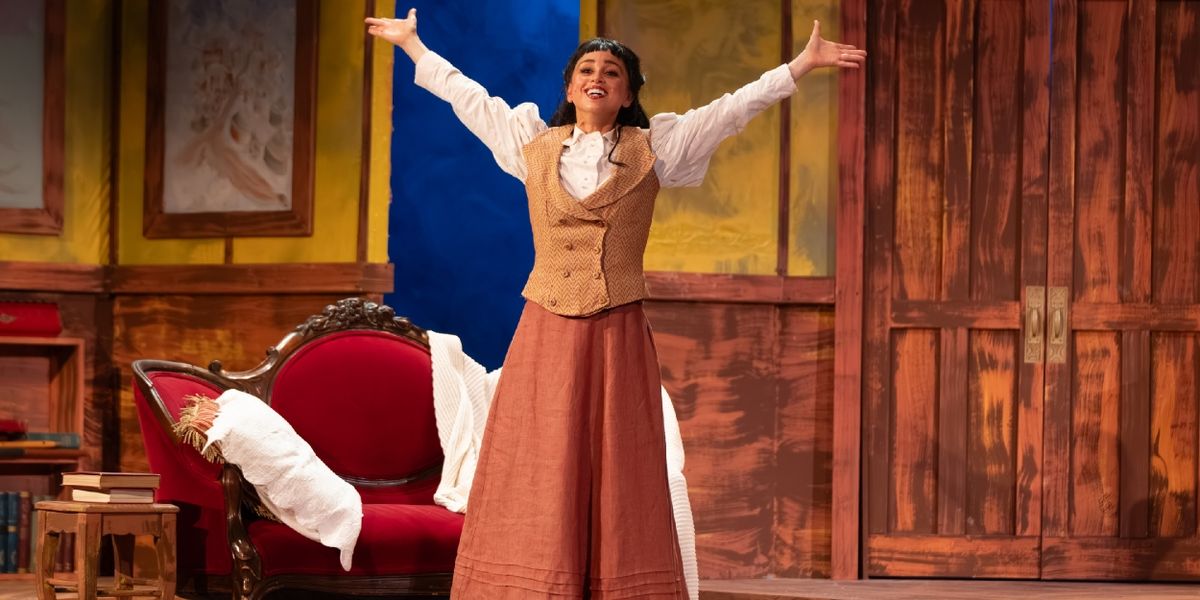
“The little company that could!” For thirty years or so that sobriquet has been perfect for the wonderful Union Avenue Opera Company. As they enter their 31st season they’ve left a quite glorious trail of shows spanning the long history of opera: from Purcell through Mozart, Rossini, Donizetti, Bellini, Wagner, Verdi, Puccini, etc., etc. They’ve also offered quite modern works (Doubt, Susannah, Streetcar Named Desire). They’ve trod that “iffy” territory of “is-it-an-opera-or-is-it-a-musical?” where live such folks as Gershwin, Bernstein and Sondheim. And occasionally they have fled the confines of opera altogether and presented flat-out Broadway musicals—Carousel, Into the Woods, Ragtime.
Saturday they opened My Fair Lady.
This beloved musical has everything going for it: absolutely captivating melodies by Frederick Lowe, lovely clever lyrics by Alan Lerner, and plenty still of the incomparable wit of that old master George Bernard Shaw, from whose play, Pygmalion, the musical is adapted.
We all know the story. After all, there have been four Broadway revivals since its debut in 1956. The block-buster movie appeared in 1964, and there have been countless productions and tours all around the world ever since.
Once more Artistic Director Scott Schoonover has assembled some very fine voices.
The lovely Brooklyn Snow (who sang that unforgettable Cunegonde in Candide) again blesses the Union Avenue stage—this time as Eliza Doolittle, the Cockney flower girl. Her voice is sublime as ever, but Eliza is for much of the show engaged in clever rapid lyrics. So there are, alas, only a few occasions when Ms. Snow has opportunity to show us the glory of her pure soprano voice. But she is spot on in Eliza’s very real grit and spirit.
Eliza’s domineering mentor, Prof. Higgins, is sung by Trevor Martin, who, unlike Rex Harrison, can actually sing! And he’s a handsome and personable actor. Martin captures Higgins’—well, not “arrogance”—merely his objectively very high opinion of himself—and his utter dismissal of all that clap-trap people call “manners”.
Steve Isom, long a favorite on St. Louis stages, takes the role of Col. Pickering—and he’s wonderfully comfortable in it. His Pickering is deeply decent and caring—in fact, a gentleman. It’s a fine performance.
Alfred P. Doolittle, Eliza’s irrepressible, irresponsible, irredeemable father is ably sung by Paul Houghtaling, but he lacks much of the buoyant reckless, joyous spirit this role needs.
Donna Weinsting, another local favorite, plays Henry Higgins’ mother, who insists that his intellectual brilliance is no excuse for his incorrigible rudeness. She brings her usual comic confidence to the role.
Freddy Eynsford-Hill is sung by Charles Calotta. And sing he does! Now Freddy is a feckless but charming young man, genteel but with neither brains nor money. He is instantly smitten with Eliza and spends much of the show simply mooning over her. He has one beautiful song (reprised)—“On the Street Where You Live”. When, about an hour into the show, Mr. Calotta first started to sing this song I thought, “My god! Perhaps this is an opera after all!” His is a powerful and beautiful voice. And he’s strikingly handsome, to boot. (Maybe this Freddy is not such a bad match for Eliza.) I would love to see Mr. Calotta in a leading role, but Shaw’s Freddy is no-way a leading man; he is a following man. Eliza is tired of long letters and poems from Freddy. “Words, words, words! I’m so sick of wors!” she shouts. “If you’re in love show me!” At that point Shaw’s Freddy wouldn’t know quite what to do. Mr. Calotta’s forceful Freddy would surely just show her.
Jennifer Theby-Quinn plays Higgins’ housekeeper, Mrs. Pearce with crisp precision, and flawless diction. Even in the acoustical vagaries of this venue we could hear every word.
Musically the show is a delight. The orchestra, under Maestro Schoonover, is as fine as I’ve heard at Union Avenue. Such subtleties! For example, as Eliza sings “I Could Have Danced All Night” I was (as never before) aware of a soft racing heart-beat from the orchestra.
There is excellent chorus work. The harmonizing with Doolittle and his buddies is gorgeous, as are the songs of the chorus of servants in Prof. Higgins’ home.
But there are technical challenges in some big musicals that are simply beyond the reach of a small company such as this.
Now any play expands when it becomes a musical. Shaw’s Pygmalion has a cast of 12, My Fair Lady, on Broadway, had a cast of 40. Union Avenue pares it down to 25. Pygmalion has three sets; My Fair Lady has ten. Shaw’s play requires four scene-changes; the musical requires 18. The two largest, showiest scenes in the musical (the Ascot scene and the Embassy ball) don’t appear at all in Pygmalion. Those two scenes are to costumers what the Queen of the Night’s aria is to sopranos: the Mount Everest of their art. Happily, the Ascot scene frames the most memorable line in the whole show, when Eliza leaps up to shout vernacular encouragement to her favored horse. (This line is Alan Lerner’s, not Shaw’s, but it’s a great line, isn’t it?)
Big scenes are usually added into musicals for just one reason: Dance. In olden days Parisian theater-goers expected ballet in their plays and operas. (Molière had to add a ballet to The Imaginary Invalid to get it performed.) Nowadays when a play is adapted into a musical audiences have similar expectations: there’s gotta be DANCE! In My Fair Lady there is thus the ballroom scene—but also the Cockneys are jubilantly dancing in the streets. Choreographer Christine Knoblauch-O’Neal makes a noble effort but given the limited space and the fact that Union Avenue can afford no resident corps de ballet, the dance sequences are a little lacking.
Costumer Teresa Doggett does excellent work throughout—coster-mongers, flower girls, servants, the Ascot elite. Eliza’s ball gown is simply and elegantly beautiful.
Set designer Patrick J. Nelms has devised sets on platforms that are cleverly moved about to reveal interiors, exteriors, street scenes, etc. Stage Manager Emily Ann Fluchel and her crew do heroic work in manipulating these set pieces—swiftly and almost silently. But still the changes take a little while—delays that seriously degrade the swift pace that is essential to the flow of this comedy. One becomes aware of the almost three-hour running time.
In a larger venue an exterior scene might easily be acted against a scrim while the crew sets the subsequent scene behind it. But at Union Avenue, with no fly-space?
So there are logistical problems. But there’s also one glaring aesthetic problem: at the Embassy Ball the up-center door through which “grand entrances” are made is startlingly inappropriate. It looks almost crudely half-timbered. (???)
Lighting, by Patrick Huber, is everywhere appropriate.
Anna Maria Pileggi has done lovely work at Union Avenue. She stage-directed the very beautiful Candide (2019) and A Little Night Music (2022). But those were much smaller shows. As stage-director for My Fair Lady she was pressed between the demands of the show and the limitations of the venue—and she didn’t find the magic key.
With My Fair Lady “the little company that could” … couldn’t quite.
I excitedly await the next shows in Union Avenue Opera’s 31st festival season:
- July 25 – August 2
Josephine by Tom Cipullo—a monodrama about Josephine Baker
and
Pagliacci by Ruggero Leoncavallo - August 15 – 23
Salome by Richard Strauss

|
Guys And Dolls Kirkwood Pac (7/24-8/23) |
|
JOB New Jewish Theatre (NJT) (8/06-8/23) |
|
Mamma Mia! The Fabulous Fox Theatre (3/30-4/04) |
|
Gunhild Carling at City Winery St. Louis City Winery St. Louis (10/11-10/11) |

|
Gateway Dirt Nationals – 3 Day Pass The Dome at America's Center (12/03-12/05) |
|
Rocky Horror Picture Show Original Cast Spooktacular Tour with Barry Bostwick, Nell Campbell, and Patricia Quinn The Fabulous Fox Theatre (10/06-10/06) |

|
WSIE Music Series Event w/ Dawn Weber – August 22, 7-9pm Harold Square Outdoor Amphitheater (8/22-8/22) |
|
Wicked Fox Theatre (5/12-5/30) |
|
RUBBERBAND Touhill Performing Arts Center (2/27-2/27) |
|
The Book of Mormon (Non-Equity) Fox Theatre (2/02-2/07) |
Reader Reviews
To post a comment, you must register and login.