


Review: SALOME at Union Avenue Opera
Strauss' "Salome" plays at Union Avenue Opera through August 23
A scandalous fellow wrote a scandalous play which became a scandalous opera.
Come see it at Union Avenue Opera! It’s Salomé! And it’s a wonder!
Kelly Slawson brings a dazzlingly powerful, beautiful voice to the title role. It’s an unforgettable triumph in a real tour de force.
The opera is by Richard Strauss (a Bavarian, and no relation to those waltzing Austrian Johann Strausses). It premiered in Dresden in 1905, and from its birth it was plagued with bannings and censorship—and notoriety. Strauss wrote the score to a libretto based on a fine German translation of Oscar Wilde’s 1893 play (which Wilde wrote in French). Wilde’s play was itself inspired by a short story, “Hérodias”, by Flaubert (1877).
Wilde’s Salomé is strange and haunting and drenched in sensual imagery. It is Wilde at his most poetic, at his most sweetly, ripely corrupt. It is an incantation. It is almost chthulian in its subtly growing dread.
The tale is taken from brief accounts in the Gospels of Matthew and Mark. At a birthday feast for Herod Antipas he asks his step-daughter/niece to dance for him. He promises her anything she wants. She dances—and demands the head of the captive John-the-Baptist.
The story was a favorite among artists and writers of the nineteenth century, who had become infatuated with exotic “Orientalism”. Wilde, like Flaubert, heaps on the lavish, luxuriant, antique sensual detail. Herod is terrified at the thought of killing so holy a man. He begs Salomé to choose something else—from a vast list that makes the most lavish fairy-tale treasure-trove seem like the merest Cracker-Jack prizes.
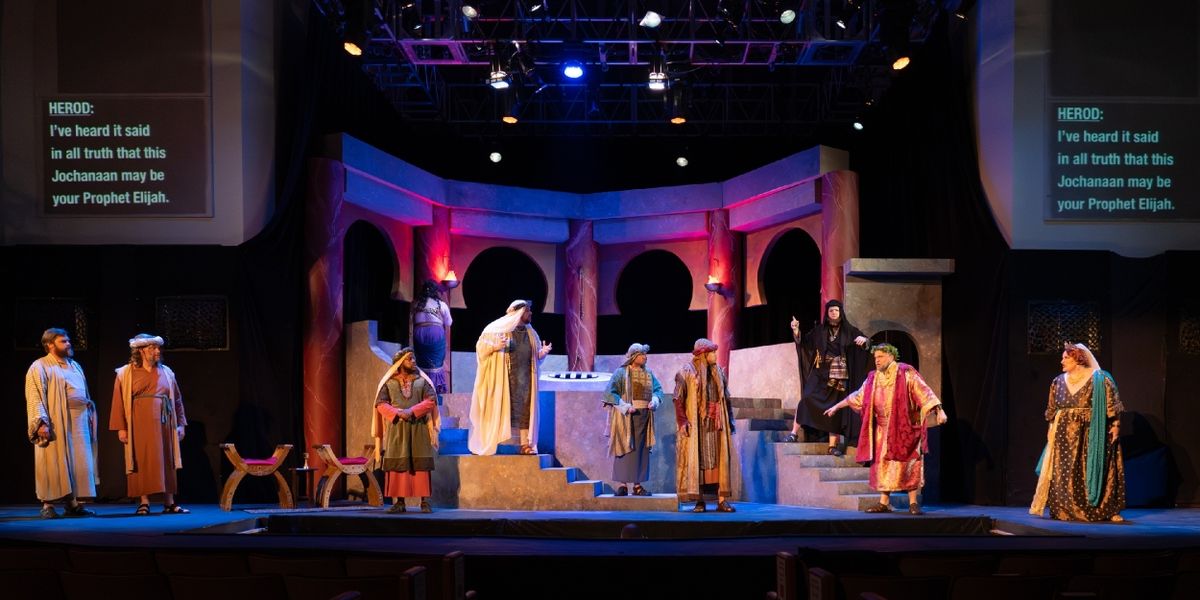
Patrick Huber’s beautiful set is quite perfect for this show. Great red-marble pillars support four slightly Moorish arches. The pillars—with gray-blue striations—are … not “red”… what color is that? It is exactly the color of an aorta! Two sets of gray marble steps curve up gracefully to a central platform. Up there, in the center, is the lid to the cistern in which Jochanaan is imprisoned.
It is a magical, omen-filled night. There is a curious scent of Hamlet in this story: fearful guards on the castle parapets, supernatural demands from out the blackness (Hamlet’s Ghost cries out for vengeance; Jochanaan, in the voice of God, demands punishment.) Even the family stresses are identical: a king is killed, his brother usurps both his throne and his wife, and the queen’s child writhes in torment.
Yes, there’s definitely something rotten in the state of Judea.
The singers in principal roles are all making their Union Avenue debuts.
Kelly Slawson is simply superb as Salomé! The range for this role is frightening. (What on earth was Strauss thinking?) But Ms. Slawson handles it with astonishing ease. And her voice is capable of great passion. It’s a remarkable performance.
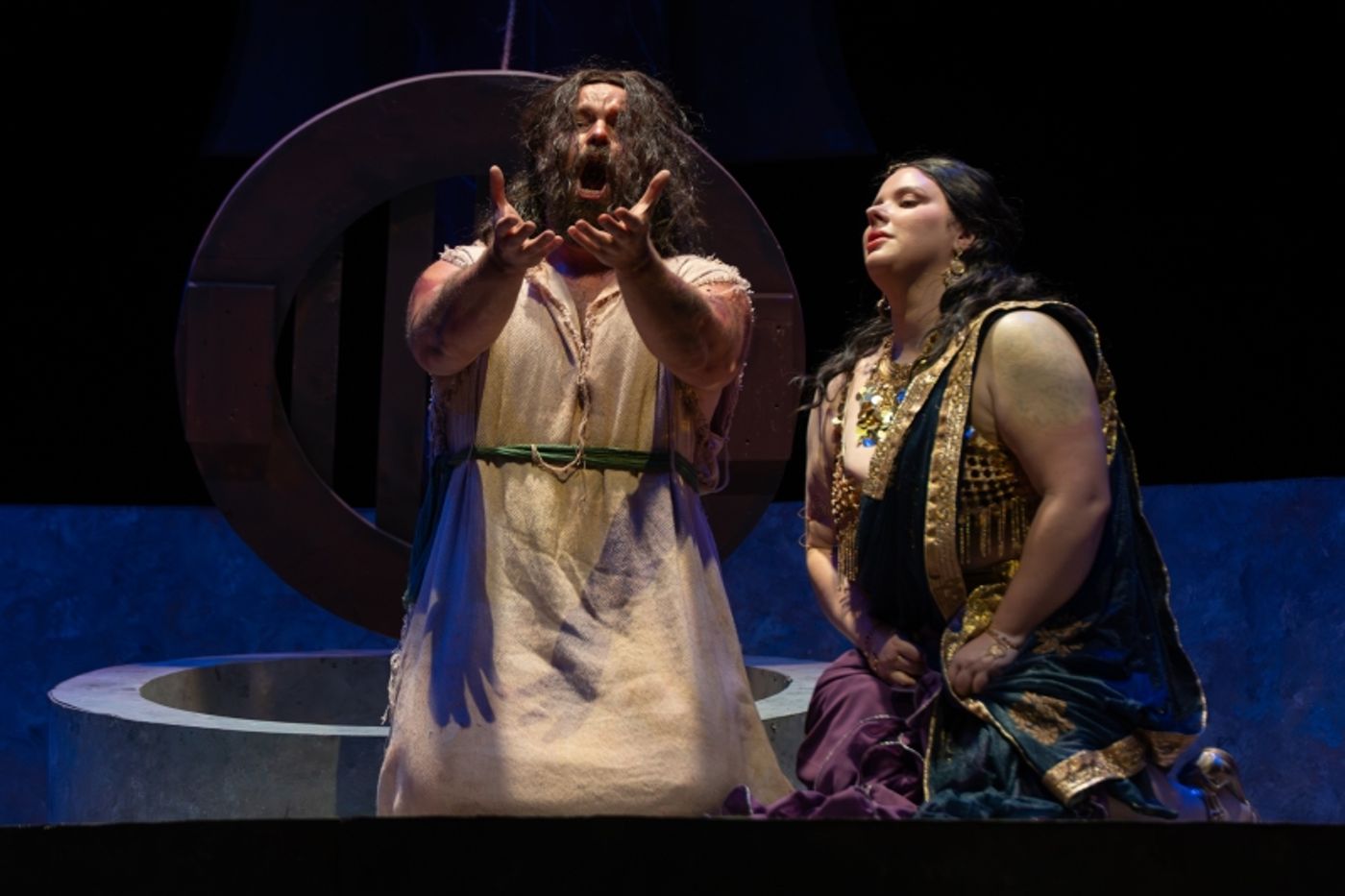
Daniel Scofield sings Jochanaan. His is a huge mountain of voice and might well be the voice of God. Even when singing off-stage he commands the scene. Marvelous work!
Herod is sung by tenor Will Upham, whose voice has just the right edge to cut through to the heart of a scene. He deftly balances Herod’s drunkenness and fear, and fills his final panic with enormous energy.
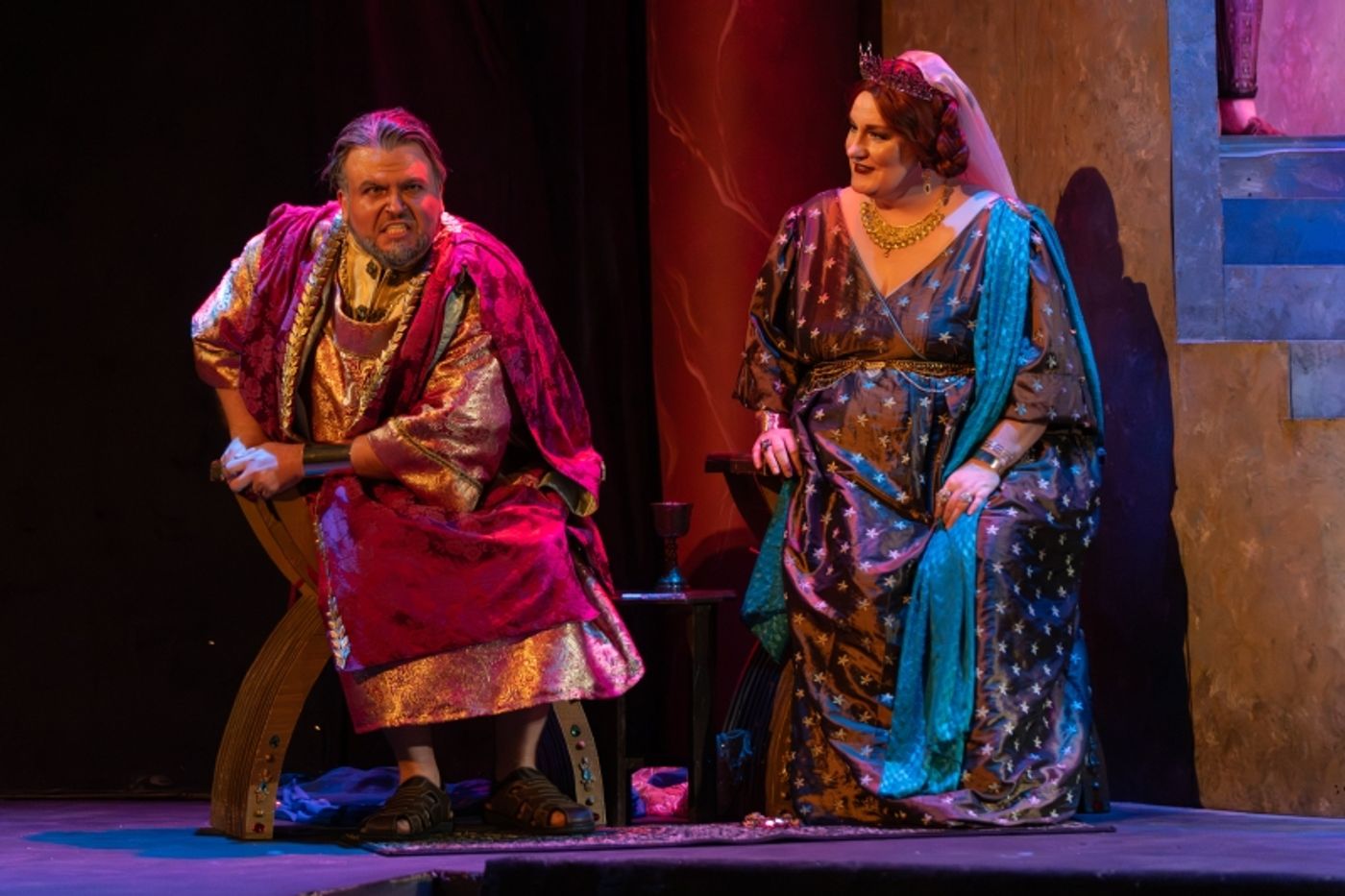
Joanna Ehlers sings Herodias. This is a lady who is not to be diverted from her goal. When others are seeing fantastic things in the moon she says, “The moon is the moon.”
Ms. Ehlers gives her a granite strength.
Very fine work is done by Brian Skoog as Narraboth, the handsome young Captain who is besotten with Salomé—and who kills himself at the thought of her lusting after Jochanaan.
The young page of Herodias is beautifully sung by Emily Geller. She emanates a convincing boyishness as she again and again urges Narraboth: “Do not look at her. I pray you not to look at her.”
There is bad luck in looking too much at Salomé!
The court is overflowing with excellent voices among the Romans, Cappadocians, and various Jews, Nazarenes, slaves and servants.
Costumer Teresa Dogget outdoes herself in garbing this throng—representatives of various religious and political worlds. Her Roman soldiers are the most authentic I ever saw on stage. When a Cappadocian appears he seems to stride right out of a Nativity set. The royals glitter in silks and gold. Jochanaan wears a rough peasant robe, his hair a wild black, tangled mane. He is ferocious!
This is an opera without intermission. It just could not have an intermission. It is one long, slow, rising climax. Things are repeated and repeated, mesmerically repeated. Wilde is casting a spell over us. We are distracted for a while by an almost comic scene where a handful of Jewish clergy and scholars bicker over ecclesiastical minutiae. But then the spell continues. The score has many leitmotifs that recur, but it is the relentless repetition of phrases in the Iibretto that enchants us, that hypnotizes us—and that seems so similar to the technique of Phillip Glass—endless but subtly changing reiteration that eventually—without seeming to—goes somewhere.
Salomé is an angsty teen-ager, rebelling against her mother. She’s disgusted by her step-father’s lusting after her. She’s a “Goth”. She’s an “emo-girl”. She’s sex-obsessed. Jochanaan has been screaming out the most horrible things about her mother, Herodias—calling her a whore and slut. So, of course, Salomé is driven to give herself to him. She is mono-maniacally focused on that goal. And when her seduction is brutally rejected she is quite happy to ask for his head.
How many times does Salomé say to Jochanaan, “I will kiss thy lips”? Nine times, by my count, over many pages. This is perhaps the most anticipated kiss in all theatrical history. When she finally kisses the lips of his severed head it is not only the achievement of this long-anticipated promise—it is a slap at her step-father: “I will kiss a dead man rather than you!”
THE DANCE: Oscar Wilde invented the phrase “the dance of the seven veils” (and that only in a stage direction). The Bible has no description of it, but Flaubert waxes in erotic detail for a full page. Scholars have suggested traces to the Sumerian goddess Inanna who goes to the Underworld to seek her lover. She must shed jewels and robes at each of seven gates—to at last stand naked in a state of Truth in “the Land of No Return”.
Well …
Anyway, this notorious dance has been the focus of generations of censors and blue-noses. It’s been an inspiration to swarms of strippers. Performers in Salomé (both play and opera) have taken a spectrum of stances from “I’m a respectable woman” to “a G-string is tacky—I’ll go nude!” No one will be arrested for the dance at Union Avenue Opera. It is all quite decent. Exciting—but decent. Salomé is joined in the dance by two graceful and light-footed servants. Credit goes to choreographer Maggie Nold.
Mark Freiman is Stage Director. He’s a veteran and knows his stuff. He manages the cast on the various levels beautifully. But scenes between Salomé and Jochanaan sometimes lack that necessary laser-like focus.
Now, in the Bible Salomé chooses her prize on her mother’s direction. In Flaubert Salomé has never even met Jochanaan. Her mother has kept Salomé a secret for months, training her in the arts of “dance and pleasure” so that Herod will fall in love with her, thus securing Herodias’ place in the court. Again Herodias directs her daughter’s choice of prize.
But Oscar Wilde makes of this old tale a totally different work of art. He gives Salomé agency; he makes her the protagonist. It becomes a tale of erotic obsession. She chooses the prize—and she declares her choice, relentlessly, six times. Salomé should not be able to take her eyes away from Jochanaan. Especially when she finally has his head. For her to walk away from it is to destroy the spell. I understand that we want a singer to sing to the audience; we want a varied “stage picture”—but this must not come at the expense of Salomé’s overpowering obsession.
Lighting is by Zack Metalsky. He gives us grandly dramatic hues, quite appropriate for this mood-piece. Too often, though, the singers were singing in soft shadow. We all listen with our eyes, too. So a little more light would have helped us. At the apex of the set—around the cistern—singers found a lovely brighter pool, which was perfect. That particular location—perhaps one of the foci of the arch—also seemed to be acoustically sweet.
Strauss’ score is quite modern. Many Victorian ears found it troubling, but we moderns receive it as rich and exciting. There are dissonances, yes, but they support the disturbing moments in this strange and gorgeous piece. Scott Schoonover conducts a large and fine orchestra, extracting every nuance of the thrilling score.
Richard Strauss’ Salomé continues at the Union Avenue Opera through August 23.
(Photos by Dan Donovan)
Reader Reviews
To post a comment, you must register and login.