


Review: LATER LIFE at Theatre Artists Studio
The production runs through November 9th at Theatre Artists Studio in Scottsdale, AZ.
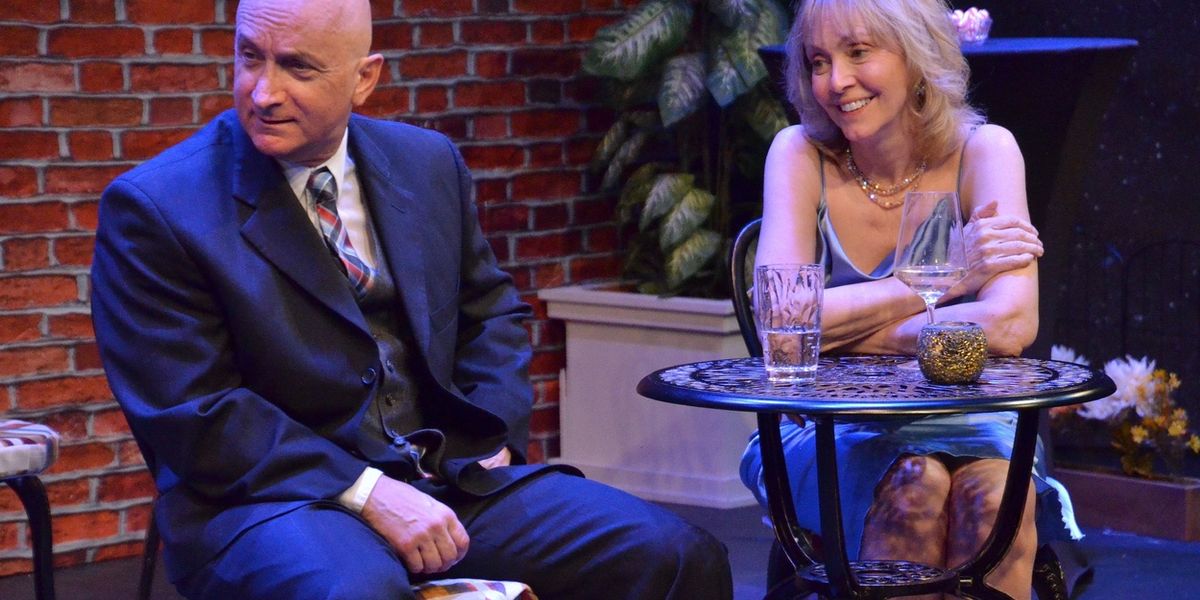
A. R. Gurney’s LATER LIFE unfolds on a Boston terrace overlooking the harbor, a space suspended between the warmth of a party and the chill of the night air. It’s the perfect metaphor for the world Gurney’s works chronicle: gracious, tasteful, and ever so slightly paralyzed. Here, two former lovers meet again after decades apart, tentatively bridging the gap between memory and reality. But Gurney’s real subject isn’t rekindled romance; it’s the architecture of regret – the ways we construct our lives to feel safe, only to find ourselves trapped inside the walls we’ve built.
Mark Baris’s set design establishes that duality of openness and confinement. His terrace is both elegant and slightly austere. It’s a fitting stage for Austin (David Sussman) and Ruth (Vicki Ronan), who occupy a kind of emotional terrace themselves: suspended between what was and what might have been, high above the messy, risk-laden streets of the world below. Every exchange between them – courteous, careful, and circumscribed, yet sometimes teasing and suggestive – hints at the tension between Austin’s need for safety and Ruth’s impulse toward connection. Both are testing how far safety will stretch before it snaps.
Director Shana Rebilas Bousard understands that Gurney’s play unveils a world of understatement where silences carry more force than dialogue. Her pacing is patient and precise, letting pauses breathe and allowing meaning to accumulate in the space between words. It’s a demanding approach for both actors and audience, but it honors Gurney’s intent: to show how much of life slips away not through action but through avoidance.
As the lights rise, we hear Don’t Make Love to Me, an original song by Joe Bousard, which perfectly captures the play’s romantic ambivalence. The melody suggests yearning, but the title warns against fulfillment. It’s a lovely preface to a story about desire held perpetually in check. From there, Gurney’s world opens through conversation rather than confrontation, and through carefully shaded performances that mirror the emotional restraint of his characters.
David Sussman’s Austin is a man of gentility and quiet panic, someone who has spent a lifetime perfecting composure while ever fearful of some impending tragedy. He’s a variation of John Marcher, the protagonist in Henry James’s short story The Beast in the Jungle, in which a man’s lifelong fear of catastrophe blinds him to the simple act of living. Marcher believes some awful fate is “lying in wait, like a beast in the jungle.” In LATER LIFE, that “beast” takes the form of Austin’s emotional caution: his fear of risk, of stepping beyond the safety of manners and self-control. Sussman captures the nervous stillness in the role, the way politeness can become both armor and prison.
Opposite him, Vicki Ronan’s Ruth offers warmth tinged with rueful humor. Her performance suggests that she has fought to escape the limitations Austin has accepted, yet she, too, circles back to the safety of memory. Their scenes together are subdued, almost whispered, moments of intimacy filtered through decades of caution. Under lesser direction, this restraint might flatten; here, it deepens. The quietness of their interaction becomes a kind of elegy.
Breaking through that quiet, the play’s “other people” – two actors playing a carousel of supporting characters – bring refreshing bursts of comedy and energy that keep the production buoyant. Tom Koelbel is a pure delight: his opening soliloquy on the packaging and aroma of cigarettes, delivered to a politely baffled Austin, is a miniature masterclass in neurotic self-disclosure…and just the first in a series of well-played caricatures. Debra Rich, meanwhile, revels in the play’s comic interludes, embodying a succession of women with dazzling wigs and wardrobe. Each persona is an exaggerated reflection of the social world Ruth and Austin inhabit but no longer quite fit in. Together, Koelbel and Rich serve as the play’s pulse, injecting moments of vitality into a narrative otherwise governed by emotional reserve.
This interplay between the static and the spirited, between emotional paralysis and the flicker of life just beyond reach, lies at the heart of LATER LIFE. Gurney’s structure, like Baris’s terrace, is architectural: each polite exchange a beam, each silence a wall. Yet within this carefully built house of manners, you can feel the ache of the unspoken. What emerges is not merely a story of missed romance but a quiet tragedy of a couple that equates safety with salvation.
If there is irony in Gurney’s world, it is a distinctly American one. The tragedy is not in losing love but in being too civilized to claim it. His characters have been raised on restraint, comfort, and the avoidance of risk, traits that recur, for example, in The Dining Room and The Cocktail Hour. In that sense, LATER LIFE becomes more than a drawing-room comedy; it’s a cultural elegy. Austin’s terrace could just as easily overlook not only Boston Harbor but the fading landscape of an entire class: genteel, articulate, and exhausted.
By the play’s close, nothing explosive has happened, and that’s the point. Gurney offers no catharsis, no transformation, only recognition. The audience leaves as Austin does: reflective, uneasy, aware of how decorum can disguise despair. Bousard’s direction leans into that discomfort, allowing the final image to linger: one figure adrift in safety, realizing too late that the tragedy he feared (the “beast”) was his failure to pursue love.
In the end, LATER LIFE asks us to consider what our own terraces look like: the habits, fears, and comforts that keep us watching life from a polite remove. It’s a play of quiet precision and cumulative ache, and in this production’s best moments – from Koelbel’s manic cigarette lament to the fragile silences between Sussman and Ronan – we feel the full measure of Gurney’s compassion for those who mistake restraint for redemption.
LATER LIFE runs through November 9th at:
Theatre Artists Studio -- https://www.thestudiophx.org/ -- 12406 N. Paradise Village Parkway E., Scottsdale, AZ -- 602-765-0120
Photo credit to Kandyce Hughes – L to R: David Sussman, Vicki Ronan
|
The Seagull Flagstaff Shakespeare Festival (8/14-8/15) |

|
It's A Wonderful Life Don Bluth Front Row Theatre (11/19-12/23) |
|
The Velocity of Autumn by Eric Coble Live Theatre Workshop (8/07-8/30) |

|
A Tribute to Woodstock 1969: The Music of Janis Joplin, Joe Cocker, The Band, Jefferson Airplane and more Hale Centre Theatre (8/14-8/29) |
|
Geoffrey Asmus 191 Toole (9/27-9/27) |

|
SHE LOVES ME Don Bluth Front Row Theatre (9/17-10/31) |

|
Campbell, Rogers, and Denver: A Tribute Hale Centre Theatre (11/06-11/21) |
|
BASKERVILLE: A Sherlock Holmes Mystery Don Bluth Front Row Theatre (7/23-8/29) PHOTOS |
|
I'm Gonna Marry You Tobey Maguire The Scoundrel and Scamp Theatre (9/24-10/11) |

|
The Tempest Arizona Theatre Matters (10/05-12/31) |
Reader Reviews
To post a comment, you must register and login.