The History of the Mark Hellinger Theatre and the Attempts to Bring It Back
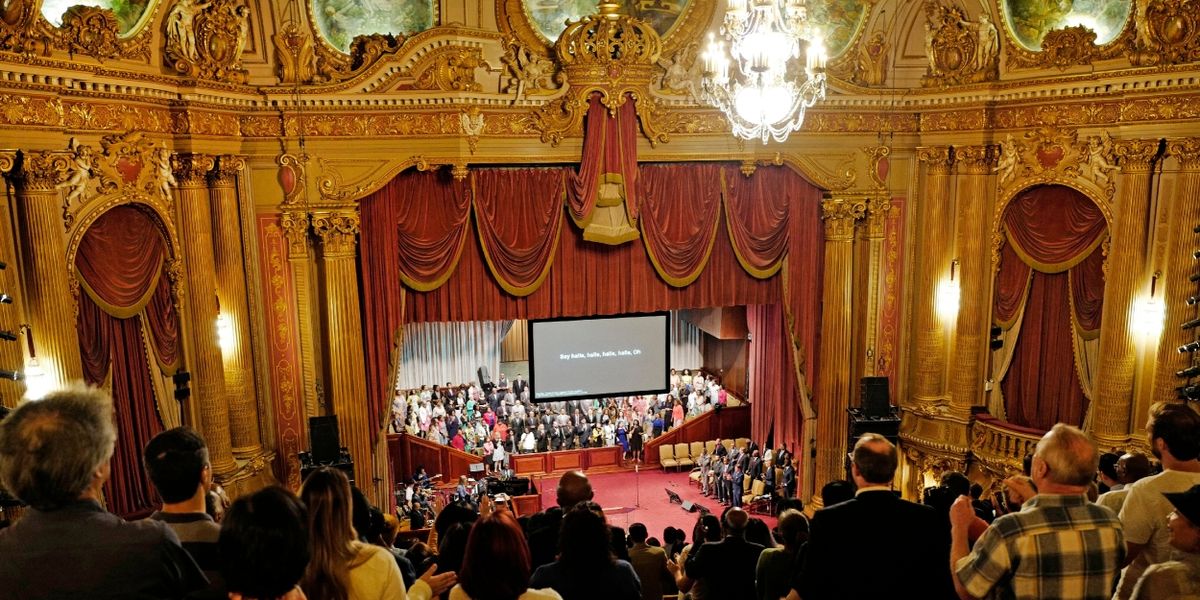
The Mark Hellinger Theatre is now the The Times Square Church.
Do you have a burning Broadway question? Dying to know more about an obscure Broadway fact? Broadway historian and self-proclaimed theatre nerd Jennifer Ashley Tepper is here to help with Broadway Deep Dive. BroadwayWorld is accepting questions from theatre fans like you. If you're lucky, your question might be selected as the topic of her next column!
Submit your Broadway question here!
This time, the reader question was: With recent talk that Andrew Lloyd Webber wants to restore the Mark Hellinger Theatre, what's the building's history?
The Times Square Church, located on 51st Street between Broadway and 8th Avenue, is an extremely storied New York City spot. While it may not be apparent to those who unknowingly pass by the church today, the venue across from the Gershwin’s stage door was once a glorious Broadway theater… and could potentially be one again someday.
The Times Square Church originally opened in 1930 as a movie palace called the Warner Bros. Hollywood Theatre. At the time, grand movie theaters were beginning to be erected in the Times Square area, to take advantage of audiences interested in viewing the ever-evolving art form. Movie theaters were built side by side with the many legitimate theaters in midtown. The Warner Bros. Hollywood Theatre showed films such as Hold Everything, which in 1930 opened the venue, and Moby Dick (1930) during its first few years of use. Warner Brothers built the theater to showcase their new “talkie pictures”. During this time, the venue’s entrance was on Broadway rather than on 51st Street. The theater’s owners experimented with presenting both movies and vaudeville for awhile. Solely screening films did not bring the Hollywood Theatre financial success, particularly during the beginning of the Great Depression.
In 1933, the theater owners obtained additional land on 51st Street so that dressing rooms could be added and the backstage area could be expanded. In doing this, they made the Hollywood a possibility for legit theatre bookings. In 1934, the Hellinger presented its first Broadway production: Calling All Stars, a revue that was masterminded by Lew Brown, best known as one third of the team of Henderson, Brown, and DeSylva.
During its first decade as a Broadway house, the now legit space, called at times the Hollywood Theatre, the Warner Theatre, and the 51st Street Theatre, boasted eight productions. After Calling All Stars was Sweet River (1936), a George Abbott-helmed adaptation of Harriet Beecher Stowe’s Uncle Tom’s Cabin with Juanita Hall of future South Pacific fame credited with arranging and directing the show’s choral work. That production was short lived as was the Hollywood’s next show, Knights of Song (1938), a bio-musical about Gilbert and Sullivan, featuring their own songs and staged by Oscar Hammerstein II. The 1939 edition of the revue George White’s Scandals transferred to the Hollywood for the final month of its run. Then came the Hollywood’s most notable show so far, the Eddie Cantor vehicle Banjo Eyes (1941), which featured future blockbuster novelist Jacqueline Susann in a minor role. Three special ballet engagements also played the theater in the early 1940s. During a brief return to film in the 1940s, Casablanca made its world premiere in the theater in 1942.
By this time, those attending shows, movies, vaudeville, or ballet at the theater were entering on 51st Street. The original narrow entrance on Broadway was closed off and eventually demolished. The entrance on 51st Street led to a glorious lobby with a domed ceiling, beautiful murals, and royal theatrical flair. The theater interior was designed in the Baroque style by Thomas W. Lamb. Much more ornate and expansive than the interior of the majority of our Broadway houses today, the theater has a classic elegance. The auditorium, with a current seating capacity of around 1,600 is also lavishly designed. Because the theater has landmark status for both its exterior and interior, the Times Square Church has not changed the original design, which is one thing that makes the house ripe for a Broadway comeback someday. One can attend a church service today and experience the theater in all its glory, looking similar to how it did during its Broadway heyday.
It wasn’t until 1948 that the theater began to hit its stride as a Broadway house. In this year, producer Anthony Brady Farrell bought the theater and renamed it the Mark Hellinger, after the famed journalist, writer, and producer who was well known on Broadway and in Hollywood from the 1920s through the 1940s. Hellinger’s column about Broadway was one of the first of its kind and was read by everyone in the business. In 1948, it wasn’t rare to have one individual control one Broadway house; in fact, many Broadway theaters were operated this way in the early 1900s, rather than being controlled by a theatre organization owning multiple houses. Farrell owned the theater from 1948 until 1957 when he sold it to Max and Stanley Stahl. The Stahl family ran the theater until they sold it to The Nederlander Organization in 1976.
During Farrell’s years running the Hellinger, the theater had its first actual hit with the now-forgotten 1949 musical Texas, Li’l Darlin’. Farrell also boasted a landmark Broadway mega- hit during his time owning the Hellinger. This was My Fair Lady. Alan Jay Lerner and Frederick Loewe’s landmark musical, originally starring Julie Andrews and Rex Harrison, opened at the Hellinger in 1956 and played to rapturous audiences there until 1962, when it spent its last few months on Broadway at the Broadhurst and Broadway Theatres. My Fair Lady even held the record for longest running musical in Broadway history for several years, before being ousted for the record by Hello, Dolly!
Future theatre greats including Terrence McNally and Charles Strouse told me in interviews about their time as fans on 51st Street while My Fair Lady was playing the Mark Hellinger. Strouse was courting his future wife, Barbara Siman, who was in the My Fair Lady ensemble, at the time. He was allowed by the stage door man to stand in the wings to watch the final scenes of My Fair Lady. At the time, he was about to get his big break as the composer of Bye Bye Birdie. McNally tried to see My Fair Lady on the night he moved to New York City when he was 17 years old in 1956. The box office treasurer informed him that the show was sold out for a year but that 30 standing room only tickets would be sold at 10am each day for $1. McNally lined up overnight with dozens of others who were hopeful for a ticket, and got to see the show the next day.
The Hellinger became an illustrious, well known destination because of My Fair Lady becoming a phenomenon. Shortly after it opened, Lerner and Loewe were captured by photographer Gordon Parks working throughout the Hellinger; the photos are a terrific time capsule of the Hellinger in the mid-century.
The 1950s prior to My Fair Lady also found the following shows making their mark at the Hellinger: Tickets, Please! (1950, Hal Prince’s first Broadway credit), the hit revue Two on the Aisle (1951, with score by Jule Styne, Betty Comden, and Adolph Green), Plain and Fancy (1955, both opened and closed at the Hellinger but played the Winter Garden in between). Jule Styne had three shows at the Hellinger over the years. In addition to Two on the Aisle in 1951, Hazel Flagg in 1953 and the Carol Burnett vehicle Fade Out-Fade In in 1964 both played the theater. Styne’s office was just upstairs at the Hellinger for many years. Many of his notable musicals as well as collaborations with stars like Ethel Merman, Mary Martin, and Barbra Streisand were developed at his office in the Hellinger, so it made sense for him to pop downstairs to compose a Broadway show as well! In fact, Styne occupied the office even past the time that the venue was a theater, after it became the Times Square Church.
Not yet a religious venue and still a theatrical one, the Hellinger in the 1960s following My Fair Lady’s reign was home to the following original productions: The Sound of Music, A Funny Thing Happened on the Way to the Forum, On a Clear Day You Can See Forever, and Dear World. A prime choice for large musicals due to its capacity as well as its grand appearance, the Hellinger was rarely without a tenant. It also hosted Michael Bennett’s debut as a Broadway choreography in A Joyful Noise (1966) and Katharine Hepburn leading a Broadway musical in Coco (1969). During Coco, the Uris Theatre (later the Gershwin) was being built across the street from the Hellinger, and after being implored by Hepburn herself, the construction workers agreed to stop their jackhammering during her big number every matinee so the Hellinger audience wouldn’t be distracted by the noise!
A Joyful Noise wasn’t the only Michael Bennett-related history that took place at the Hellinger. The A Chorus Line movie was shot in the theater, so if you want to see the space today without leaving your home, check that out. Several Tony Awards broadcasts also happened at the Hellinger, in 1970, 1980, and 1987. Because the theater is so large, it was a good choice for the Tonys back when they happened in a Broadway theater. The obscure but delightful 1981 television movie Senior Trip starring Liz Callaway, Scott Baio, Mickey Rooney, and Jason Alexander is another fun one shot at the Hellinger.
In 1984, Bennett attempted to buy a significant share in the Hellinger from the Nederlanders. As a partial owner of the theater, he would’ve had an automatic home for his future shows, including Scandal, which was currently in the works. One of the reasons Bennett was a fan of the space was because of its deep stage area—which makes it an ideal home for large musicals. Sadly, the deal didn’t work out and Bennett passed away due to AIDS-related illness a few years after. He was never able to take over what he called his favorite theater. Bennett’s lawyer and longtime close friend John Breglio tried to make A Chorus Line’s first Broadway revival happen at the Hellinger in 2006 but by that time, the Times Square Church had moved in and wasn’t interested in a rental.
During the 1970s, the Hellinger was home to the production it is second most-often known for after My Fair Lady: Jesus Christ Superstar. The rock opera moved in in 1971 and thrilled Broadway audiences for nearly two years. The 1970s also welcomed a variety of fascinating underappreciated musicals, including Seesaw, 1600 Pennsylvania Avenue, Timbuktu!, Platinum, Saravá, and The Utter Glory of Morissey Hall. The Hellinger had a hit at the end of the 1970s with Sugar Babies (1979), but after it closed in 1982, struggled to find another long-runner. A Doll’s Life, Merlin, Grind, Rags, and a variety of short-lived special dance and concert engagements called the Hellinger home before it reached its final Broadway production to date: Legs Diamond.
The gifted and dynamic entertainer and singer-songwriter Peter Allen starred in and wrote the songs for this musical about the legendary gangster, Legs Diamond. It was an odd combination of artist and subject matter and Legs Diamond became a notorious title since it ended up being the last Broadway show at the Hellinger to date.
When we presented a reunion concert of Legs Diamond at 54 Below, I had the honor of receiving a private tour of the Times Square Church with a group of the surviving cast members. Not only did we get to see the areas of the theater that are open to the public and church attendees, we went backstage to look at the former dressing rooms that cast members remembered from their time in the space. Several have been converted into offices and into mini-television control rooms that run the Megatron during church services. Overall, the space has been kept remarkably similar to what the cast members remembered, largely thanks to the landmarking.
At first, in an era where Broadway theaters sat empty and theatre owners couldn’t get anyone to pay rent, the Nederlanders leased the Hellinger to the Times Square Church at the cost of $1 million per year for five years. Then in 1991, the church bought the theater outright—or got a 99-year-lease, depending on who you ask. Either way, the church has told interested parties for years now that the only way they’d now consider vacating the Hellinger is if a new, larger venue can be found for them to move to in Manhattan—on top of the financial deal that would need to be struck. At various times, The Shuberts, Disney Theatrical, Cameron Mackintosh, and several other heavy hitters have tried to get the Hellinger back in the hands of Broadway. No plan has panned out yet. The theatre environment today is very different than it was in 1989 after Legs Diamond closed, when the Nederlanders were desperate for a consistent tenant. It pains many that this beautiful venue full of theatre history, perfect for all of the large musicals that compete for Broadway houses, is off the market.
There were rumors of the Hellinger returning to Broadway in the 1990s when the original productions of Miss Saigon and Sunset Boulevard both pursued the theater, but the church was adamant that they would be staying in the venue.
One of the most fascinating footnotes of the saga is that before the Times Square Church took over the Hellinger, they actually rented the Nederlander for two years, from 1987 to 1989. No one was interested in the run-down theater on 41st Street. During the 1980s and 1990s, shows would sometimes rent the Nederlander to rehearse in because it was cheaper than renting rehearsal space! It easily could have been the Nederlander Theatre that the organization sold to the church instead of the Hellinger; only circumstances made it the Hellinger we lost instead of the Nederlander.
Also prior to the sale, there were plans to rename the Mark Hellinger the Richard Rodgers and majorly renovate the theater. When this fell apart, the 46th Street was renamed the Richard Rodgers instead. One wonders if there might have been more of a campaign or incentive to keep the Hellinger for Broadway if it had just recently been invested in with a renovation as well as a renaming after one of Broadway’s legends.
Most recently, reports appeared of Andrew Lloyd Webber wanting to obtain the venue and return it to life as a Broadway theater. Webber was involved in fruitless efforts to purchase the Hellinger in the 1990s when his Sunset Boulevard would’ve found a perfect home there. Only time will tell if anyone can convince the Times Square Church to sell and move elsewhere. In the meantime, take heart in the fact that the public can still visit the Mark Hellinger Theatre during church services and that the landmarking means the theater cannot be destroyed. It can only wait.
Comments
Videos