


Review: CAT ON A HOT TIN ROOF at Tennessee Williams Theatre Company
Now through July 27
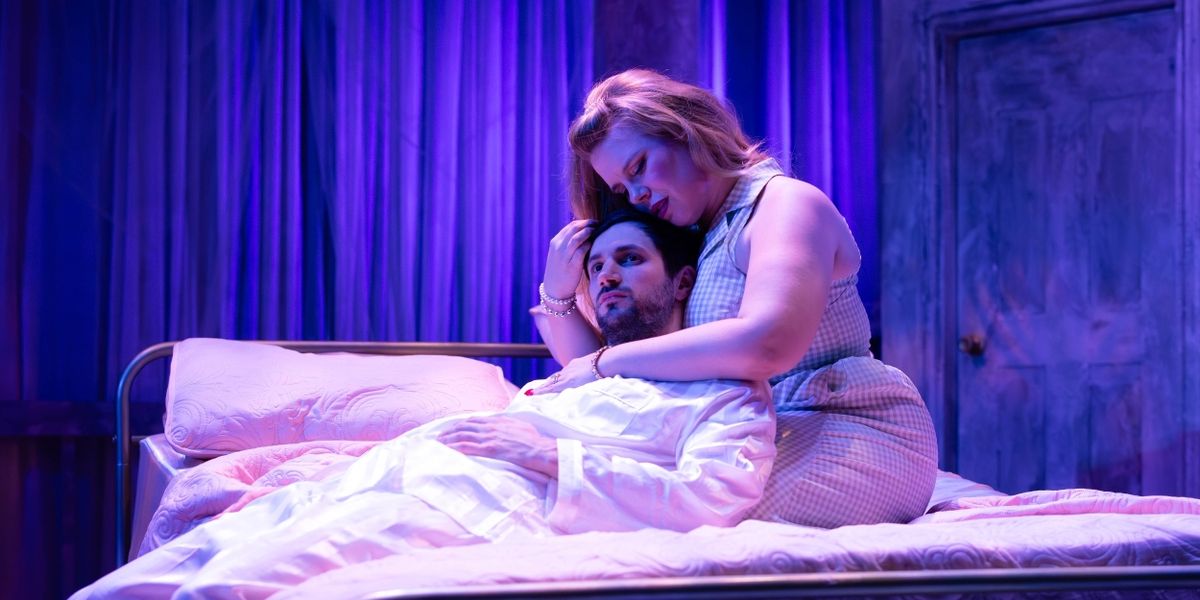
There are productions that revisit a classic with reverence—and then there are productions that get under its skin, crack it open, and show you the raw, beating heart underneath. Tennessee Williams Theatre Company’s CAT ON A HOT TIN ROOF, now playing at the Marquette Theatre in New Orleans, does exactly that. It’s electric. It’s guttural. And it’s one of the boldest things I’ve seen TWTC do, and that’s saying something.
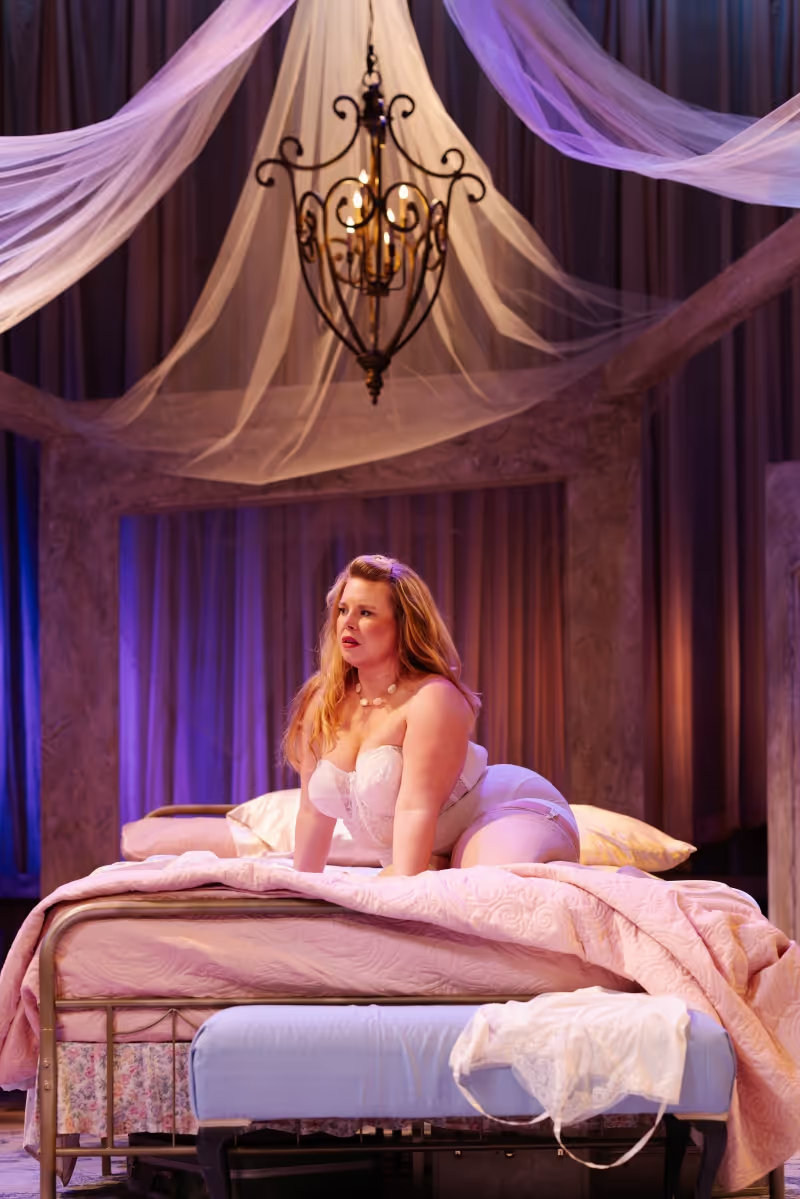
Photo credit: Brittney Werner
Directed by TWTC co-founder Augustin J. Correro, this version of CAT isn’t interested in nostalgia, leaning into the fractured intimacy of the Pollitt family with unflinching precision. It’s fierce, sharp and dripping with tension, reframing Williams’ Pulitzer-winning play for a new generation without losing the thick, Southern humidity of its roots. Correro’s decision to use the original Broadway ending, the first time New Orleans audiences have seen it in over a decade, adds further potency. It shifts the emotional conclusion away from sentimentality and into something far more complex and ambiguous. This CAT isn’t declawed; it scratches and it stings.
For those unfamiliar, CAT ON A HOT TIN ROOF is a Southern Gothic powder keg of a play, centered on the Pollitt family gathering at their Mississippi estate to celebrate Big Daddy’s birthday. But under the surface, it’s all lies, grief, greed and long-buried truths. Brick, once a golden boy athlete, now drinks himself to forget the death of his Best Friend, while his wife Maggie desperately tries to reconnect with him and secure their place in the family legacy. Meanwhile, Brick’s brother Gooper and his wife Mae circle like vultures, eager to seize control of the inheritance. It’s a story about family dysfunction, emotional repression and the brutal cost of denying your truth.
Rebecca Elizabeth Hollingsworth is magnetic as Maggie the Cat, delivering a knockout performance. She commands the stage from her first entrance, all claws and vulnerability packaged in white lingerie. Her Maggie is witty, sensual, furious and painfully aware of the social game she’s losing. Hollingsworth's Maggie is not just sultry—she’s survival incarnate, clinging to a crumbling marriage and social status with clawed grace. She’s the kind of woman you ache for and admire all at once. Brandon Kotfila’s Brick is an understated counterweight: stoic, emotionally iced over and cracking beneath the surface. The way he carries his silence is masterful. You feel everything he’s trying not to say.
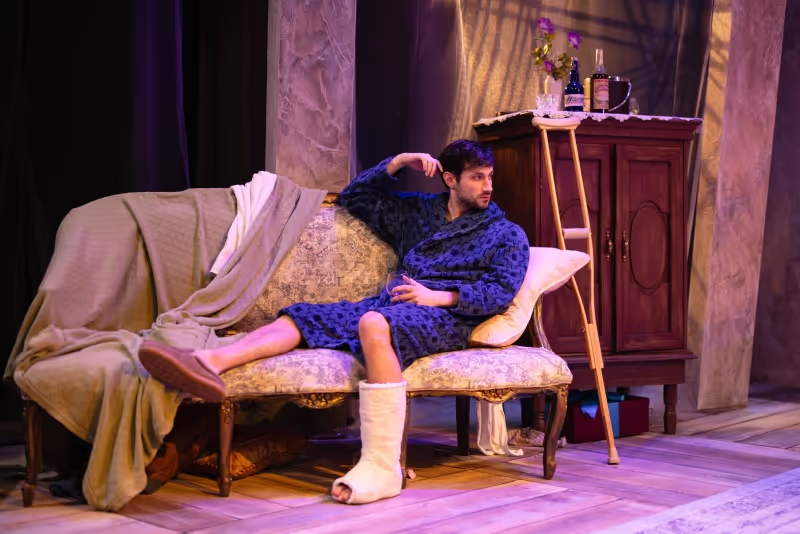
Photo credit: Brittney Werner
And Brick’s silence is not just grief. It’s repression and confusion, all rolled into one. What makes this portrayal of Brick so fascinating, and quietly devastating, is how it leans into a possible asexual reading of the character. Kotfila’s Brick is tormented not just by the loss of Skipper, but by what he couldn’t give him. There’s a suggestion that Brick was never able to love Skipper in the way Skipper wanted, and perhaps that inability wasn’t just about fear or masculinity or social shame, but something deeper and more internal. That same emotional wall extends to Maggie. Despite the heat between them, there’s a physical and psychological barrier Brick can’t (or won’t) cross. Watching that play out on stage adds layers to every glance, every silence, every “click” of his imagined crutch. The chemistry between Maggie and Brick is jagged and electric, fraught with years of loss, longing and emotional landmines.
Then there’s Randy Cheramie as Big Daddy, a role he’s played before but here he brings a brutal honesty to it that makes the entire play revolve around him. Thunderous and shockingly vulnerable, Cheramie doesn’t merely reprise Big Daddy; he dominates the stage with a presence that is as commanding as it is heartbreakingly human. His scenes with Brick are thick with unspoken history and the kind of father-son confrontation that leaves bruises in its wake.
Margeaux Fanning’s Big Mama brings both warmth and heartbreak; Andrew Niemann and Monica R. Harris as Gooper and Mae are delightfully conniving; and the kids (played by Ayden Crump, Loren Mark and Leah Williams) bring just the right touch of adorable chaos. Every role is dialed in and every performance has bite.
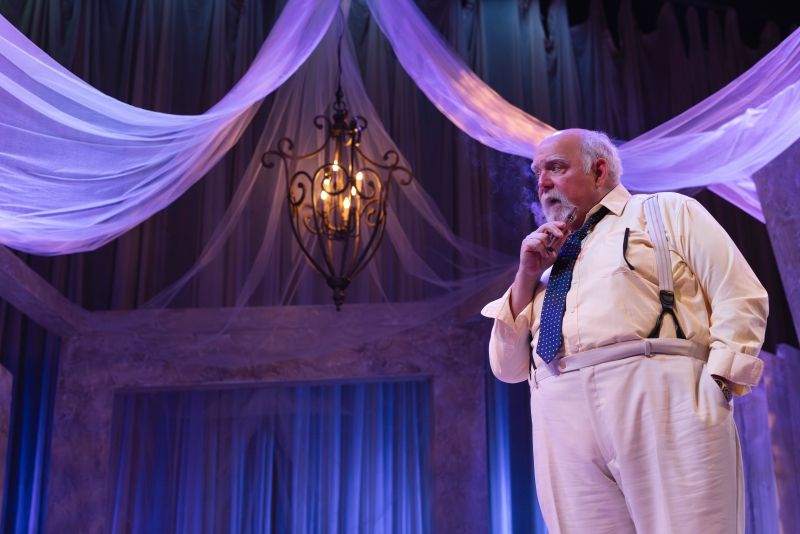
Photo credit: Brittney Werner
But it’s not just the cast that delivers. Visually, the show is a dreamscape of Southern decay and emotional claustrophobia. The abstract set, framed by gauzy drapes and angular beams, feels both elegant and oppressive, like a memory you can’t quite escape as it begins to collapse in on itself. Set designer Nathan Arthur’s choice to suggest, rather than fully render, the Pollitt estate gives the space a ghostlike quality.
Diane K. Baas’s light design shifts between dusky violets, blistering pinks and lonely blues, heightening the emotional temperature of each scene. Costume design by Kelsey Brehm is equally thoughtful with each detail speaking to the characters’ inner states and Nick Shackleford’s sound design adds a layer of emotional texture that hums through the space like Southern summer air: hot, close and impossible to ignore.
CAT has always been about family dysfunction, closeted truths and the lengths we’ll go to avoid looking at the things we fear most, but in this staging, those themes feel less like “mid-century drama” and more like your own front porch, your own family gathering gone off the rails. The story’s themes of mendacity, repression, family dysfunction and existential longing are rendered not as melodrama, but as lived experience. It’s funny in all the right ways, but when it hits, it hits hard.
TWTC is clearly having a conversation with the audience, not just presenting a play. They’re asking: what if you’ve never seen CAT ON A HOT TIN ROOF before? What if this is your first encounter with Tennessee Williams? Would it still land? The answer, for this production, is a resounding yes.
This isn’t a soft Southern elegy. This is a play about inheritance, of land, of secrets, of trauma. It’s about what we pass down and what we refuse to name. And TWTC isn’t pulling punches. They’re swinging.
CAT ON A HOT TIN ROOF runs July 10-27 at Marquette Theater at Loyola University New Orleans.
Sign up for all the news on the Fall season, discounts & more...
|
The Carpenters Songbook: A Live Celebration Lutcher Theater (11/07-11/07) |
|
Laughter on the 23rd Floor Le Petit Theatre (10/01-10/18) |
|
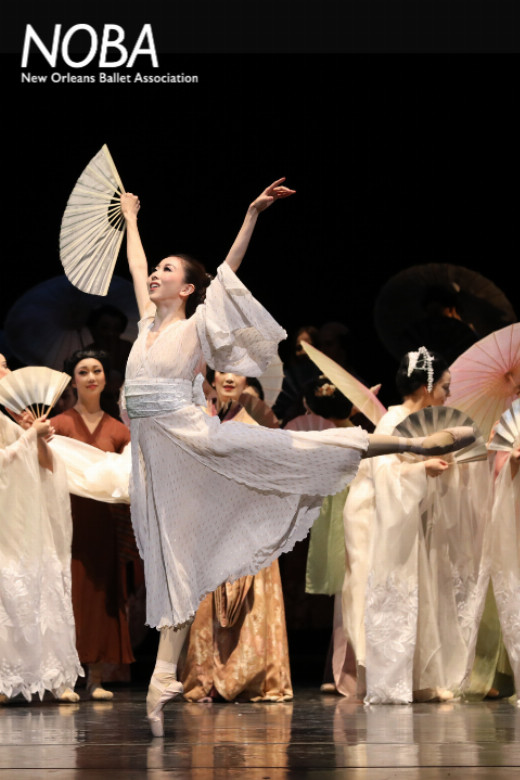
Houston Ballet "Madame Butterfly" Mahalia Jackson Theater (4/17-4/17) |
|
The Nutcracker Jefferson Performing Arts Center (12/19-12/20) |

|
The Rocky Horror Show Rivertown Theaters (10/23-10/31) |

|
Argentina's Tango After Dark Mahalia Jackson Theater (2/20-2/20) |
|
Macbeth Sullivan Theater (10/01-10/10) |

|
The Play That Goes Wrong Sullivan Theater (4/30-5/09) |

|
Finding Nemo Rivertown Theaters (1/08-1/24) |

|
The Rocky Horror Picture Show Spooktacular Tour with Barry Bostwick Mahalia Jackson Theatre (10/29-10/29) |

Reader Reviews
To post a comment, you must register and login.