


Interview: Sorab Wadia Says LIFE OF PI at Wharton Center Stimulates Imaginations
See the inspiring story for yourself from March 11-16.
Life of Pi, the new play based on the book of the same name, is being hosted at the Wharton Center from March 11th to 16th. Life of Pi opened in the West End in 2022, amassing 5 Olivier Awards (including Best New Play). It had a short stint on Broadway in 2023, where it ended up winning Best Scenic Design, Best Sound Design and Best Lighting Design at the Tony Awards.
BroadwayWorld Michigan had the pleasure of speaking with the actor who plays Pi’s father, Sorab Wadia. Read our interview below ahead of seeing the show at Wharton Center!
Can you tell me about yourself and your theatre career?
I began my career as a concert pianist and opera singer, and then I transitioned into musical theatre and regular spoken theatre. I’ve been in this career for 35-40 years now. [It’s been a] long and winding road.
Can you describe the story of Life of Pi for people who may not know about it?
It is the story of a young boy whose parents are immigrating from India to Canada because of political turmoil in India. They have a whole zoo of animals with them. When their ship goes down in the middle of the Pacific Ocean, what happens to the boy and some of the animals? [Life of Pi is a] story of survival — a boy on a boat with some animals surviving the Pacific Ocean, and all the lessons he learns along the way until he is saved.
Who is your character and what role does he play in the story?
I play the father of Pi. He is a stern and loving father [who] tries to teach his son and daughter lessons for life. He plays a pivotal role in the later half of the play after the ship has gone down and Pi is in the liferaft. The ghost of the father comes back to inspire his son. He teaches Pi all sorts of lessons on survival in the middle of this ocean. It’s a beautiful role, I love playing it. It can be angry, it can be very stern, but that comes from wanting the best for his children and from a deep love for his children.

Photo by Evan Zimmerman for MurphyMade 2024
I’ve seen photos of the pretty remarkable puppetry that’s featured in this show. Do you get a chance to work with any of them?
Oh yeah; in the zoo, I work with the zebra a little bit. When the ship is sinking, I work with the hyena and the orangutan. And I work a little bit with Richard Parker [the tiger], I also work with the goat whose name is Buckingham. What the audience sees is even better than what I see, because when there’s distance between the puppet and the audience, it looks even more beautiful.
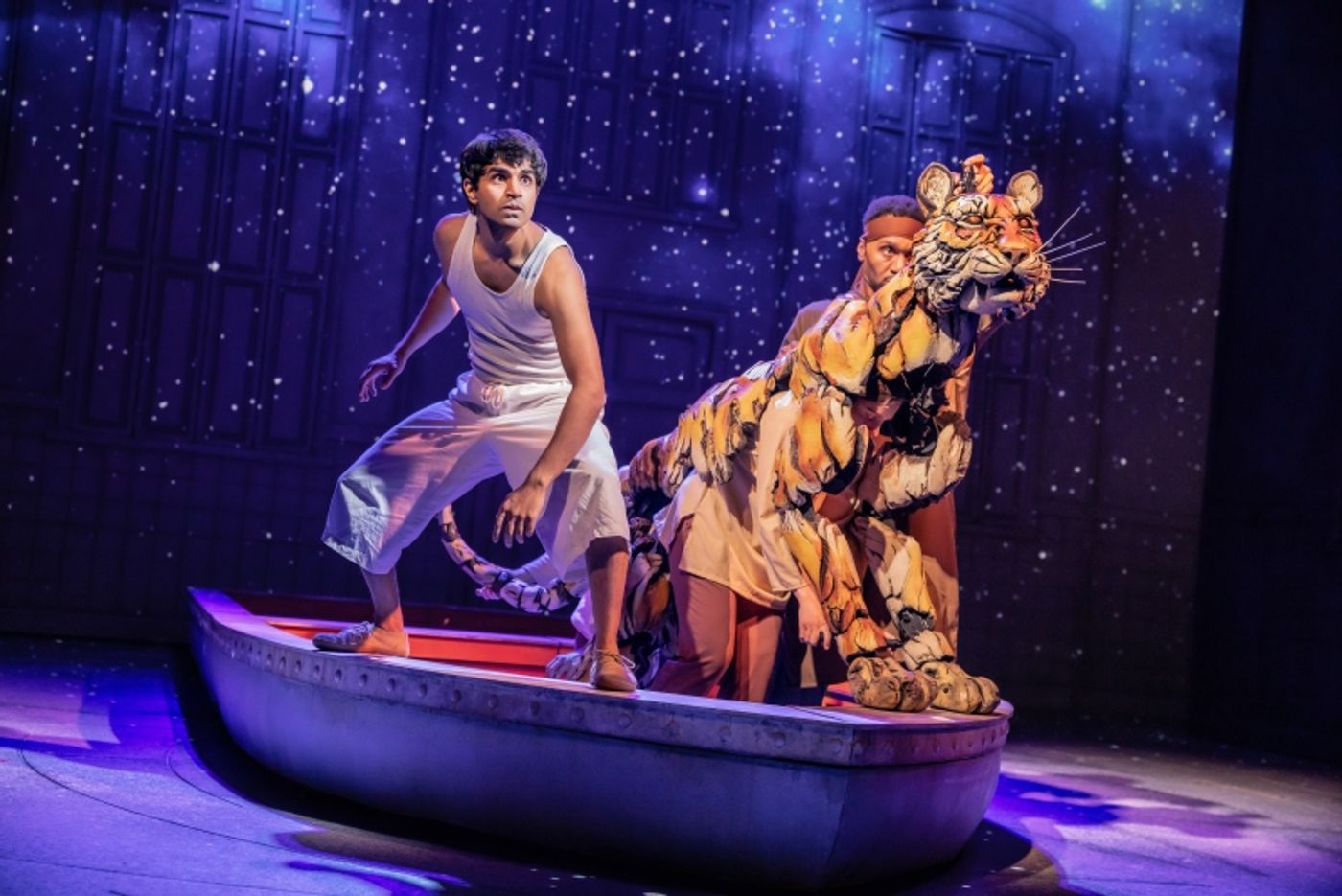
Photo by Evan Zimmerman for MurphyMade 2024
These puppets are different from [The Lion King] in that the puppets are more interactive. It’s more between humans and animals, whereas in The Lion King everyone is an animal — stylized animals interacting with stylized animals. Here, it is human beings interacting with actual wild animals, which is a slightly different angle on the theatre with puppets [concept].
We always make sure to tell everyone that just because the show has puppets, does not mean it is for young children. This is not The Lion King…we don’t recommend it for kids under 10 years old. There is a lot of violence; animals fighting animals, or animals fighting humans, etc. It can be graphic, it can be violent, but it’s also very beautiful for adults or older children.
How does the format of a stage play enhance the story compared to reading the book?
That’s a lovely question…the visuals. When you read a book, you imagine it, you make a movie in your head, which is a beautiful thing. That’s why we encourage kids to read, because it stimulates the imagination, it sparks creativity. This theatre piece sparks a different creativity and different imagination because you’re seeing gorgeous visuals that you may not have imagined when you read the book. You also see the effects, you’re like, “oh, I didn’t think they could do that, I didn’t know how they would portray the storm.” The way it comes to life is mind-boggling. It amazes people. That creativity...the video, the lighting, the sound, the set, the acting, the puppets...all of that comes together in a very magical way.
%20in%20the%20National%20Tour%20of%20LIFE%20OF%20PI_%20Photo%20by%20Evan%20Zimmerman%20for%20MurphyMade%202024.jpg?format=auto&width=1400)
What can audiences look forward to when they come to see Life of Pi at Wharton Center?
Besides all the stuff I just said, being amazed by the stagecraft and the magic of the puppets, I think they can come to see an inspiring story. A story where a small, young underdog, a 17-year-old boy, was left alone in the middle of the Pacific Ocean and survived. An inspiring story of survival in the face of the worst that the planet can throw at a young boy. That’s a story we can all use in times where we all have problems in life and have obstacles to overcome.
Do you have any social media accounts that people can follow?
I do, and I’m trying to post more regularly from the road. It’s my name, @sorabwadia. I do a lot of Instagram posts about the show, about life on the road and the silliness of it and the joys of it and the beauty of it.
Is there anything else you’d like readers to know?
Don’t bring very small children, they can be traumatized.
[Also,] come with a sense of wonder. Prepare to be entertained and amazed for those 2 hours and 15 minutes.
Tickets for Life of Pi are on sale now at Wharton Center's official ticketing outlets: online at whartoncenter.com, at the official Wharton Center Ticket
Office, or by calling 1-800-WHARTON.
To keep updated with Life of Pi, visit their website at lifeofpibway.com, and follow them on Twitter at @lifeofpibway, on Instagram at @lifeofpibway, and on Facebook at facebook.com/LifeOfPiBway.

|
Ghost Light Cabaret Series: One Hit Wonders Flint Institute of Music (8/31-9/02) |
|
A Grand Night for Singing Hill Auditorium (10/04-10/04) |

|
Disney's The Lion King Cobb Great Hall (4/08-4/25) |
|
The Book of Mormon (Non-Equity) Stranahan Theater (2/18-2/21) |
|
Men's Glee Club Spring Concert Hill Auditorium (4/17-4/17) |

|
SIX (Boleyn Tour) Wharton Center [Cobb Great Hall] (12/01-12/06) |

|
Cabaret Gilmore Theatre Complex (3/19-4/04) |

|
Hadestown Flint Institute of Music (4/15-4/15) |
|
Murakami by the Sea Arthur Miller Theatre (4/08-4/11) |
|
The Book of Mormon Flint Institute of Music (3/22-3/22) |