


Interview: Orlando Arriaga of THE COUNTER at 4th Wall Theatre Co.
Exploring the power of subtle storytelling in THE COUNTER at 4th Wall Theatre Co.
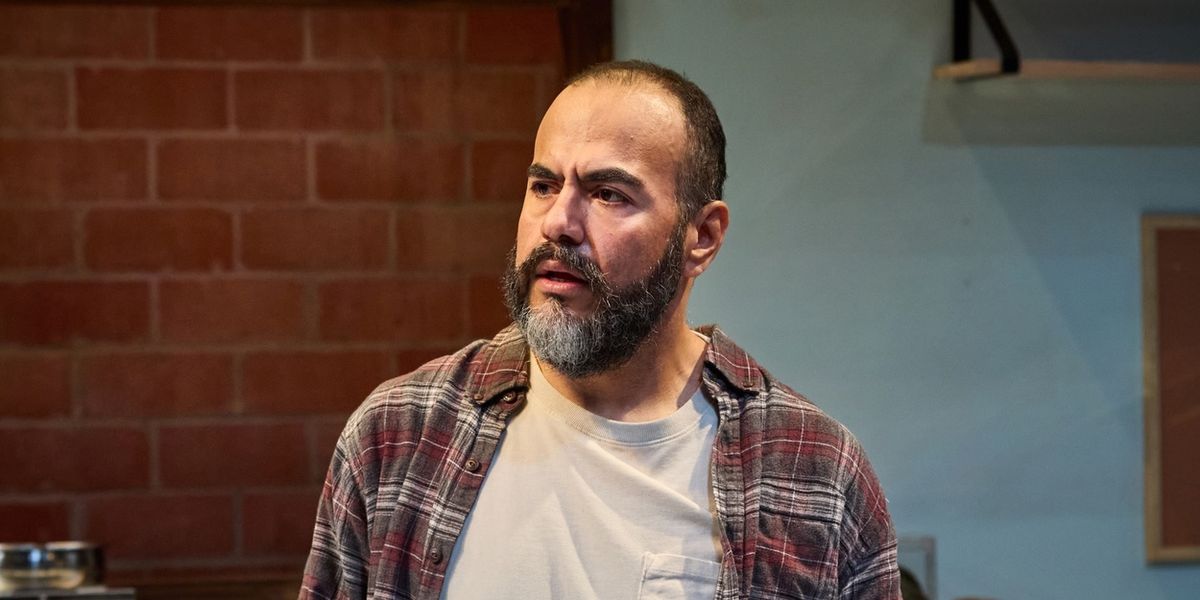
At a small diner table, over coffee and conversation, an entire world quietly unravels in The Counter. In 4th Wall Theatre Company’s intimate production, the stakes are not built on spectacle but on silence, subtext, and the fragile space between two people trying to be seen.
For actor Orlando Arriaga, who takes on the role of Paul, the play offers a different kind of thrill. Known for larger theatrical worlds and bold character work, Arriaga now leans into stillness, restraint, and the tension that simmers beneath everyday conversation. In a script that turns expectations on their head, Paul says little, but carries much.
We spoke with Arriaga about finding emotional depth without monologues, building chemistry in such an exposed setting, and why this quiet, character-driven story feels exactly right for Houston audiences right now.
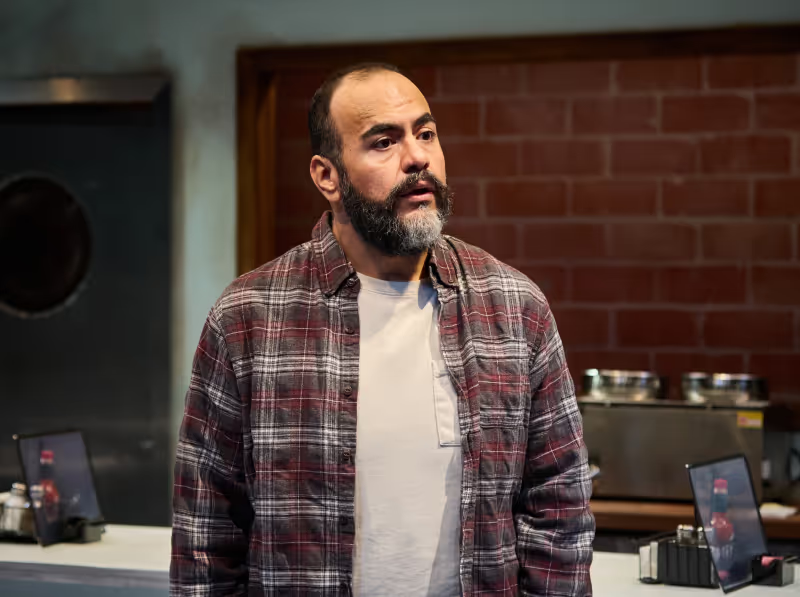
Photo by Gabriella Nissen
The Counter is set almost entirely at a diner table. What was your first reaction when you read the script and realized how intimate this story is?
I live for these types of stories! I don’t think I’m out of the norm in saying films and plays where the characters are sitting down talking to each other can be thrilling. It can be gripping, riveting and at the same time customary. When done right it’s just so interesting. Examples are: the play August Osage County when the family are sitting at the table talking and the opening scene in the film Inglorious Bastards. In both, they’re just talking but there is something boiling underneath and there is an ever present tension that’s building up.
I loved reading The Counter for the first time and I couldn’t guess what was going to happen. The story turns a couple of times. We’re learning about the characters in very conventional ways in the first half of the play because we think these are traditional characters and in some ways they are but then right in the middle it takes quite a turn. And it comes out of nowhere, all though there are a few clues given in the beginning.
I guarantee everyone watching will think, “Oh these are two regular people getting to know each other”, but when it drops they’ll say, “Oh, I was wrong about that!”
Paul doesn’t say a lot, but there’s so much going on underneath. How did you find his emotional life without relying on big speeches?
I’ve recently done work where my characters have very long monologues and they tell you exactly what they are thinking and feeling. This is not necessarily true for Paul in The Counter. He’s covering alot. He doesn’t want to talk and if he does, it’s not just to anyone. I’m familiar with that, personally. I love to chat with people at work in the theatre and at gatherings but out in public I don’t even like to be noticed. I don’t want to talk to another person unless I have to. I get it. It’s been interesting navigating through his emotional life. I won’t say it’s been easy but it’s something I’m familiar with and it’s a process that I myself am learning from.
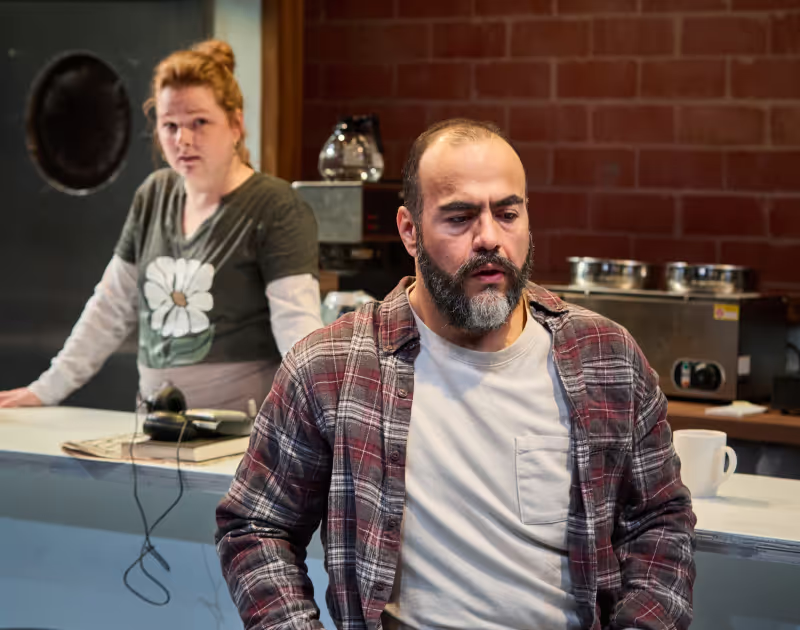
Photo by Gabriella Nissen
This play really lives in the connection between two people. What’s it been like building to that relationship with your scene partner in rehearsal?
It’s easy building a relationship with Katie, who’s played by Faith Fossett. Mostly because Faith doesn’t give you a choice in the matter. She’s up close and personal no matter what stage of friendship you’re at with her. It’s great, actually because I’ve just met Faith a few months ago. We did get into trouble early on because Paul and Katie are getting to know each other at the beginning of the play but Faith and I were playing it like we were best friends already. It’s actually been a little tricky putting a bit of distance and awkwardness into the relationship.
Meghan Kennedy’s writing captures everyday conversations in such a real way. What about her voice or this story stood out to you?
Yeah it’s interesting right? The text is somewhat bare. It’s not lacking at all but it is bare and trimmed down to it’s essentials. To me the script feels dependent on a creative team to bring out what is not said but only denoted by the text. I’m down for that. That’s a good challenge for me. Meghan Kennedy is giving the story tellers complete ownership on how we tell her story and I dig that.
How does performing a quiet, character-driven play like this feel in a space like 4th Wall Theatre, especially for Houston audiences?
It’s brilliant. The space at 4th Wall does have it’s challenges but it’s great for audiences to watch shows and great for actors to work in. It doesn’t require performing. Especially for The Counter. This show is perfect for the space at 4th Wall. The script isn’t asking you to work so hard and in fact it’s begging the opposite. The text just needs to be said. No acting required, really. It feels false if we’re trying to act an emotion. I spent 2025 working in larger theaters with large characters. I did Noel Coward’s Private Lives which requires a certain style and richness from the performance along with The Lehman Trilogy which had me playing 17 characters! I was so accustomed to this that I came into The Counter ready to emote and project! The was not the right choice. Thankfully Christy Watkins, our director has been a great guide for us. She detects falseness very quickly.
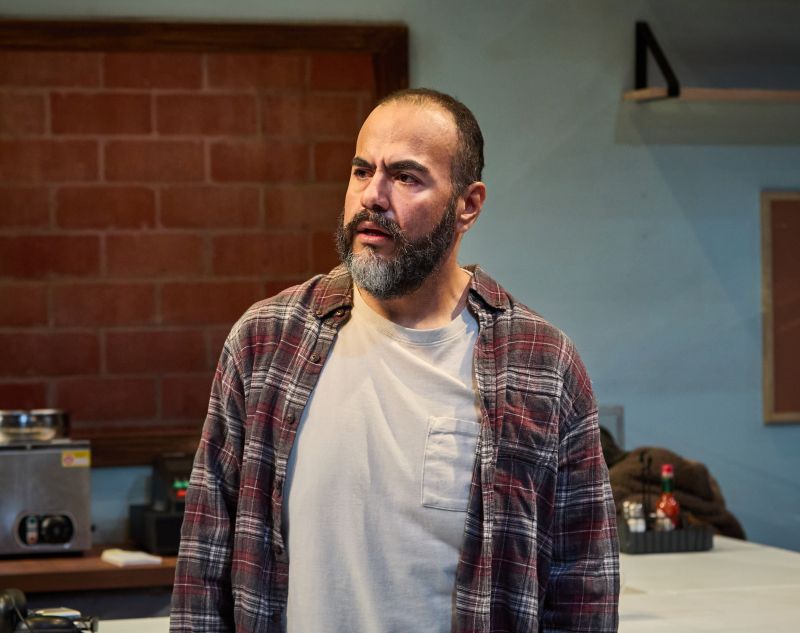
Photo by Gabriella Nissen
Was there a moment in rehearsal where Paul really “clicked” for you?
People who know me, know that I’m a glass half-full type of person but Paul is a very glass half-empty man. We had an invited audience for our first rehearsal. There is a turn that happens in the script that can either be easily understood or hard to believe. Thankfully the audience believed it and it became clear to me that I was on the right path with Paul when the reaction came. I understood then that I can bring who I am to Paul a lot easier than I thought. There’s room for me in him even though we’re quite different.
What do you hope Houston audiences take with them after spending an evening at The Counter?
Let’s be there for each other. No matter our differences. We live in a very divisive time but I hope that people can come into the theatre within a community and spend less than an hour and a half with broken characters trying to mend themselves. I hope people learn from Katie and Paul.
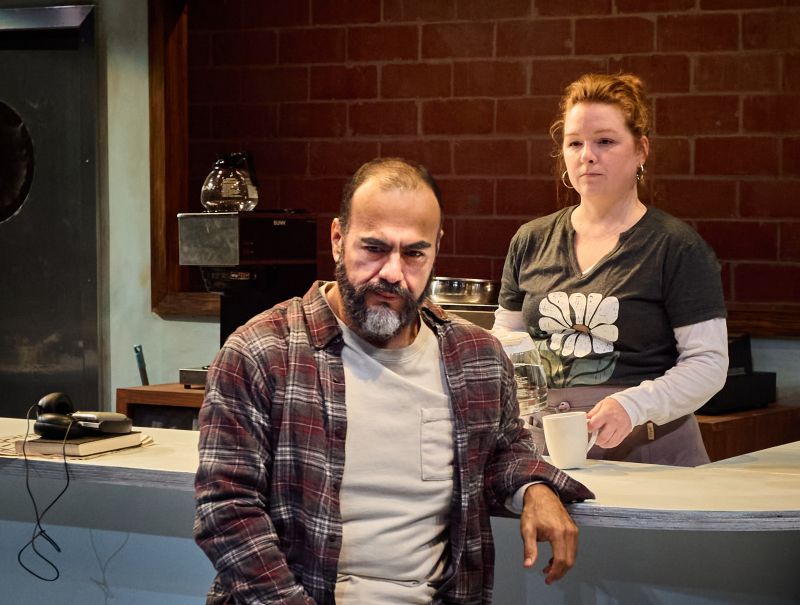
Photo by Gabriella Nissen
Prefer BroadwayWorld in Google Search?
Add us as a preferred source so our stories show up more often in Top Stories and Google’s AI answers — for you.

Sign up for all the news on the Fall season, discounts & more...

|
Rhinoceros The Catastrophic Theatre (9/18-10/10) |

|
Serial Killers: The Crucifixion of the Black Man in America Nikki El Films & Theatre (10/17-10/17) |

|
Carousel Moores Opera House (10/22-10/25) |

|
Rowan & Martin's Laugh-In by Ed Friendly & George Schlatter Theatre Suburbia (4/16-5/15) |

|
Hardy WhiteWater Amphitheater (11/21-11/21) |

|
The Sound of Music The Hobby Center for the Performing Arts (9/29-10/04) |

|
Christmas Belles by Jones, Hope & Wooten Theatre Suburbia (11/06-12/05) |

|
JEZEBEL: The Criminally Country Musical Art Factory (9/18-9/27) |

|
To The Bone Theatre Southwest (5/28-6/19) |

|
anthropology Theatre Southwest (10/30-11/21) |
