


REVIEW: The Festival d'Avignon Presents NÔT By Marlene Monteiro Freitas
The audience enters La Cour d’Honneur to the looping vamp of Prince’s “Computer Blue.”
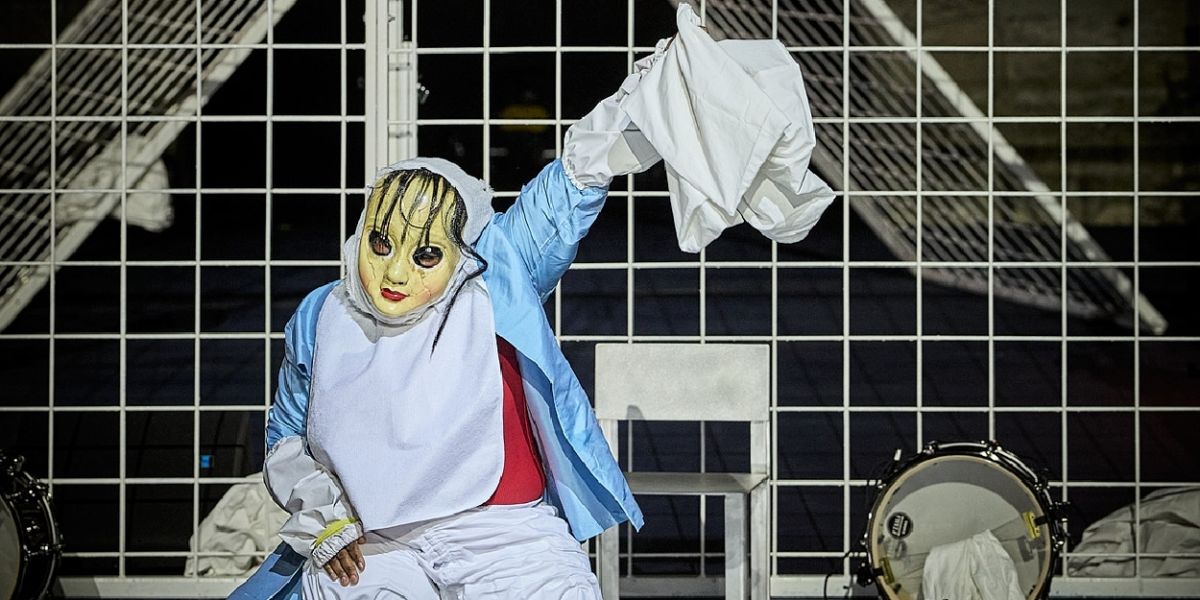
This past week, I found myself explaining the concept of “commit to the bit” to a friend in Paris. “But what is the bit?” he asked. If only he had seen Marlene Monteiro Freitas’s Nôt, currently in performance at the Festival d’Avignon’s Cour d’Honneur, he would have encountered an extraordinary case study. Through a landscape of imaginative invention and grotesque aesthetics, Nôt commits to the bit with unwavering intensity. That commitment transforms the production’s potentially withholding thematic opacity into something enchanting.
The audience enters La Cour d’Honneur to the looping vamp of Prince’s “Computer Blue.” Yannick Fouassier’s set is sparse and utilitarian: three beds stage right, water pitchers, a few scattered chairs, and a long white wire fence slicing the stage horizontally. Rui Antunes’s sound design, which later incorporates opera, rock, and subtle live effects, slowly expands the Prince loop as dancer Joaozinho da Costa enters, dressed in a white tennis skirt. He gestures with the skirt in jerky, fragmented movements while distractedly scanning the audience. Fouassier’s lighting, which includes angled spotlights, flat washes along the fence, and a washed-out backdrop, flickers absentmindedly like a tech check. Once da Costa exits, we’re informed that the performance is now beginning.
Performer Rui Paixão enters in relative silence, his hair slicked back and clad in a suit. He walks to a microphone where he silently mimes a passionate speech through clownish gestures. He evokes a vaudevillian Arturo Ui. At stage left, Ben Green appears, his face hidden behind a plastic doll mask of a young woman. He cleans the immaculate set, grunting suggestively. He then removes the mask, and Paixão dons an identical one. Paixão then grunts and mimes defecating into a chamber pot. He licks the pot clean with exaggerated satisfaction. This grotesque sequence continues as he moves through the audience, clasping hands, leaning on chairs, and, when two audience members flee, dumping the (empty) pot on them. Those audience members were no doubt wondering how this piece was “inspired by the tales of One Thousand and One Nights.”
If you hadn’t entered the theatre with the name “Scheherazade” in mind, it’s unlikely she would have occurred to you. Yet within that distant frame, certain resonances emerge. A cold patriarchy looms onstage. In one sequence, Miguel Filipe, Henri “Cookie” Lesguiller, and Tomàs Moital sit center stage, strumming the backs of snare drums in sync with operatic music. In response, Marie Albert, Ben Green, and Rui Paixão commit to their performances with playful terror. They make their beds while simultaneously surveying the space around them. Mariana Tembe, who stands out even in this cast of electrifying performers, sits center stage while wearing her own copy of the plastic doll mask. Costume Designer Marisa Escaleira has modified Tembe's jumpsuit to accommodate the absence of her legs by taping together the empty legs at the knees and ankles, transforming them into a kind of puppet. Tembe rocks out with them, whipping the faux limbs like glow sticks in a rave. Later, she strips off the mask and suit, singing and charging across the stage in a colorful costume.
Each moment claims intensity through its scale. The performers don’t just “commit to the bit” momentarily; they commit until they are utterly alone in it. The performer, like Scheherazade, must use what they have to make their case. In one mesmerizing sequence, three performers sit center stage with two pieces of cutlery each. Over several minutes, they perform a finely choreographed percussion solo. The perfectly timed clinks of their knives ring out against the low groan of the theatre as audience members trudge for the exits. But those who stayed and applauded the segment witnessed a love song to the imagination, and to the power of storytelling, so long as you commit to the bit.
Photo Credit: Christophe Raynaud de Lage
Recevez l'actualité de Broadway sur WhatsApp
Recevez les dernières mises à jour, les nouvelles de dernière minute et une couverture exclusive directement dans l’application.

|
MODE D''EMPLOI POUR METTEUR EN SCENE ... TH DU ROND POINT - SALLE ROLAND TOPOR (11/21-11/27) |
|
|
LA TRESSE THEATRE DE LA RENAISSANCE (9/25-1/10) |
|
|
PARIS IS MAGIQUE GAITE RIVE GAUCHE (6/24-8/29) |
|
VELVET TH DU ROND POINT-SALLE RENAUD BARRAULT (1/07-1/10) |
|
|
UBU ROI THEATRE DE PARIS (9/16-10/25) |

|
DRAG RACE FRANCE LIVE SAISON 4 - DRAG RACE FRANCE LIVE CASINO DE PARIS (9/24-10/02) |
|
|
LE BAR DES LÉGENDES MELO D'AMELIE (9/15-12/30) |
|
ROMEO & JULIETTE LDLC ARENA (3/24-3/26) |

|
CLEMENT VIKTOROVITCH ZENITH DE LILLE (2/06-2/06) |
|
|
GUY DE MAUPASSANT - LE HORLA COMEDIE OBERKAMPF (9/20-9/27) |