


REVIEW: The Festival d'Avignon Presents LAAROUSSA QUARTET By Selma & Sofiane Ouissi
What remains is the embodied labor itself, both individual and collective, mechanical and deeply personal.
Choreographers Selma and Sofiane Ouissi appear only on screen in Laaroussa Quartet, now in performance at the Festival d’Avignon’s La Fabrica. Seated outdoors in Tunisia, the camera lingers on their gestures, offering only fleeting glimpses of their faces as they occasionally enter the frame. The performers move with a dancer’s intentionality, yet filmmaker Nicola Sburlati captures them with the same documentary style he applies to earlier footage of Tunisian fields, women working pottery, and communal gatherings. Whether onscreen and onstage, Laaroussa Quartet offers an unadorned meditation on the shape of labor.
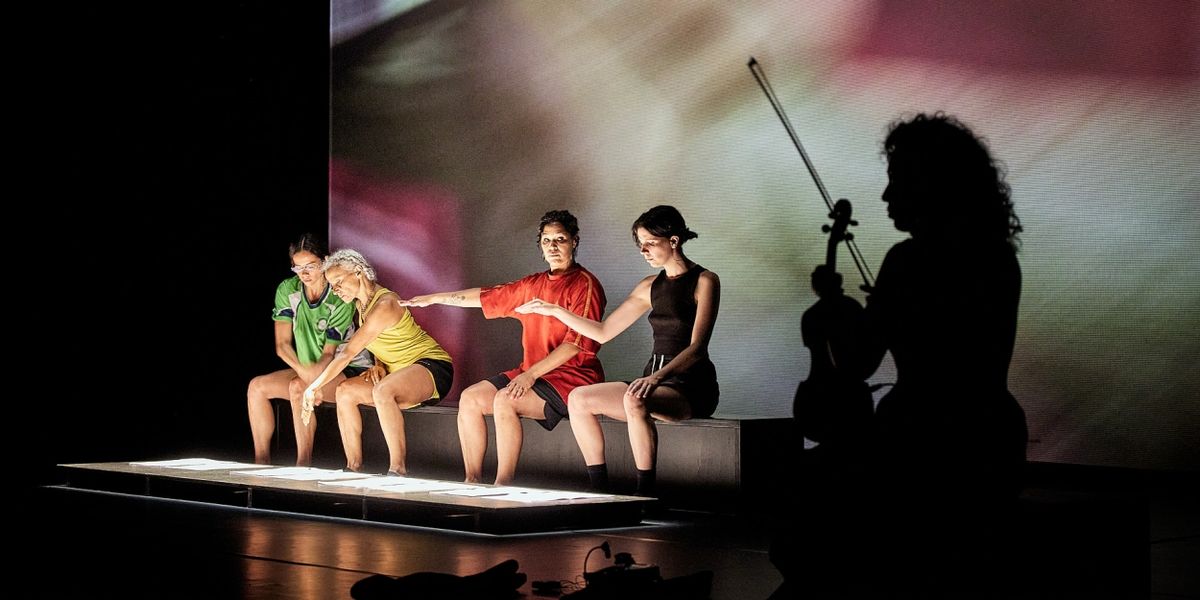
Six performers (four dancers, a violinist, and a singer) enter the stage. The dancers, dressed in bold-colored jerseys and tank tops (green, yellow, red, and black), place oversized sheets of music notation across the stage. The set is otherwise spare, grounded by designer Simon Siegmann’s brutalist long bench at center stage. Singer Chedlia Saïdani, dressed in traditional attire from her hometown of Sejnane, Tunisia, sits quietly stage left, while violinist Aisha Orazbayeva, dressed in black, accompanies the performance with her original score. Her atmospheric compositions shift between the mournful resonance of a whale’s call and the hypnotic repetition of Philip Glass.
Laaroussa Quartet examines the lives of women in Sejnane, Tunisia. These lives are shaped by both labor and poetry. The piece opens, and is later punctuated, by the recitation of Selma Ouissi’s poem “Ô femme au regard perdu dans les collines…” First recited in Arabic with French subtitles, the poem later returns in Spanish and English. Then, after further video segments, Saïdani, who has remained in quiet observation from her folding chair stage left, steps forward to sing an ancient folk song from Sejnane. As the stage darkens, the four dancers gather on the bench. Siegmann’s lighting suddenly concentrates from above, casting their pages of notation in glowing relief. The women adjust their headphones, allowing them to hear the timing, and begin again.
Selma and Sofiane Ouissi derived these gestures, and those of the dancers, from the traditional pottery techniques of Sejnane. The movements arise from the body’s interaction with clay, incidental, yet fully embodied. Though surely memorized by now, the dancers keep their focus on the notation. This notation dictates their gestures, but not their quality. Personality seeps through the imprecision. They share fleeting moments of camaraderie: a knowing glance during a difficult phrase, a flash of admiration, a genuine pause of rest.
At the work’s conclusion, the dancers turn their backs to the audience and remove their shirts. They repeat the gestures, but this time, the imagined object they had been shaping is no longer visible. What remains is the embodied labor itself, both individual and collective, mechanical and deeply personal.
Photo Credit: Christophe Raynaud de Lage
Recevez l'actualité de Broadway sur WhatsApp
Recevez les dernières mises à jour, les nouvelles de dernière minute et une couverture exclusive directement dans l’application.

|
BOLLYWOOD MASALA CASINO DE PARIS (3/11-3/14) |
|
THE RISE ZENITH NANTES METROPOLE (12/11-12/12) |
|
|
TEAM BUILDINGUE, LA COMÉDIE MUSICALE - TEAM BUILDINGUE LA SCENE PARISIENNE - SALLE 1 (10/13-11/24) |
|
|
ET N''OUBLIEZ PAS LA PIECE LA GAÎTÉ-MONTPARNASSE (9/22-5/25) |
|
|
MERCI DE VOTRE COLLABORATION TH DU ROND POINT-SALLE RENAUD BARRAULT (11/04-11/14) |
|
|
OÙ VA LE SON QUAND IL NOUS QUITTE ? TH DU ROND POINT -SALLE JEAN TARDIEU (3/24-3/24) |
|
C''EST SI SIMPLE L''AMOUR RADIANT - BELLEVUE (5/04-5/04) |
|
|
UNE HISTOIRE DE FRANCE RADIANT - BELLEVUE (11/27-11/27) |
|
|
BLACK LEGENDS, LE MUSICAL LE 13E ART (11/26-1/31) |
|
|
LES HOMMES VIENNENT DE MARS - LES HOMMES VIENNET DE MARS ET LES FEMMES DE VENUS GRAND PALAIS - THEATRE LOUIS PASTEUR (1/31-1/31) |