


Review: STEREOPHONIC at Connor Palace (Key Bank Broadway Series)
Disappointing STEREOPHONIC at Connor Palace
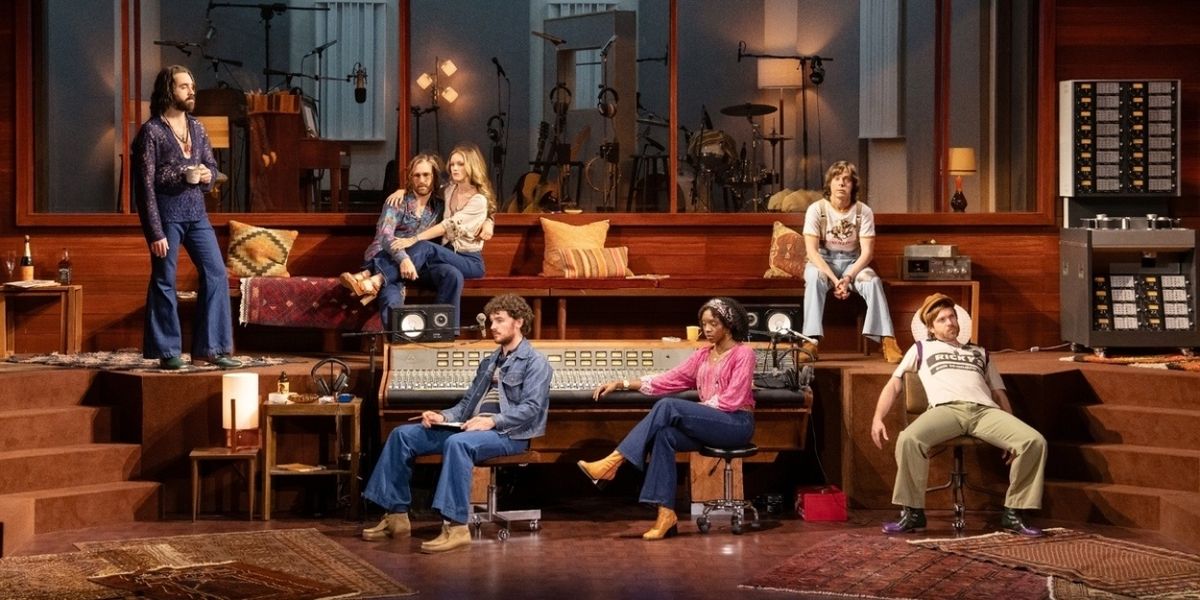
What drama or comedy has received the most Tony-Award nominations?
The logical guesses would be DEATH OF A SALESMAN, STREETCAR NAMED DESIRE, or maybe, OUR TOWN.
The answer: STEREOPHONIC.
“The original Broadway production of STEREOPHONIC made history when it garnered 13 nominations at the 77th Tony Awards, breaking the record previously held by SLAVE PLAY.”
It ran 321 performances on Broadway, exceeding its initial 14-week limited engagement.
STEREOPHONIC, which is now on stage at the Connor Palace, is a 4-act, 3-hour production, was written by American playwright David Adjmi, with music composed by Will Butler.
The script has a unique background. Adjmi and Butler began working on the piece in 2014, with the idea of creating a piece of theatre that felt like the audience was watching a documentary unfolding on stage, while avoiding the piece becoming a full-blown musical in which songs and dances are seamlessly woven into the play’s fabric. This is not the same format as CHORUS LINE, FIDDLER ON THE ROOF or RENT.
The play follows a fictional British-American band through a turbulent year in a studio. It kind of mirrors Fleetwood Mac's messy interpersonal relationships and creative struggles to produce their hit album, Rumours. So much a mirror that there were lawsuits concerning the parallel of the stories.
(In reality, "Fleetwood Mac producer Ken Caillat and co-author Steven Stiefel sued the creators of STEREOPHONIC in late 2024, alleging copyright infringement for allegedly stealing substantial parts of their memoir, Making Rumours.” “A settlement in December, 2024, resolved the dispute and paved the way for future productions.”)
Each of the four-acts has a specific date, place and action. For example, in Act I set in July, 1976, in Sausalito, CA, an unnamed band gathers at a studio in Sausalito to record their second album. The band rehearses new songs, while their personal angst-filled lives unfold.
In Act II, which takes place in September of 1976, musical and aesthetic conflicts continue, with different arrangements of various songs being tried.
Act III, which takes place in late December of 1976, continues to probe the album’s march toward completion, while personal issues continue to thwart the progress.
Act IV: First week of June 1977, Los Angeles, CA reveals more of the nightmare of the recording process and the lies that are needed to accomplish the task.
David Greene, the Senior Vice President of Programing for Playhouse Square writes, in the show’s program notes, “At its heart, STEREOPHONIC is about the creative process—exhilarating, exhausting and often brutal.” He goes on to state that after he saw the show in the Big Apple, “The play lingered with me for days, not because of its spectacle, but because of its honesty.” He also states that, in his opinion, “the show is unforgettable.”
I wish I, and, as it appears much of the audience, agreed with Greene.
My attention started to wain about a half-hour into the show. It was about the same time that I noticed audience members starting to exit the theatre.
After intermission, and my wife having asked, “Do we have to stay?,” I became aware that the two rows in front of us, were basically empty. A glance to the left indicated that that section, which had been totally occupied, had lost many of its members.
At the show’s conclusion, when the nice LAND audience was usually on its feet giving a show a standing ovation, many of this assemblage were flooding toward the exits, having given meager applause.
Is the show bad? I think not. It is contains conflicts that seem contrived, and a fragmented soap-opera story, which doesn’t always flesh out what is going on. These are overlaid on a marvelous musical score.
If only the script was of the same quality as the music.
I’m not sure what motivated the Tony nominators and voters to garner the show its many honors, but it appears that not only I, but some of the local audience, were not as enthralled.
The less than enthusiastic reaction is not aimed at the cast. They were excellent. Their singing and musicianship were of the highest level. In addition, David Zinn’s studio set was perfection. Director Daniel Aukin paced the show well.
Maybe the problem was editing of the original script to what is now dubbed “The Radio Edit”—the cutting of the running time to three hours. Maybe something was lost in the paring. Maybe it was vastness of the Connor Palace and the loss of the needed intimacy. Maybe it was all the awards, setting the audience’s expectations too high. Whatever. . .
CAPSULE JUDGMENT: The touring production of STEREOPHONIC was, in the mind of this observer, unfortunately, less than expected! (I wish I had seen the Broadway show as the basis for comparison.)
STEREOPHONIC, as part of the Key Bank Broadway Series, runs through January 26, 2026. For tickets 216-241-6000 or go to www.playhousesquare.org.
Next up: Feb 3 – 22, Connor Palace…the acclaimed Tony Award®-winning musical SUFFS about the brilliant, passionate, and funny American women who fought tirelessly for the right to vote.
Sign up for all the news on the Fall season, discounts & more...

|
A Puertas Abiertas LatinUs Theater Company (10/23-11/08) |

|
Disney's Frozen Renaissance Theatre (11/21-11/29) |

|
Dracula: A Horror Story Renaissance Theatre (10/02-10/18) |

|
Dear Evan Hansen Baldwin Wallace University Main Stage Theatre (11/12-11/22) |

|
Dear Evan Hansen Beck Center for the Arts (2/12-3/07) |

|
The Comedy of Errors Great Lakes Theater (2/05-2/21) |

|
Sweeney Todd The Demon Barber of Fleet Street Great Lakes Theater (10/23-11/08) |

|
Ben-Hur: A Tale of the Christ Ohio Star Theater (5/25-10/23) |

|
Elijah: Prophet of Fire Ohio Star Theater (5/15-11/05) PHOTOS VIDEOS |
|
Dear Evan Hansen Short North Stage - Garden Theater (1/23-2/14) |

Reader Reviews
To post a comment, you must register and login.