


Review: COSÌ FAN TUTTE, London Coliseum
Big top brilliance, old-school soul: a Così fan tutte that respects opera's roots.
 Phelim McDermott directing Così fan tutte is a bit like asking a Catholic priest to do Mass in full drag. You know something deliciously outrageous is going to happen. You also know, whether people will like it or not, that it might be exactly what this masterpiece out of step with modern attitudes needed.
Mozart’s opera is, on paper at least, a lab experiment in human faithlessness. Two men test the fidelity of their fiancées, everyone fails, and the moral is either (if you go by Mozart’s original title) “women are like that” or (if you go by McDermott’s preferred title of Cosi fan tutti), “people are like that”. Either way, this Così leans gleefully into farce, treating the plot not as a philosophical treatise but as a cavalcade of social slapstick.
The result is a staging that fizzes with physical comedy. Paule Constable's superbly realised Skyline Motel does more 180-spins than a flailing government, the ridiculous disguises are milked for all they're worth, and dignity is something the characters misplace early on and never bother to look for again.
There’s an implicit understanding here about something intrinsic to Così: it already knows it is absurd and it doesn’t care. McDermott’s great contribution is to stop pretending otherwise. The lovers are not noble souls crying out to the gods as they wrestle with existential doubt. They are humans, and humans are (for the most part) farcical creatures, especially when pretending to be in control.
This approach suits Mozart’s music surprisingly well. The score is all elegance and emotional precision, but it also has an impish smirk lurking in the corner. McDermott lets that smirk take over the room. Ensembles become finely tuned comic machines. Recitatives feel less like connective tissue and more like fuel for the next bit of chaos. There's a sense that the director trusts the music to do the emotional heavy lifting while he arranges the bodies in ever more inventive configurations of humiliation.
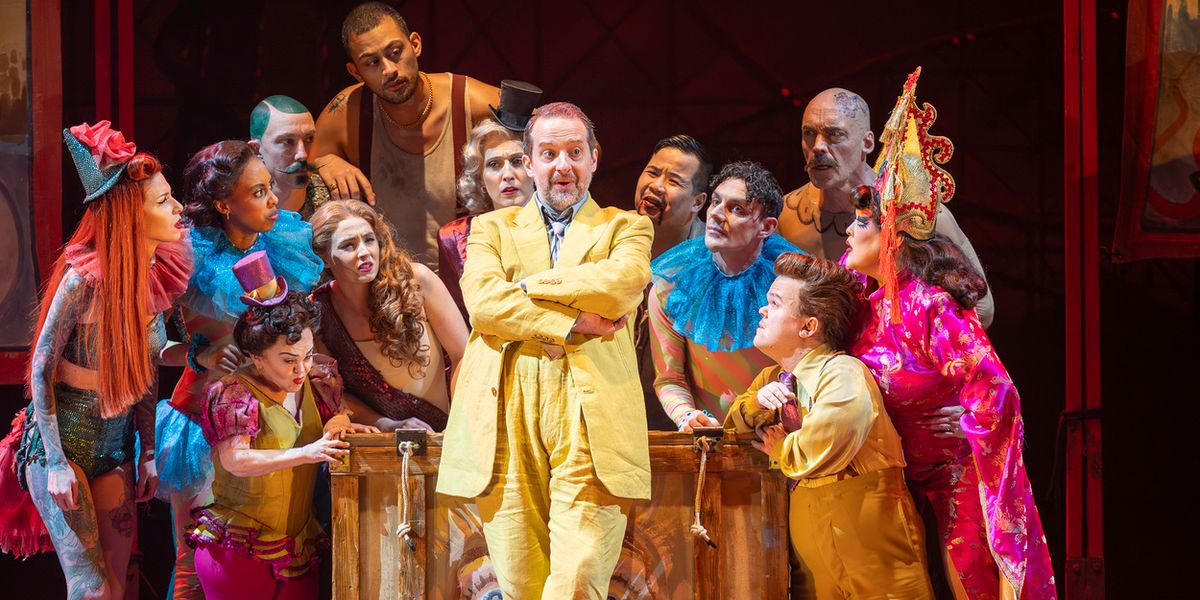
Set around a Coney Island fairground, the most contentious and frankly fabulous aspect of this Così is the inclusion of what is referred to in the programme as the “skills ensemble”. A bizarre term for what is boils down to being a team of highly regarded variety artists, the “ensemble” features celebrated international talent in the form of burlesquer Lilly Snapdragon, bellydancer-slash-sword wielder Leah Debrincat and the 6’11 Alex Heaton (a tall guy for a tall story sounds about right).
-X4.jpg?format=auto&width=800)
Photo credit: James Glossop
While they undoubtedly add visual and physical flair, there is always the lurking danger that Così just becomes a theme park ride. A little too much showboating here, a gag that lingers too long there, and there’s a danger that Mozart’s melodies become background music for a very expensive version of Much Ado About Nothing.
The production skirts this peril with many more successes than failures. There are moments of pure genius which land with the precision of a well aimed custard pie even if a few feel like the pie has been thrown just because there was still one leftover. When it works, it really works. When it doesn’t, you can almost hear Mozart politely clearing his throat.
The cast are all on top form, their performance as sublime as the plot is ridiculous. Indian baritone Darwin Prakash went from studying rocks at the University of Delhi to winning the UK’s National Mozart Competition. Together with British-American tenor Joshua Blue, the pair play Guglielmo and Ferrando respectively as a pair of charmingly devious officers.
Lucy Crowe’s Fiordiligi and Taylor Raven’s Dorabella match their undercover lovers note for note but the evening belongs to the two conspirators. In his canary-yellow suit, Andrew Foster-Williams is a devilish Don Alfonso, sealing the hapless men into a deal which could cost them dear. His accomplice, the chambermaid Despina, gets the best lines as ever but Ailish Tynan does a brilliant job of reminding us why we return to Così time after time.
-X3.jpg?format=auto&width=800)
Photo credit: James Glossop
Amid the fairground reverie and motel room shenanigans, McDermott’s irreverence has a point. By pushing the comedy hard, he exposes the cruelty at the heart of the opera. The laughter catches slightly in the throat. These people are not just silly, they are being experimented on not just by Don Alfonso but by each other, and by a society that treats fidelity both as a joke and a moneyspinner. In that sense, the production feels oddly honest and modern. Love, it suggests, is beautiful, insane and disposable, sometimes all in the same bar of music.
Those deriding McDermott's inclusion of cabaret folk in this apparently non-traditional treatment would do well to remember three things. The first is that — as this is sung in English and the one of the only three Italian words uttered is unforgivably mispronounced — absolute fidelity to the original 1790 production is not an overriding ambition here.
The second is that opera is trying hard to attract audiences that don’t travel to shows on a Freedom Pass while still keeping faith with problematic classical works. It’s a tricky tightrope walk that means inherently misogynistic works like Così and The Magic Flute are happily handed over by the ENO to auteurs like McDermott and Simon McBurney for re-imagining.
The last is that, as much as opera likes to pretend it was born fully formed as a respectable art form complete with marble columns and long Italian vowels, in reality it began life as a glorious sideshow. Early practitioners like Monteverdi were not building temples to high culture but inventing a new kind of spectacle for courts that already had dancing dwarfs, mechanical lions and people paid handsomely to burst into song on cue.
Opera emerged in late Renaissance Italy as an experiment asking what would happen if drama were sung all the time. The answer? Total excess. Bigger emotions, louder feelings, improbable plots and voices doing things no human voice should reasonably attempt. From castrati marketed like exotic marvels to gods descending on visible machinery, opera has always thrived on showiness, surprise and a faint whiff of the freakish. (The red velvet, tuxedos and corporate sponsorships came along some time later.)
At heart, opera remains what it always was: the most elaborate tent at the fair, promising wonder, sensation and more than enough emotional charge to keep things interesting. In that regard, this Così carries on that tradition in grand style.
Read our guest blog with baritone Darwin Prakash here.
Così fan tutte continues at the London Coliseum until 21 February.
Photo credit: James Glossop





Reader Reviews
To post a comment, you must register and login.