


Preview: World Premiere of Moravec-Campbell ALL SHALL RISE at Carnegie, May 5 by Oratorio Society
Under Maestro Kent Tritle, the new work brings a musical form used by Bach and Handel into the 21st century
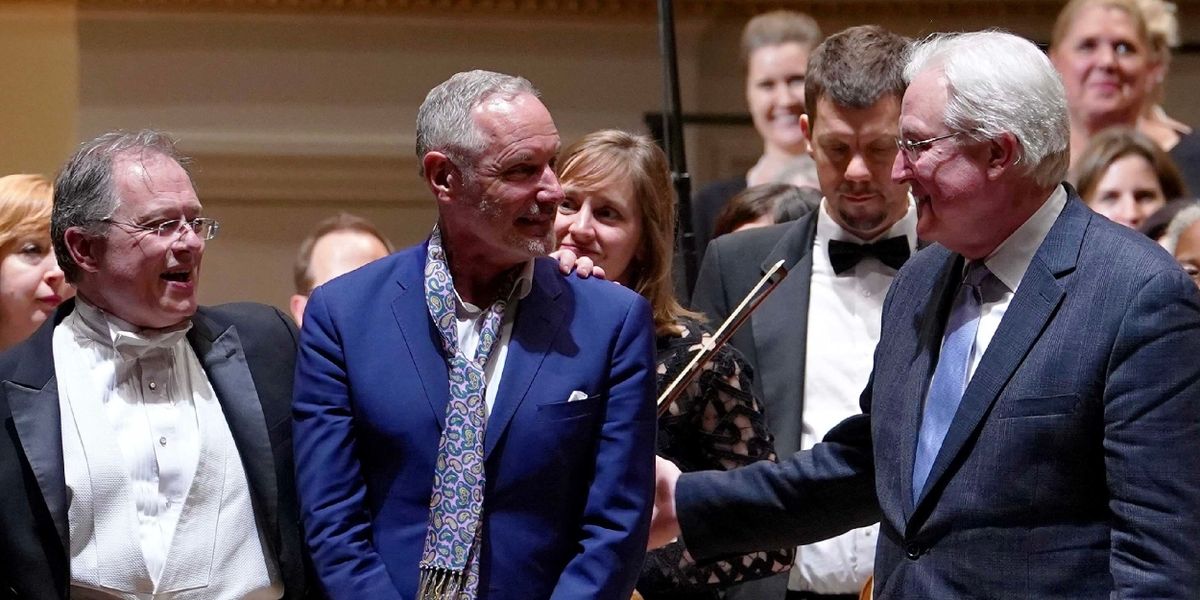
The Oratorio Society of New York (OSNY) under Maestro Kent Tritle brings the world premiere performance of ALL SHALL RISE, by composer Paul Moravec and librettist Mark Campbell, to Carnegie Hall on May 5. It concludes their American Voices trilogy of choral works—this one about the history of voting rights in the US.
That’s not to say that the pieces will be going into storage after the performance and not heard again until someone rediscovers them a century from now. Hardly. The earlier segments of the multipart musical work—SANCTUARY ROAD, about the Underground Railroad, and A NATION OF OTHERS, about Ellis Island and the immigrant experience are the others—were commissioned by OSNY with the underwriting of Jody Spellun and have had dual lives (or are about to) as oratorios and, later, fully staged operas.
But ALL SHALL RISE is a fitting denouement to the trio of compositions, according to the major players in its development, including Moravec and Campbell—and Tritle, who heads the OSNY, which has its own storied history, including the NY premiere in the 19th century of the Brahms Requiem.
Says Tritle, “I think what’s wonderful about these pieces, besides their inherent beauty, is that they bring a new perspective to a form that’s been around for hundreds of years, including notable works by Bach, Handel, Haydn and Mendelssohn, among many others.”
According to the New Oxford American Dictionary, an oratorio is a large-scale musical work for orchestra and voices—typically on a religious theme—performed without costumes, scenery or action.
“During my decades with OSNY, I’ve worked to integrate the music of contemporary composers alongside the traditional pieces we perform,” says Tritle. “Of course, the chorus had previously done lots of premieres of works that have become part of the canon, but were considered new work (or close to it) when they were first performed by them decades or more ago, some conducted by their composers.”
He continues, “Closer to the middle of the 20th century, especially in the ’50s, people became a little afraid of doing contemporary pieces, as composers went out on such interesting limbs with challenging styles; consequently, our group and others like it, began to increasingly rely on traditional formulas for success that were easier for their audiences to relate to.
“What’s happened more recently is that new music began to go in so many varied directions that concert-goers find more relatable. In the case of Paul (Moravec), it’s often a post-romantic approach that is very tonal but nonetheless challenging for our singers.”
He adds, “I want to add variety to the array of music we do, which stretches the abilities of the members of our chorus: expanding our musical aptitude,” he adds, “by doing works that they don’t know and may not be as linear as some of our other repertoire.”
“In the case of the trilogy, the material is also much more relevant to our lives than we might have imagined going into it. Let me be clear: It’s not designed to make a political statement although ultimately it does at some level. I think it’s important for us to have a sense of music being not just something that we use to escape from the stresses and difficulties of the world but something that really motivates us on a deeper level to be the kind of person that we want to be.
“The significance of ALL SHALL RISE being about voting rights is important because of what it means about belonging to society: Am I a full-fledged member of society or am I excluded? It’s something that is universal.
“I think it’s brilliant on the part of Paul and Mark that they didn’t do another time-specific moment. SANCTUARY ROAD was about the Civil War and A NATION OF OTHERS took place in 1921 with the influx of immigrants.
“ALL SHALL RISE could have been set in 1960 in Mississippi. But by the breadth of it—stretching from Revolutionary America to the election of Barack Obama in 2008—I think it acknowledges what we’re really trying to do with the trilogy: Tell the stories of unsung American heroes.
“I was first introduced to Paul when I was working with the Dessoff Choirs, between 1996 and 2004, and he did a cycle called ‘Songs of Love and War.’ When we received the commission for the first part of what’s become the American Voices Trilogy, now titled SANCTUARY ROAD, he brought in Mark, a noted librettist/lyricist with whom he’d recently written a very successful opera setting of Stephen King’s THE SHINING and the rest, as they say is history.”
“Mark had never written an oratorio before, but he’s a very smart guy and understood what I was saying quite rapidly,” says Moravec. “We had already developed a way of working together from doing THE SHINING and it transferred over easily to what we were trying to accomplish with SANCTUARY ROAD.”
But from the start, the two artists began to develop a modern-day riff on the oratorio: “It’s a little more story based, using subjects that have occurred in the past but remain resonant to audiences today,” says Campbell. In SANCTUARY ROAD, they chose what they saw as grand stories, taken from the work of William Grant Still, which were outside the realm of the religious or biblical elements that are central to the traditional oratorio form.
“These three works we developed for OSNY involve ordinary people caught up in extraordinary circumstances,” says Moravec. “And by that I mean what they did was anonymous to history but known to their friends and families.” They are specifically human, individual souls, and the creators frequently used their own words, which Mark had discovered in the course of his research.
Says Campbell, “I never say I do lots of research but ‘enough’—because I believe that there’s a certain point where a story is emerging and I let it take over. I believe that the libretto has to exist as fiction, an original story: It can’t just be an historic cavalcade. For me, that’s dull,” he continues.
“While there’s a certain point when you always have to be true to the facts, you can’t be slavish to them,” asserts Campbell. “I think there are moments of real exhilaration in understanding that democracy is very powerful and that the basic heart of democracy promotes equality. Ultimately, it’s a good time to be doing this piece because it reminds the audience about how powerful democracy is—but also how fragile it is and how we have to work to maintain it.”
In ALL SHALL RISE, Moravec and Campbell have incorporated historical characters—sometimes but not always the most famous on a particular topic—including Benjamin Franklin and Frederick Douglass but also people like Mathilde Franziska Anneke, an adopted American who worked to enfranchise women and published the first woman-owned feminist periodical in the US. Besides quoting them, the work also includes fictional accounts of lives they affected.
“There are aspects of all the stories we use that are always timely—both timely and timeless—and universal, which can be applied anywhere in the world. But,” Moravec adds, “this is not a documentary. It’s not a political, polemical statement. It’s a work of imagination, you know, and I think Mark will tell you the same thing, as fervently as he holds his political views.
“That is the nature of the work: fiction. If you try to put your views across as a political being too heavy-handedly, you’re liable to cut off the impact from just the people you want to reach. You don’t want to be ‘preaching to the choir’ because that way nobody wins.
“What I do is to make a work of art that lets the audience decide what they want to get out of it,” Moravec concludes and Campbell concurs. “What I want people to come away with is hope. Hope—that’s it.”
Caption: (from left) Tritle, Campbell and Moravec at premiere of SANCTUARY ROAD.
Credit: Eduardo Patino/OSNY
Sign up for all the news on the Summer season, discounts & more...
