


Gaudí Centennial Will Be Celebrated With World Premiere of SEVEN DREAMS OF GAUDÍ
The event is on Saturday, June 10, 2026.
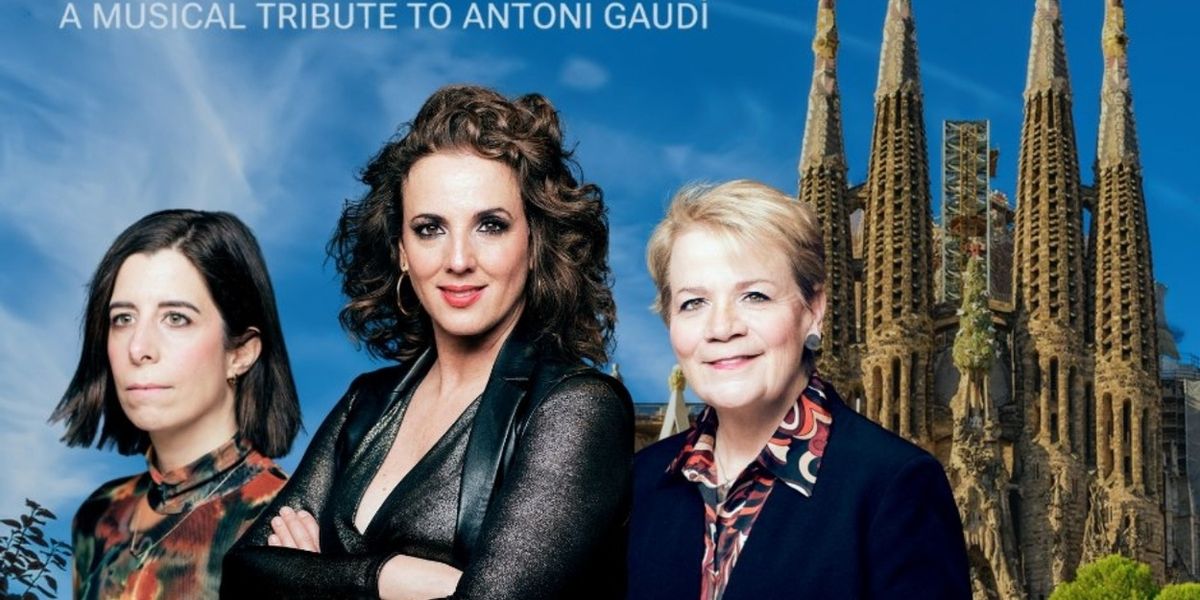
Barcelona will celebrate a landmark cultural event on Saturday, June 10, 2026, the centennial of visionary Catalonian architect Antoni Gaudí's passing, with the world premiere of Boston-based Catalan composer Olivia Pérez-Collellmir's Seven Dreams of Gaudí at the Palau de la Música Catalana. This monumental symphonic choral work featuring a libretto by award-winning Catalonian poet Anna Gual, brings together 200 musicians from the Philharmonia Orchestra and choirs of Orfeó Català, including Chamber Choir of the Palau de la Música Catalana, Youth Choir of the Orfeó Català, and Young Women's Choir of the Orfeó Català, conducted by American conductor Marin Alsop. The program also features Arvo Pärt's Da pacem domine for strings and choir and Tabula Rasa for solo violins, prepared piano, and chamber orchestra.
Seven Dreams of Gaudí unfolds over seven movements or “dreams,” each reflecting a defining moment in Gaudí's artistic and personal journey. Created under the artistic advisorship and mentorship of Argentinian composer Osvaldo Golijov, Pérez-Collellmir and Gual, who recently published her first poetry collection in English and Catalan titled Unnameable, have created a 35-minute work that guides listeners through the movements: “Nature,” “The Workshop,” “Duality,” “Grief,” “The Uprising,” “Prayer,” and “The Basílica.”
Taking place during the “Year of Gaudí,” which is also expected to mark the completion of the Tower of Jesus, the tallest of the eighteen towers rising from the Basilica de la Sagrada Familia, will bring one of Gaudí's unrealized acoustic projects to life. Gaudí's distinctive hyperboloid bells, originally designed for the Sagrada Familia but whose prototypes were lost during the Spanish Civil War, are now being realized by architect and musician Galdric Santana, director of the Gaudí Chair at the Polytechnic University of Catalonia. After more than 12 years documenting and studying Gaudí's designs for the bells and the cathedral towers, Santana is now overseeing their casting. These bells, which will eventually ring from the towers of the Nativity facade, will sound for the first time in a musical context during the finale of Seven Dreams of Gaudí, fulfilling a dream left unfinished during Gaudí's lifetime.
About Seven Dreams of Gaudí
The first movement or dream, “Nature,” transports listeners to Gaudí's childhood and honors nature as one of his greatest teachers. With much of his architecture drawing influence from organic forms, colors, natural structures, and the movement of living beings, this opening movement reveals how nature was a source of creativity for the young architect. Featuring a boy soprano voicing the perspective of a young Gaudí, the soloist is accompanied by voices representing Mother Nature, filling the space with colorful symphonic sound.
The second dream, “The Workshop,” finds influence from Gaudí's father's workshop, where Gaudí developed his ability to perceive space and volume through watching his father work with copper. The movement highlights the percussion section, mirroring the sounds of anvil and hammer strikes. It is propelled by mechanical and rhythmic noises, immersing the listener in the world of blacksmiths and ironworkers, who played a significant role during that era.
Exploring Gaudí's internal world, the third dream, “Duality,” presents the idea of Gaudí as both a visionary genius and an obsessive character. Challenged by the aesthetic and beauty standards of the era, Gaudí faced the emotional turmoil of either conforming to societal expectations or pursuing his own radical visions, which were far ahead of their time.
Dream Four, “Grief,” reflects on Gaudí's intimate bond with the maternal figure and Mother Nature. Having experienced the loss of many loved ones throughout his life, this movement emphasizes the voice of his mother, voiced by a Catalonian soprano, Núria Rial, who was a guiding presence and source of consolation. For Gaudí, grief is not merely sorrow, but an essential part of his emotional and artistic development.
Taking a significant musical and emotional shift, dream five, “The Uprising” commemorates the events of the Tragic Week, a series of violent social unrest and anti-clerical movements involving the Spanish army, anarchists, freemasons, socialists, and republicans in Barcelona and other cities in Catalonia in July 1909. Gaudí, who was a deeply religious man, was shaken by the hatred and destruction, contrasting sharply with his hope for a renewed humanity. Throughout the piece, the music illustrates how his spiritual vision clashes with the chaotic atmosphere of the time.
Reflecting Gaudí's spiritual faith, dream six, “The Prayer,” focuses on his connection with God. As a devout Roman Catholic, Gaudí's faith provided ongoing inspiration, strength, and comfort. Religion greatly influenced his architectural and design work, with the Sagrada Família serving as a physical symbol of the Catholic faith and a place for atonement for the sins of the modern world. Portraying Gaudí's personal spiritual realm, this music in this penultimate movement depicts his intimate and spiritual connection with God.
The final dream, “The Basílica,” is dedicated to the Sagrada Família temple, which symbolizes the synthesis of Gaudí's artistic and spiritual vision. The seventh movement will feature the unique tubular bells Gaudí designed, but never installed. Through Galdric Santana's expertise, the bells have since been constructed and will ring for the first time in history, becoming one of the leading instruments of this movement. The work culminates with the convergence of his deep faith, inspiration from nature, technical mastery, and ambition to elevate architecture into a symbolic and transcendent experience.
Seven Dreams of Gaudí is developed by a diverse team of collaborators, including Galdric Santana as the Historic and Acoustic Advisor, Osvaldo Golijov as the Artistic Advisor, American composer Marti Epstein as the Artistic Mentor, Arturo Rodríguez as Co-Orchestrator, Jennifer Ritvo Hughes as Senior Producer, María del Mar de Ros Raventós as Institutional Relations Advisor, Raquel Peula as Associate Producer, and Almudena Campos as Advisor.
The program originated and is presented by EAC Productions, an independent company founded in 2020 by Renée Chan and Patrick Mitchell, fostering creativity and community through art and music. EAC develops and promotes musical and artistic projects across the US and Spain. EAC is inspired by community, history, and the preservation of local culture, and supports live music productions, street art projects in Barcelona's El Born neighborhood, as well as a musical podcast exploring the history of New Orleans rhythm and blues music.
|
American Composers Orchestra: Hello, America: We Gather Here at Carnegie Hall Carnegie Hall (10/27-10/27) |
|
American Composers Orchestra: New Virtuoso: Low End Theory at Carnegie Hall Carnegie Hall (3/18-3/18) |
|
Carnegie Hall Presents: Santiago Cañón-Valencia and Victor Santiago Asuncion Carnegie Hall (11/10-11/10) |