


|
A Woman of No Importance
(1996) A Woman of No Importance is a play by Irish playwright Oscar Wilde. The play premièred on 19 April 1893 at London's Haymarket Theatre. It is a testimony of Wilde's wit and his brand of dark comedy. It looks in particular at English upper class society and has been reproduced on stages in Europe and North America since his death in 1900. A film based on this play is in production and is due to be released in 2011. |
 |
|
The Definitive Broadway Collection
(1988) This is simply the best and most comprehensive collection of Broadway music ever collected! 142 of the greatest show tunes compiled into one volume - this is one book that every Broadway lover must have! Songs include: Don't Cry for Me Argentina * Edelweiss * Hello, Dolly! * I Could Have Danced All Night * I Dreamed a Dream * I Know Him So Well * Lullabye of Broadway * Mack the Knife * People * Send in the Clowns * Somewhere * Summertime * Sunrise, Sunset * Tomorrow * What Kind of Fool Am I? * ... |
 |
|
Assasins
(1993) Assassins is a musical with music and lyrics by Stephen Sondheim and book by John Weidman, based on an idea by Charles Gilbert, Jr. It uses the premise of a murderous carnival game to produce a revue-style portrayal of men and women who attempted (successfully or otherwise) to assassinate Presidents of the United States. The music varies to reflect the popular music of the eras depicted. The musical first opened Off-Broadway in 1990, and the 2004 Broadway production won five Tony Awards. |
 |
|
What's It All About
(1993) He was born Maurice Joseph Micklewehite in London's impoverished East End. And yet Michael Caine emerged as one of the world's most versatile, enduring, and beloved actors of our time. With the easy charm of a natural raconteur, Caine takes us onto the sets and into the homes of Hollywood's most talented celebrities. Candid, vibrant, and warm, here is a captivating self-portrait of a man who is at once sublimely ordinary and freshingly unique, one of the greatest actors in film today. |
 |
|
The Big Book of Broadway
(1994) This 2003 revised edition includes 70 songs from classic musicals to recent blockbusters like The Producers, Aida and Hairspray. Includes: All I Ask of You * Bring Him Home * Camelot * Elaborate Lives * Everything's Coming up Roses * If I Loved You * The Impossible Dream (The Quest) * A Lot of Livin' to Do * One * Some Enchanted Evening * Tell Me on a Sunday * Thoroughly Modern Millie * Till There Was You * What I Did for Love * and more. |
 |
|
The Actor's scenebook: Scenes and monologues from contemporary plays
(1984) Schulman and Mekler provide 78 new, fully playable scenes with story notes, including more monologues for men and women from today's best new plays. A diverse selection of scenes and characters to challenge the full range of readers' talents as actors. |
 |
|
The Sanford Meisner Approach: An Actors Workbook
(1994) Founding member of the famed Group Theater and friend, colleague, and later rival to Lee Strasberg, Sanford Meisner spent his life teaching a variation of the Stanislavsky-based Method acting that brought Strasberg so much fame. In this clearly written introduction to Meisner's techniques, Silverberg, himself a graduate of Meisner's Neighborhood Playhouse School of Theater, outlines a 15-week program of exercises designed by Meisner to help actors approach each performance with the playful spon... |
 |
|
On Method Acting
(1989) Practiced by such actors of stature as Marlon Brando, Robert De Niro, Julie Harris, Dustin Hoffman, and Ellen Burstyn (not to mention the late James Dean) the Method offers a practical application of the renowned Stanislavsky technique. On Method Acting demystifies the "mysteries" of Method acting -- breaking down the various steps into clear and simple terms, including chapters on: Sense Memory -- the most vital component of Method acting Improvisation -- without it, the most integral p... |
 |
|
Drafting for the Theatre
(1992) This process-oriented text—supplemented by 280 illustrations—is structured to provide students with a proper and practical approach to the development of drafting and related skills for the theatre. Dennis Dorn and Mark Shanda emphasize the standard drafting and designing practices of the theatre industry through a series of projects and exercises that help the student in the development of research skills. The early sessions focus on the basics of lettering, tool introduction, geometric... |
 |
|
The Playboy of the Western World and Riders to the Sea
(1993) Two beautifully crafted dramas set among the folk of the Aran Islands and western Irish coastlands. The Playboy of the Western World deals with its young hero’s progress, in the eyes of others, from timid weakling to paragon of bravery. Riders to the Sea is a dark elegy to the fragile existence of those who live at the mercy of the sea. Reprinted from authoritative editions, complete with Synge’s preface to The Playboy of the Western World. New introductory Note. |
 |
|
Travesties
(1994) Travesties was born out of Stoppard's noting that in 1917 three of the twentieth century's most crucial revolutionaries -- James Joyce, the Dadaist founder Tristan Tzara, and Lenin -- were all living in Zurich. Also living in Zurich at this time was a British consula official called Henry Carr, a man acquainted with Joyce through the theater and later through a lawsuit concerning a pair of trousers. Taking Carr as his core, Stoppard spins this historical coincidence into a masterful and riotous... |
 |
|
The Right to Speak: Working with the Voice
(1993) In The Right to Speak, renowned voice teacher Patsy Rodenburg teaches you how to meet any speaking challenge with total self-assurance. Rodenburg has trained thousands of actors, singers, media personalities, lawyers, politicians, business people, teachers and students in the art of using their voice fully and expressively without fear. She has taught them how to breathe, how to support their breath, how to stretch their voice to meet any vocal effort and how to have total confidence in whatever... |
 |
|
The Heidi Chronicles
(1991) The graduating seniors of a Seven Sisters college, trying to decide whether to pattern themselves after Katharine Hepburn or Emily Dickinson. Two young women besieged by the demands of mothers, lovers, and careers--not to mention a highly persistent telephone answering machine--as they struggle to have it all. A brilliant feminist art historian trying to keep her bearings and her sense of humor on the elevator ride from the radical sixties to the heartless eighties. |
 |
|
Voice and the Actor
(1991) "Speaking is part of a whole: an expression of inner life." Cicely Berry has based her work on the conviction that while all is present in nature our natural instincts have been crippled from birth by many processes—by the conditioning, in fact, of a warped society. So an actor needs precise exercise and clear understanding to liberate his hidden possibilities and to learn the hard task of being true to the ‘instinct of the moment’. As her book points out with remarkable persuasiveness ‘... |
 |
|
The Stagecraft Handbook
(1996) This manual covers every aspect of scenery c onstruction, with information on shop organisation, tools, s afety, scaled drawings and materials as well as construction techniques. A wealth of illustrations help show how to make quick, inexpensive scenery. ' |
 |
|
Costume Designer's Handbook: A Complete Guide for Amateur and Professional Costume Designers
(1992) Newly revised and updated, The Costume Designer's Handbook is now more comprehensive than ever and is the backbone of any costume designer's library since its original publication in 1983. |
 |
|
Towards a Poor Theatre
(1991) "One of the century's most impressive theatrical manifestos" - Irving Wardle Jerzy Grotowski created the Theatre Laboratory in Opole, South-West Poland, in 1959. His work since then, with a small permanent company, became one of the most potent sources of information for modern actors and directors. This is a record of the ideas that motivated the work of the Theatre Laboratory, and of the company's methods and discoveries.In his Preface Peter Brook writes: "Grotowski is unique. Why? Because no ... |
 |
|
Ginger: My Story
(1992) Winning a dance contest in Texas launched the 14-year-old Virginia Katherine McMath on her acting career and eventful personal life, episodes, emotions and dialogue from which she recreates here in exhaustive detail. Now 79, this devout Christian Scientist recalls her early vaudeville days in a determinedly upbeat tone, as well as her stage and film hits, including the 10 musicals-- Top Hat , Swing Time , etc.--in which she and Fred Astaire co-starred. Also discussed is Rogers's Oscar-winning Ki... |
 |
|
Creating Unforgettable Characters
(1990) In this book, Linda Seger shows how to create strong, multidimensional characters in fiction, covering everything from research to character block. Interviews with today's top writers complete this essential volume. |
 |
|
No Acting Please
(1979) No Acting Please-Beyond the Method a Revolutionary Approach to Acting and Living. Foreword by Jack Nicholson |
 |
|
Free to Act: An Integrated Approach to Acting
(1990) Free to Act presents a holistic approach to actor training that integrates physical and psychological technique. Its integrated approach emphasizes the idea that the body informs the mind and that emotion is rooted in physical action. Providing a carefully developed system of training, Free to Act guides the student-actor through the complex process by which an actor is formed. |
 |
|
The Best Broadway Songs Ever
(1985) We've made this book even better with the addition of songs from some of Broadway's latest blockbusters such as Miss Saigon, The Phantom of the Opera, Aspects of Love, Les Miserables, and more - over 70 songs in all! Highlights include: All I Ask of You * As Long As He Needs Me * Bess, You Is My Woman * Bewitched * Camelot * Climb Ev'ry Mountain * Comedy Tonight * Don't Cry for Me Argentina * Everything's Coming Up Roses * Getting to Know You * I Could Have Danced All Night * I Dreamed a Dream *... |
 |
|
Building A Character
(1989) This is the second volume of Stanislaviski's enduring trilogy on the art of acting. The "System" which he describes is a means both of mastering the craft of acting and of stimulating the actor's individual creativeness and imagination. It has become the central force determining almost every performance we see on stage or screen, and still remains today the only comprehensive theory of acting we possess. In Building a Character Stanislavski discusses with mastery and insight the actor's physic... |
 |
|
Three Plays: Desire Under The Elms, Strange Interlude, Mourning Becomes Electra
(1995) These three plays exemplify Eugene O'Neil's ability to explore the limits of the human predicament, even as he sounds the depths of his audiences' hearts. |
 |
|
The Actor's Book of Contemporary Stage Monologues
(1987) This is the only book that offers a comprehensive collection of contemporary stage monologues for a complete range of roles. An invaluable tool for actors looking for new audition material or for anyone interested in theater. |
 |
|
J.B: A Play in Verse
(1989) Based on the story of Job, this drama in verse tells the story of a twentieth-century American banker and millionaire whom God commands be stripped of his family and wealth, but who refuses to turn his back on God. J.B. won the Pulitzer Prize for drama in 1959 and the Tony Award for best play. More important, the play sparked a national conversation about the nature of God. |
 |
|
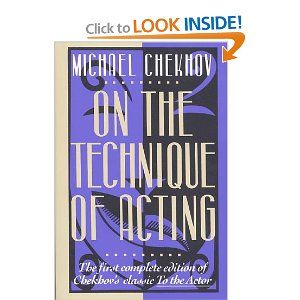
On the Technique of Acting
(1993) In the four decades since its first publication, Michael Chekhov's To the Actor has become a standard text for students of the theater. But To the Actor is a shortened, heavily modified version of the great director/actor/teacher's original manuscript, and On the Technique of Acting is the first and only book ever to incorporate the complete text of that brilliant manuscript. Scholars and teachers of Chekhov's technique have hailed On the Technique of Acting as the clearest, most accurate presen... |
 |
|
The Beggar's Opera
(1987) Written in 1728, John Gay’s opera caricatures society, marriage and Italian operatic style in this comic satire which is considered revolutionary because it took on poverty and corruption as its subject as told by the thieves, prostitutes and villains of the slums and prisons of 18th century London. The lyrics were set to famous songs the day making it hugely popular with audiences and a radical departure from traditional opera. Bertolt Brech and Kurt Weill’s The Threepenny Opera is based on... |
 |
|
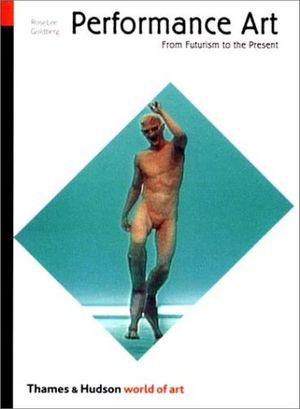
Performance Art: From Futurism to the Present
(1988) Performance is in some sense a combination of theater, dance, mime, concept art, music, and-today-even video; it can be simply defined as live art by artists. Goldberg discusses its origins in tribal rituals and passion plays and its twentieth-century revival by the Futurists. Surrealists, Dadaists, and Bauhaus artists. |
 |
|
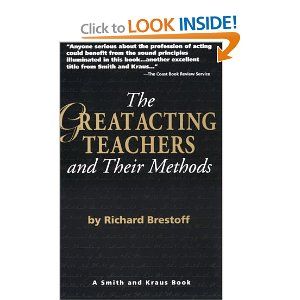
The Great Acting Teachers and Their Methods
(1995) With clarity and insight, Richard Brestoff introduces the great acting teachers, explaining their techniques and how ther are applied today. Beginning with Quintilian and Delsarre he guides us to the present with an inside look at what is currently being taught in the major acting schools and private acting studios; The Actor's Studio, Yale University, NYU, Juillard and many more are visited. Great Acting Teachers and Their Methods will help you understand the most important ideas about acting, ... |
 |
|
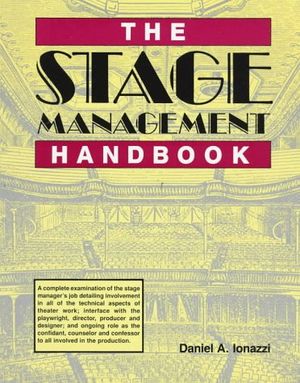
The Stage Management Handbook
(1992) Offers advice, for both professional and amateur stage managers, on putting on a show, discussing its three phases, and includes information on the organizational structure of theaters and how to manage human behavior. |
 |
|
The Theater and Its Double
(1994) A collection of manifestos originally published in 1938, The Theater and Its Double is the fullest statement of the ideas of Antonin Artaud. “We cannot go on prostituting the idea of the theater, the only value of which is in its excruciating, magical relation to reality and danger,” he wrote. He fought vigorously against an encroaching conventionalism he found anathema to the very concept of theater. He sought to use theater to transcend writing, “to break through the language in order to... |
 |
|
Les Miserables: Vocal / Piano Selections
(1987) This terrific songbook features 14 vocal selections from the beloved Broadway musical: At the End of the Day * Bring Him Home * Castle on a Cloud * Do You Hear the People Sing? * Drink with Me (To Days Gone By) * Empty Chairs at Empty Tables * A Heart Full of Love * I Dreamed a Dream * In My Life * A Little Fall of Rain * Master of the House * On My Own * Stars * Who Am I?. Also includes beautiful full-color photos from the production. |
 |
|
Galileo
(1994) Considered by many to be one of Brecht's masterpieces, Galileo explores the question of a scientist's social and ethical responsibility, as the brilliant Galileo must choose between his life and his life's work when confronted with the demands of the Inquisition. Through the dramatic characterization of the famous physicist, Brecht examines the issues of scientific morality and the difficult relationship between the intellectual and authority. This version of the play is the famous one that was ... |
 |
|
Me: Stories of My Life
(1992) Admired and beloved by movie audiences for over sixty years, four-time Academy Award-winner Katharine Hepburn is an American classic. Now Miss Hepburn breaks her long-kept silence about her private life in this absorbing and provocative memoir. |
 |
|
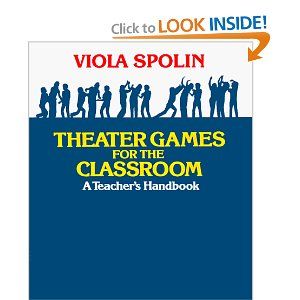
Theater Games for the Classroom: A Teacher's Handbook
(1986) Based on the best-selling book by Viola Spolin, this new CD-ROM of Theater Games for the Classroom offers the most comprehensive theater instruction for all types of students, from small children to young adults. It includes over 130 theater games and exercises, instructional strategies, video examples, a lesson planning section, alignment to other curricular areas, and alignment to California Theatre Arts standards. First developed by Spolin, the originator of modern improvisational theater tec... |
 |
|
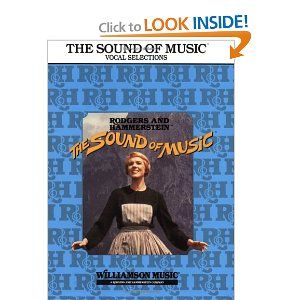
The Sound of Music: Vocal Selections
(1981) 11 songs: Climb Ev'ry Mountain * Do-Re-Mi * Edelweiss * I Have Confidence * The Lonely Goatherd * Maria * My Favorite Things * Sixteen Going on Seventeen * So Long, Farewell * Something Good * The Sound of Music. |
 |
|
Sense of Direction: Some Observations on the Art of Directing
(1984) By the founder of the famous American Conservatory Theatre (A.C.T.) in San Francisco - a candid account of his working method as a director. A Sense of Direction represents a life's work in directing. William Ball engages his audience in a wide-ranging discussion of the director's process, from first read-through to opening night. An informative, insightful, and often astonishingly clear look at the the process of making theatre. |
 |
|
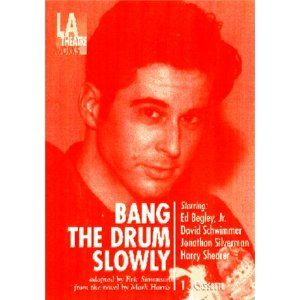
Bang The Drum Slowly
(1992) Sure, Harris's most acclaimed novel, the second of his Henry Wiggen books, centers around a pair of ballplayers for the fictionally fabled New York Mammoths--the novel's narrator, pitcher Wiggen, and Bruce Pearson, his tag-along catcher and best friend. And sure, on one level, it's the conventional tale of a disparate dugout population cohering over the course of a season and marching ineluctably toward the World Series. But convention, like a 55-foot curveball, ends there and then scoots off i... |
 |
|
Scene Design and Stage Lighting
(1985) Stressing recent innovations in stage lighting, the authors reveal the techniques and skills involved in designing sets for theatrical productions. |
 |
|
The Prop Builder's Molding & Casting Handbook
(1989) Demonstrates how to work with molds, castings, and vacuum forming equipment, stresses safety precautions, and discusses materials from paper-mache to breakaway glass. |
 |
|
Designing with Light: An Introduction to Stage Lighting
(1983) This comprehensive survey of the practical and aesthetic aspects of basic stage lighting design treats its subject as an art closely integrated with that of the director, actor, and playwright, and as a craft that provides practical solutions for the manipulation of stage space. An eight-page color section provides a discussion of the practical applications of color theory as well as an analysis of the color choices for the lighting design of an actual production. Numerous illustrations of techn... |
 |
|
The Pot of Gold and Other Plays
(1965) One of the supreme comic writers of the Roman world, Plautus (c.254–184 BC), skilfully adapted classic Greek comic models to the manners and customs of his day. This collection features a varied selection of his finest plays, from the light-hearted comedy Pseudolus, in which the lovesick Calidorus and his slave try to liberate his lover from her pimp, to the more subversive The Prisoners, which raises serious questions about the role of slavery. Also included are The Brothers Menaechmus, which... |
 |
|
The Threepenny Opera
(1994) Brutal, scandalous, perverted, yet humorous, hummable, and with a happy ending- Bertolt Brecht's revolutionary masterpiece The Threepenny Opera is a landmark of modern drama that has become embedded in the Western cultural imagination. Through the love story of Polly Peachum and "Mack the Knife" Macheath, the play satirizes the bourgeois of the Weimar Republic, revealing a society at the height of decadence and on the verge of chaos. Complemented with music by Kurt Weill, it was one of the earli... |
 |
|
Stage Makeup
(1990) Key Benefit: A classic in the field, this book helps makeup artists and actors learn the proper technique when applying stage makeup. Key Topics: This easy, step-by-step guide is comprised of 20 comprehensive chapters covering all aspects of stage makeup application. Topics include: basic techniques as well as new methods and materials for all types of stage makeup; updated information on hairstyles and fashions. Revered as the stage makeup bible, this book includes listings of makeup colors fro... |
 |
|
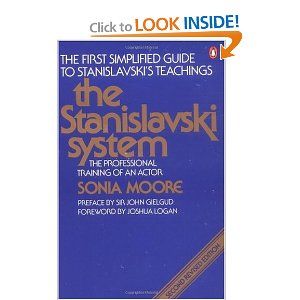
The Stanislavski System: The Professional Training of an Actor
(1984) This clearly written guide to the Stanislavski method has long been a favorite among students and teachers of acting. Now, in light of books and articles recently published in the Soviet Union, Sonia Moore has made revisions that include a new section on the subtext of a role. She provides detailed explanations of all the methods that actors in training have found indispensable for more than twenty years. Designed to create better actors, this guide will put individuals in touch with themselves... |
 |
|
A Challenge for the Actor
(1991) This volume completes Hagen's earlier classic, Respect for Acting (Macmillan, 1973). The beliefs, professionalism, and standards of training and performance that make Respect required reading for all actors are explored in this acting textbook that represents a lifetime of performance and teaching. Unlike the more academic texts, Hagen's study reflects exercises, insights, and techniques that have been taught and practiced in acting studios and on stages for many years. Readers should not be pu... |
 |
|
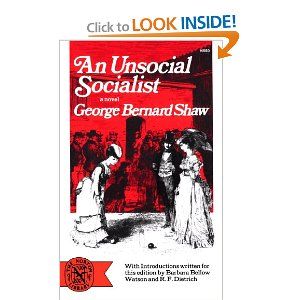
An Unsocial Socialist
(1972) An Unsocial Socialist was published in 1887, having been written in 1883. The tale begins with a humorous description of student antics at a girl's school then changes focus to a seemingly uncouth laborer who, it soon develops, is really a wealthy gentleman in hiding from his overly affectionate wife. He needs the freedom gained by matrimonial truancy to promote the socialistic cause, to which he is an active convert. Once the subject of socialism emerges, it dominates the story, allowing only ... |
 |
|
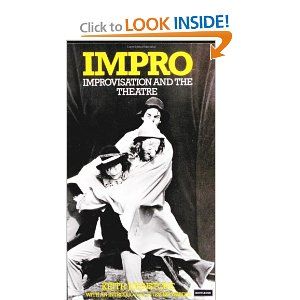
Impro: Improvisation and the Theatre
(1987) Impro ought to be required reading not only for theatre people generally but also for teachers, educators, and students of all kinds and persuasions. Readers of this book are not going to agree with everything in it; but if they are not challenged by it, if they do not ultimately succumb to its wisdom and whimsicality, they are in a very sad state indeed . . . .Johnstone seeks to liberate the imagination, to cultivate in the adult the creative power of the child . . . .Deserves to be widely read... |
 |
|
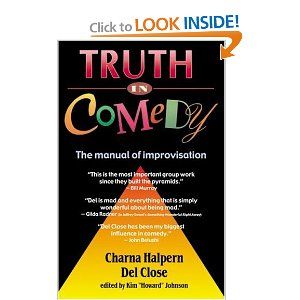
Truth in Comedy: The Manual of Improvisation
(1994) Who would have ever thought that learning the finer points of improvisation could be such fun? The "Harold," an innovative improvisational tool, helped Saturday Night Live's Mike Myers and Chris Farley, George Wendt (Norm on "Cheers") and many other actors on the road to TV and film stardom. Now it is described fully in this new book for the benefit of other would-be actors and comics. The "Harold" is a form of competitive improv involving six or seven players. They take a theme suggestion from... |
 |
Videos