


Review: Brooklyn Ballet's “SOFT POWER” Breaks Ballet's Rules
In "SOFT POWER," the choreographers don’t just merge forms; they chip away at the edges of different disciplines and soften the apparently rigid boundaries between them.
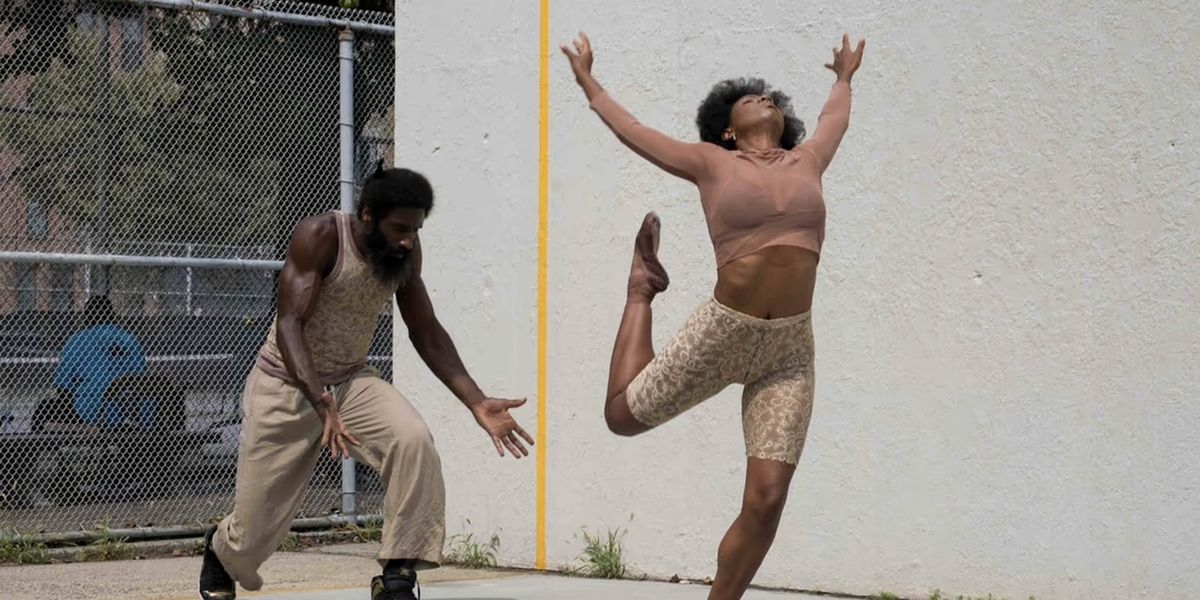
Entering the theatre for Brooklyn Ballet’s SOFT POWER, my friend and I nearly chose to sit on floor cushions. We would be inches from the dancers, and, with our legs stretched in front of us, practically on stage ourselves. An usher moved us to the second row—the floor, it turns out, was punishment for latecomers—but it didn’t lessen the sense of intimacy. Rarely does a night at the ballet feel quite so cozy.
The Mark O’Donnell Theatre, Brooklyn Ballet’s home base, has no wings or curtains. It’s a black box, and save a grand piano, there are neither sets nor scenery. The lines between audience and performer blur: when they aren’t “on stage,” the dancers linger on the perimeter, watching alongside the crowd. Rather than elevating performers above the audience, we meet them face-to-face. We sat so close that I could hear how new the dancers’ pointe shoes were and watch their faces grow slick with sweat.
Doing away with conventional boundaries is Brooklyn Ballet’s raison d’être. Since its inception in 2002, the company has differentiated itself by challenging ballet’s accepted rules (its version of The Nutcracker includes several hip-hop sequences) and imagining how the Eurocentric art form can reflect Brooklyn’s diversity. SOFT POWER is no exception: the show’s advance publicity makes much of its mingling of ballet with street dance, modern, and other styles in a “shared spectrum of dance.” Yet the choreographers don’t just merge forms; they chip away at the edges of different disciplines and soften the apparently rigid boundaries between them. They question what shifting cultural frameworks these categories are based on—and whether they still hold relevance in the interdisciplinary churn of 21st-century dance.
Alexis Diggs’ Dreams of Tomorrow appears straightforwardly contemporary: there are bare feet, loose pants, and neutral tones. The dance is all soft curves and circular movement, with each dancer moving fluidly between floor and air. Yet obsessive repetition and poised, long-limbed athleticism underpin the piece and anchor the movement in ballet technique. At its conclusion, the dancers repeat the same sequence in unison—a slow rond de jambe, a careful balance—before exiting one by one. One dancer, the lyrical Lindsey Casale, remains, repeating the phrase with mounting effort and concentration until the lights go down.
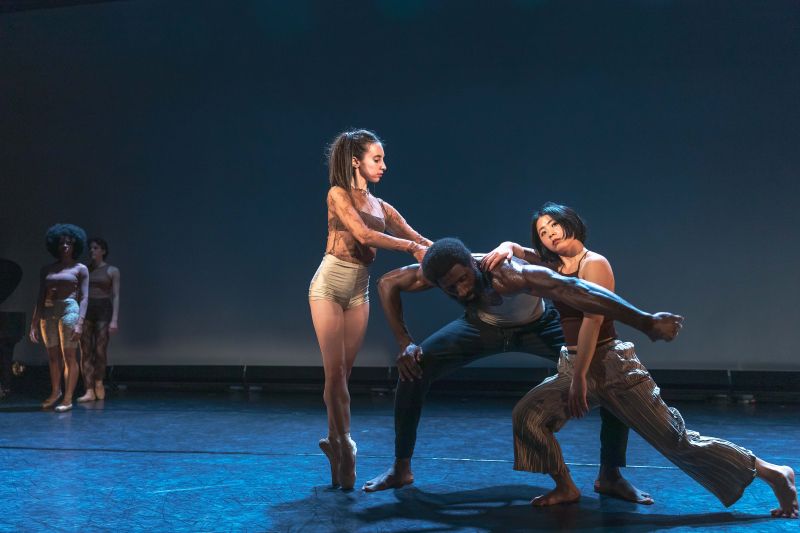
This merger of disciplines is most visible in Brooklyn Ballet Artistic Director Lynn Parkerson’s sub-binary, a piece whose name alone alludes to the undermining of binary systems. Beginning with a tension-filled duet between the buoyant Tristan Grannum and the spellbinding krumper Brian “HallowDreamz” Henry—a larger-than-life presence who seems capable of shaking out of his skin—the piece soon breaks out of the house it built for itself. Three dancers en pointe and a petite street dancer (Natasha Huang) enter, and the piano player trades his keys for a mixer. They respond to rather than negate one another: the ballet dancers grow freer and looser-limbed; the contemporary dancers bend and twist with contained, balletic elegance. A trio between Henry, Huang, and Casale (now en pointe) is particularly striking. As the dancers bear one another’s weight and climb through each other’s arms, we watch them experiment with and influence each other’s movement, finding the common ground between distinct styles.
The equilibrium achieved in sub-binary, however, is difficult to sustain. The last two pieces, Mike “Big Mike” Fields’ Let ‘Em Cook and Alexis Zanety’s Absence, feel out of place and over-performed in comparison to the show’s subtler first half. Let ‘Em Cook revolves around four pairs of dancers standing in a circle, with each group presenting two streetdance duets. While Huang and partner Calista Olson produce savvy breakdancing, most of the phrases feel underdeveloped and awkward, like high schoolers forced to perform at their annual recital. Whereas sub-binary accentuates each dancer’s strengths, here, the dancers’ gaps in skill and experience are evident.
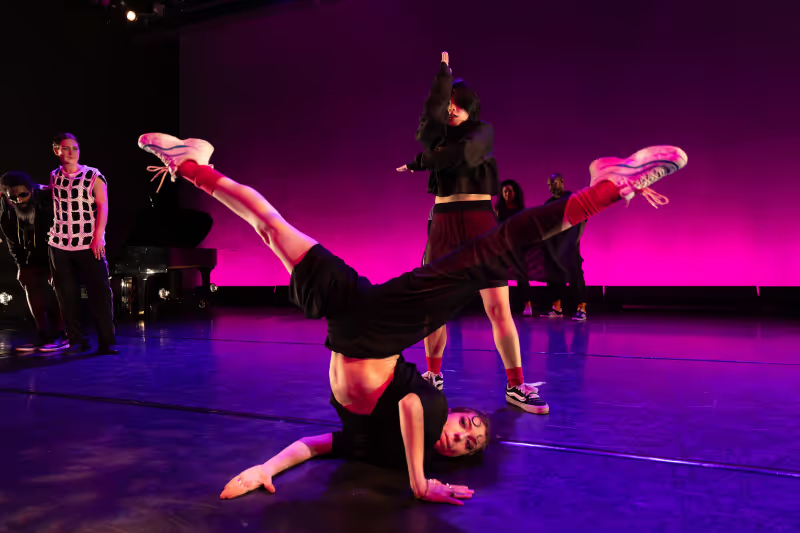
At points touching, Absence—an homage to Zanety’s deceased mother—similarly feels half-baked. What could be a fascinating collage of musical and movement styles (Zanety samples African drums, Spanish poetry, and the natural soundscape) collapses without a clear center, dissolving into disorienting chaos. When the dancers holler out in a moment meant to convey catharsis, I felt jarred rather than moved. By the time Mozart’s Lacrimosa plays, it’s clear the piece has not earned its dramatic conclusion.
SOFT POWER stands as proof that putting long-isolated dance forms in contact with each other is an inevitably imperfect venture. Sometimes the dancers fall out of turns. Often, they move out of sync. The entire show, frankly, could have used one or two extra rehearsals. Yet this messiness is the trade-off of taking risks in the dance world, and my friend and I left invigorated, confident their daring had paid off.
The Mark O'Donnell Theatre is located at 160 Schermerhorn Street, Brooklyn, New York 11201. For tickets to Brooklyn Ballet's upcoming performances, please visit Brooklyn Ballet: Events and Tickets.
Sign up for all the news on the Fall season, discounts & more...

Reader Reviews
To post a comment, you must register and login.