


Theatergoing in the Time of The Gilded Age
The Gilded Age is set in the 1880s in New York City.
Do you have a burning Broadway question? Dying to know more about an obscure Broadway fact? Broadway historian and self-proclaimed theatre nerd Jennifer Ashley Tepper is here to help with Broadway Deep Dive. BroadwayWorld is accepting questions from theatre fans like you. If you're lucky, your question might be selected as the topic of her next column!
Submit your Broadway question here!
This time, the reader question was: What was theatergoing like for the characters of The Gilded Age? What shows did they see?
The Gilded Age recently wrapped up its third season on HBO, to record-setting viewership. Much to the delight of theatre fans, the cast of the show includes a wealth of actors who are beloved for their work in theatre. Cast by Adam Caldwell and Bernie Telsey, The Gilded Age shoots in the New York area, which gave the team the ability to cast many actors who regularly work in theatre. Both Michael Engler, the show’s executive producer and director of many episodes, and Julian Fellowes, the creator, lead writer, and show runner, have roots in theatre. They were open to filling the screen with theatrical favorites, which has made The Gilded Age the hit show that it is.
Many roundups have been written about the storied theatrical careers of The Gilded Age’s actors. The Gilded Age very likely boasts the most Tony Award winners who have ever appeared in one television show, including Cynthia Nixon, Christine Baranski, Audra McDonald, Debra Monk, Phylicia Rashad, Celia Keenan-Bolger, Kelli O’Hara, Donna Murphy, Michael Cerveris, Nathan Lane, Robert Sean Leonard, Katie Finneran, Laura Benanti, Andrea Martin, Victoria Clark, Brian Stokes Mitchell, Bill Irwin, and Leslie Uggams. This is not to mention the rest of the illustrious cast, which is filled with stars of stage and screen. Social media has blown up each time a cast member has shared backstage content involving theatre, such as a recently posted singalong of “Send in the Clowns”. Endless videos have also been shared celebrating theatre career high points of Gilded Age actors, as they have wowed on screen each week.
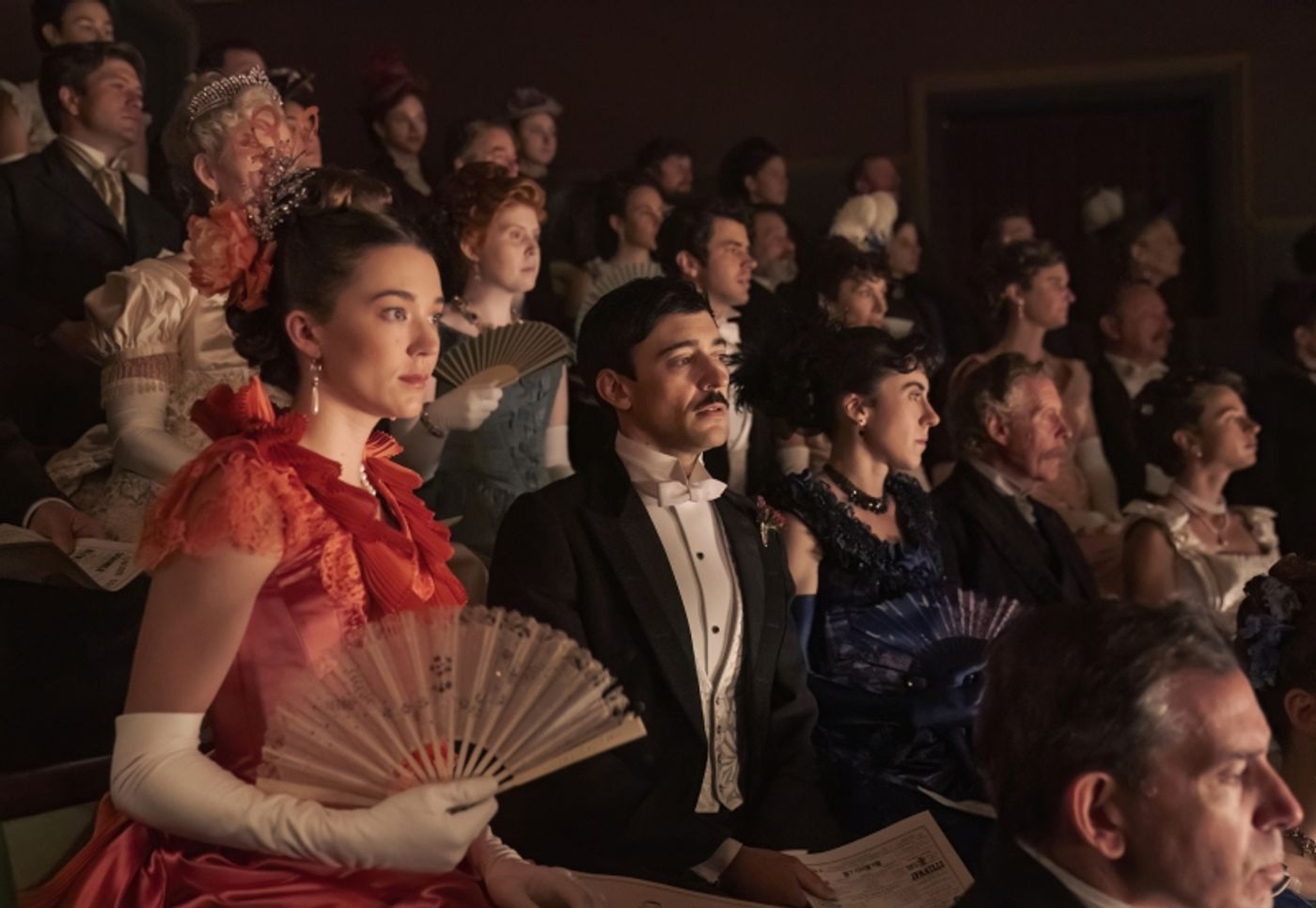
But The Gilded Age and its characters have an even deeper connection to our theatre world. These characters not only attended live performances, the performances were a cornerstone of their social life. Both the upper class society folks and the striving working class people of the era and thus the television show attended theatre in the form of comic operas, straight plays, vaudeville, burlesque, and more.
One episode depicts a large number of the core cast of characters attending the world premiere of Oscar Wilde’s first play, Vera; or, the Nihilists. The piece opened at the Union Square Theatre and ran for only one week due to lousy reviews. Opening in the midst of a heat wave (before the invention of modern air conditioning) didn’t help. Historically accurate as always, The Gilded Age shows the ladies in the listless audience fanning themselves in the hope of relief from the heat. The political play based on a true story depicted a Russian peasant named Vera who joined a group of revolutionaries in their attempt to assassinate a politician, a plot which is depicted briefly during the episode.
An article in the original Life Magazine made a comedic attempt to skewer the play, sending an unfit office boy to review it because no one else on staff wanted to attend. The piece concluded with the paper’s actual critic sending a quick negative review on a postcard from his country home in Newport. Perhaps the critic’s Newport home was nearby that of the Russells.
Because Wilde was starting to make a name for himself as an orator and poet, including one previous lauded trip to America the prior year, Vera; or, The Nihilits was highly anticipated. Tickets were in demand… right until they were not, because of the critical pans. Newspapers did note that the opening night performance, which the Gilded Age characters attended, was heavily populated by actors. Many actors lived in the Union Square area and it was not unusual for both celebrity and journeyman actors to receive invitations to an opening night at the Union Square Theatre. So the folks sitting elbow to elbow with—or more likely, one or two levels above—the characters in The Gilded Age would have been artists working on other nearby shows.
Aurora Fane invites Marian Brook to the opening, ostensibly an opportunity for her to get to know Maud Beaton better, as Maud is being courted by Oscar van Rhijn. Aurora also invites Larry Russell and Gladys Russell, who is escorted by John Adams. True to the spirit of Wilde, this means that Oscar and John, who are secretly in love, are attending the play in the guise of courting women. Meanwhile, Marian’s date is Dashiell Montgomery and Larry attends Vera with his clandestine lover, Susan Blane. This makes for a large crowd of our favorite characters gaping at the stage of the Union Square Theatre as the tragedy of Vera plays out.
Maud comments to Oscar during the performance that when Wilde was in New York lecturing the previous year, she met him at a society dinner. She confides that his appearance then was much more impressive than the play is. As The Gilded Age does so well, this weaves historical accuracy with plot development, since we later find out that Maud is only pretending to occupy a spot among the elite. This is a good lie that she tells, since indeed seeing Wilde as a dinner after his hit lecture would’ve been a glamorous honor in 1882.
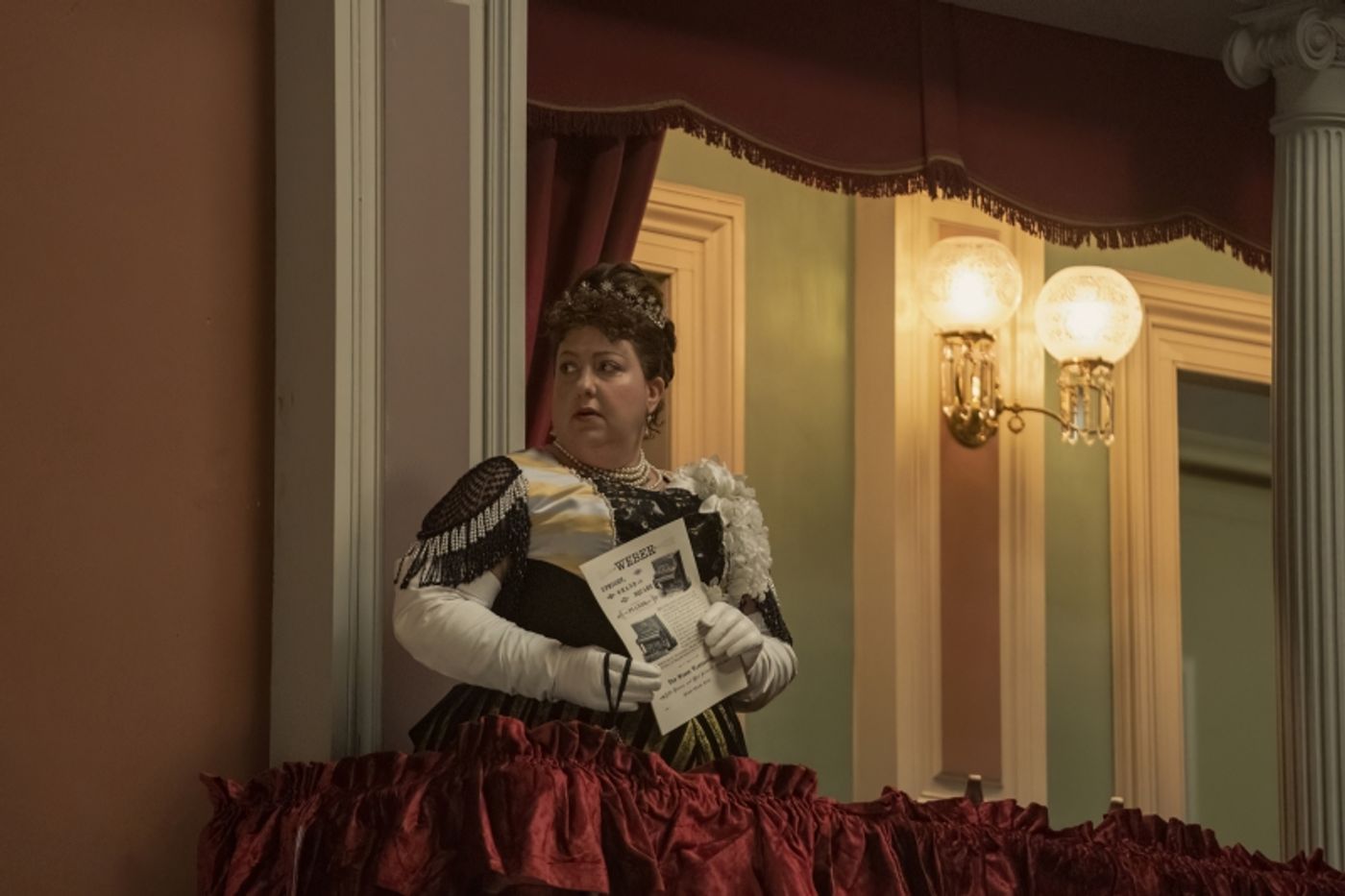
On the show, Aurora is the hostess of an opening night party in honor of Vera. We get to see both Oscar and John banter with Oscar Wilde, Oscar while concealing his true negative opinion of the play. Wilde announces that he doesn’t think the production will run, displays a keen attraction to John (who he infers is a fellow homosexual), and quips that Gladys is a critic after her summary of the evening.
Wilde’s lecture tour the previous year was done in conjunction with the Gilbert and Sullivan comic opera, Patience. Wilde and the production shared a booking manager, and a character in Patience seemed to imitate Wilde. So, the lecture tour was meant to act as supplementary material for the show. Both were a huge success, and it’s very likely that even if Maud Beaton’s interaction with Wilde was a lie, other Gilded Age characters would’ve seen Wilde’s performance or met him in society in 1882. Perhaps Aurora Fane first made Wilde’s acquaintance this way, and also attended Patience at the Standard Theatre.
In London, Patience became the first production in the world to be lit by electricity. The technological advances of electricity were gradually being incorporated into the world of theatre, just as The Gilded Age has shown them being incorporated into other elements of life. In fact, in 1885, two years after the current Gilded Age timeline, the old Lyceum Theatre (on 4th Avenue near 23rd Street) would become New York’s first theater entirely lit by electricity. Just like in The Gilded Age episode about the New York Times building, Thomas Edison participated in lighting up the place.
The New York premiere of Patience at the Standard Theatre was also distinguished, as the writers Gilbert and Sullivan had become a sensation after H.M.S. Pinafore and The Pirates of Penzance. While Agnes van Rhijn might not have approved of the low brow antics in these comic operas, undoubtedly several of our other characters would have seen the phenomenons that were Gilbert and Sullivan operas premiering in New York in the 1870s and 1880s.
Based on what we’ve seen, Aurora Fane, Oscar van Rhijn, and John Adams are perhaps the most likely to have attended H.M.S. Pinafore at the Standard in 1879, The Pirates of Penzance at the Fifth Avenue later that year, or Patience at the Standard in 1881 in conjunction with Wilde’s lecture. The three Gilbert and Sullivan hits in quick succession wowed audiences in their New York premieres. The Gilded Age characters would likely have enjoyed these hit productions much more than they enjoyed Wilde’s Vera.
The Fifth Avenue at 28th Street and Broadway, where they might have seen the Broadway premiere of The Pirates of Penzance was the first air conditioned theater in the world. Its air conditioning was not the kind we are used to today; rather fans blew air over blocks of ice in the basement that wafted into the auditorium through floor vents. (If you look closely, you can still see some of these vents in a few of our older Broadway theaters today!) Gilbert and Sullivan musicals and cool air made a night at the Fifth Avenue quite the attraction, and it’s likely that many in high society would have attended. One can picture Oscar van Rhijn and John Adams continuing to delight in “I Am the Very Model of a Modern Major General” following the performance. The area occupied by the Fifth Avenue Theatre became Tin Pan Alley, known for its many storefronts filled with music publishers, in the few years to follow. The Standard, where characters may have seen H.M.S. Pinafore or Patience, meanwhile, was even farther uptown, at 33rd Street near Herald Square. Both theaters are long gone now.
Not only did none of these theaters have modern air conditioning, they also did not have bathrooms like we are used to. Women were expected to imbibe very little while out since it was not practical to remove their tight layers of clothing quickly or without the help of servants, in order to use the restroom in a public space. There might be a spot at the theater for ladies to powder their noses and there was often a private sitting room, but rows of bathroom stalls certainly did not exist. It is because of this that so many of our older Broadway houses don’t have plentiful bathroom space today. The bathrooms that do exist today were often carved out of former closets, offices, or backstage rooms.
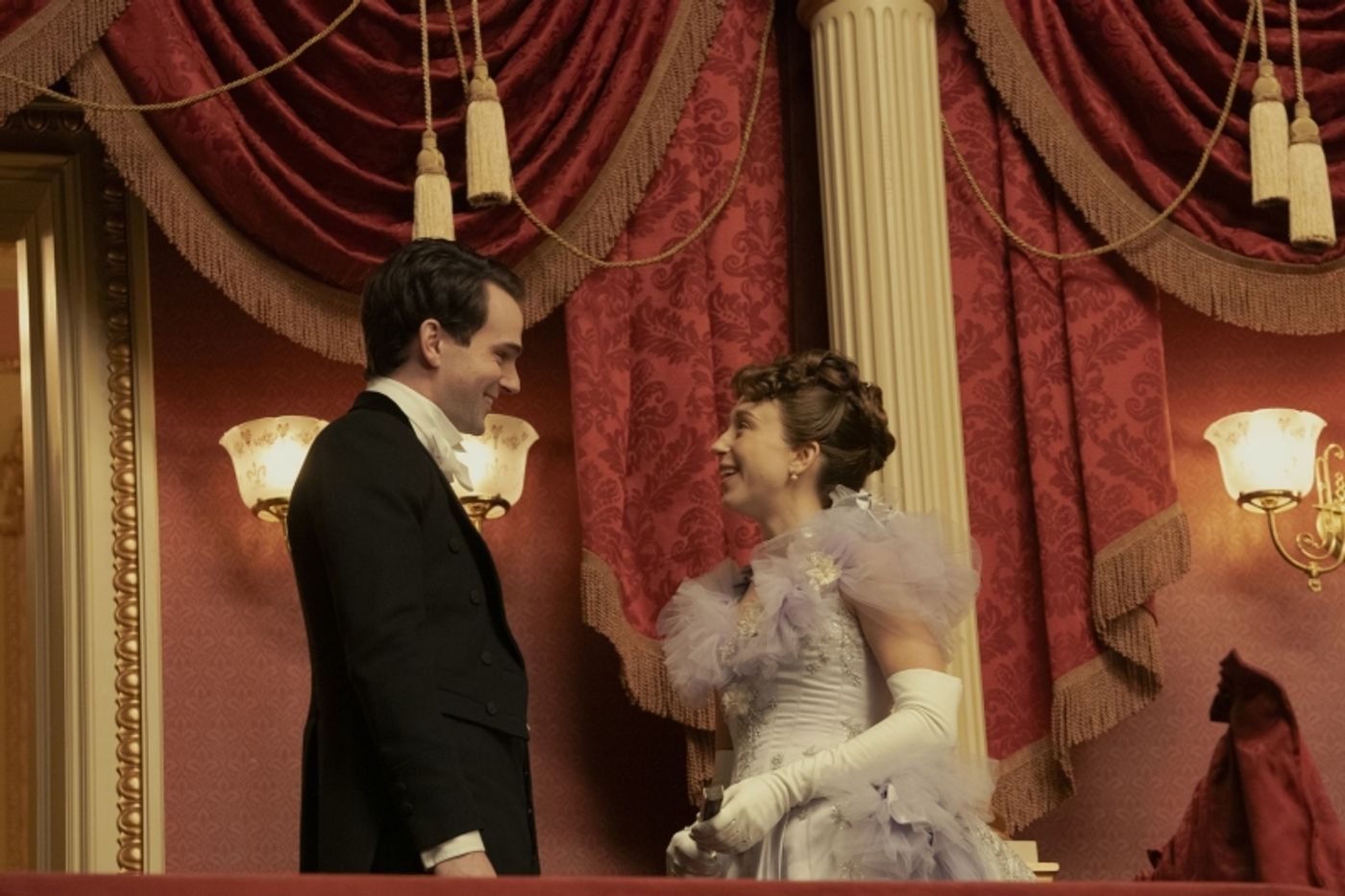
Seeing so many of our Gilded Age characters attend the performance in 1883 gives us a hint that they must have attended other similar dramatic works at the time, in addition to musical works. It’s a good guess that they may have attended other dramas at the Union Square Theatre such as the hits The Two Orphans (1874) or A Parisian Romance (1883).
The Union Square Theatre was once located at the southern crux of Union Square, on 14th Street just near Broadway. Today the real estate is occupied by Citibank’s flagship New York branch. The Union Square Theatre on 14th Street (not to be confused with a later theater of the same name on 17th Street) was built in 1870 as part of the Union Square Hotel and hosted theatre until 1893, when it transitioned to being a vaudeville house. George M. Cohan made his New York debut on its stage that year. Vaudeville persisted until 1908 when movies took over, and in 1936, the space was closed for good. The theater structure was still part of the building until it was fully demolished in 1992. Allegedly, until that time, it was the oldest surviving theatre space in New York, although it wasn’t landmarked, having been destroyed and broken up into retail space in the 1930s. But, as the building came down starting in 1989, pieces of the old theater, where Vera; or, The Nihilists once played, could be seen by passerby.
Back in the 1880s when the characters attended, the Union Square Theatre was one of the most prestigious theaters in New York. Union Square had in the prior decade emerged as a center for entertainment as well as shopping, with the Academy of Music, Steinway Hall, and Tiffany & Co. all in the neighborhood.
Not a single one of our current Broadway theaters were built at the time that The Gilded Age takes place. The theatre district in the mid-1880s was congregated around Union Square and Madison Square, with a large majority of entertainment venues on Broadway between 14th Street and 23rd Street, or nearby. It was only in the first decade of the 20th century that theaters such as the Lyceum, New Amsterdam, and Hudson began heavily populating Longacre Square around 42nd Street, which would soon be called Times Square because of the new building erected for the New York Times.
In fact, the opening of the Metropolitan Opera on 39th Street in 1883 signaled to the powerful that the theatre district was moving uptown. Season two of The Gilded Age revolved around the rivalry between the established Academy of Music and the newly opened Metropolitan Opera House. To be continued…





Comments
To post a comment, you must register and login.