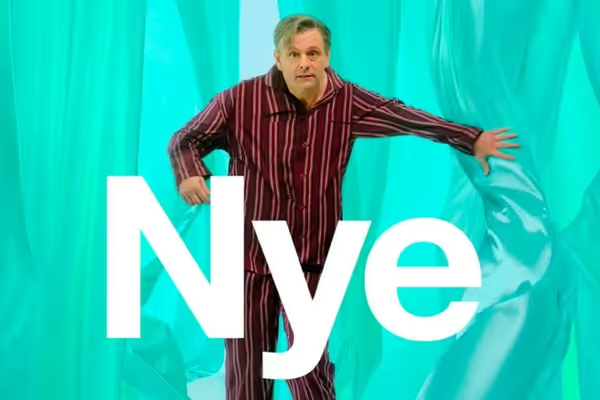
Review: Michael Sheen stars in NYE, National Theatre
Sheen returns for another dazzling turn as the founder father of the NHS
 In what feels like something of a Blue Peter moment, here comes a play which the departing Rufus Norris made earlier last year.
It’s understandable that, before he leaves The National Theatre, Sir Rufus would want to play back some of his greatest hits but the return of Nye feels slightly premature. Michael Sheen once again leads the charge as the fiery, complex, and endlessly fascinating Aneurin “Nye” Bevan. But while Sheen’s magnetic performance as the founder of the National Health Service anchors this sprawling biographical fever dream, the production itself teeters between brilliance and bewilderment, especially in its confounding first half.
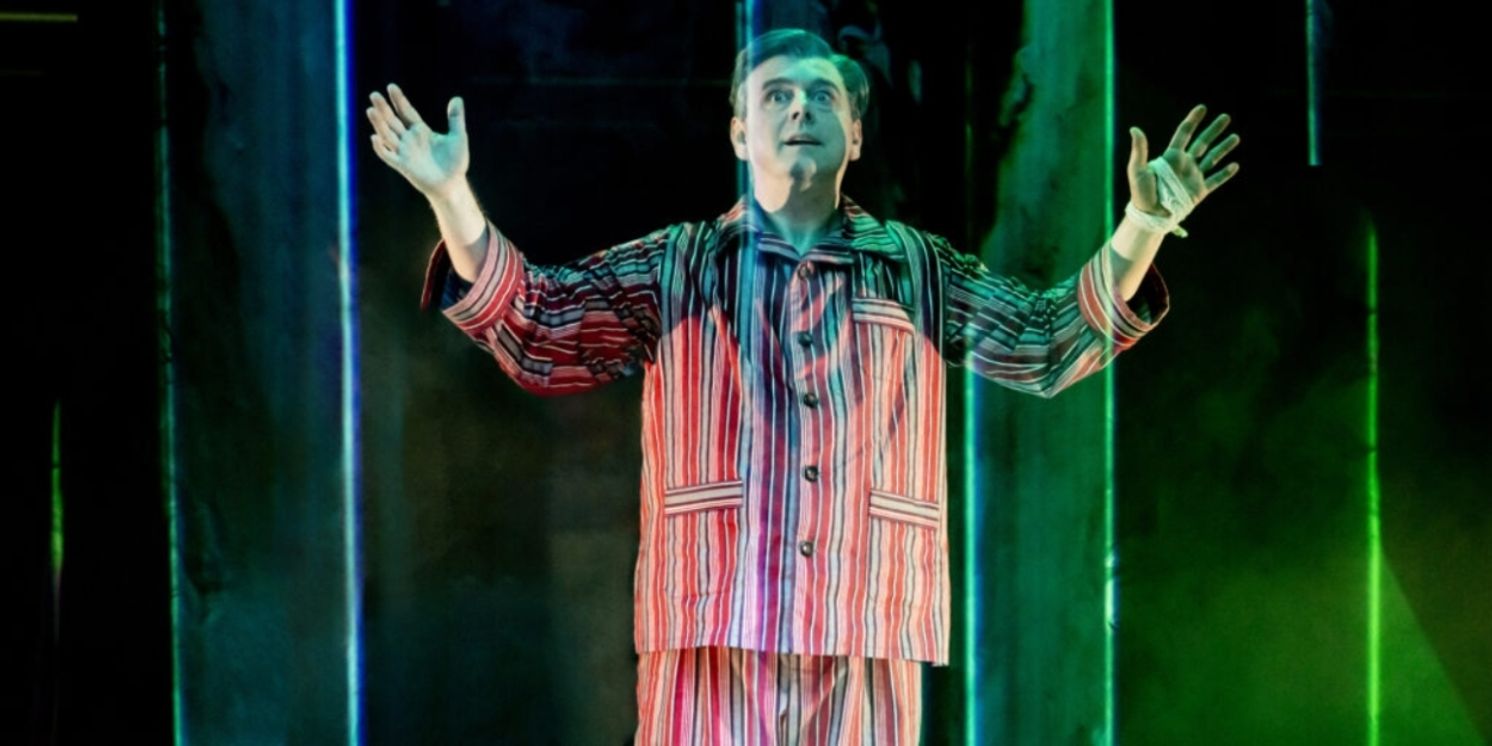
The decision to revive Nye so soon barely a year after it premiered in the very same theatre raises eyebrows. Audiences who saw it in Spring 2024 might feel déjà vu creeping in as they settle into the Olivier’s familiar embrace. Yet Sheen’s sheer force of presence is reason enough for the return. He’s not merely portraying Bevan; even in the striped pyjamas he wears throughout, he embodies him with a kind of visceral, impassioned urgency that makes the air crackle with energy. Whether delivering thunderous oratory or muttering internal monologues in the haze of a hospital bed, Sheen is utterly compelling, threading Bevan’s passion, insecurity, wit, and vision into one seamless tapestry.
But for all Sheen’s charisma, the first half of Tim Price’s script proves a challenging beast to tame. Norris (co-directing with Francesca Goodridge) seems to lean into a chaotic aesthetic, crafting a kaleidoscopic rush through Bevan’s subconscious as he lies gravely ill, drifting in and out of lucidity. The action whirls from the new NHS hospital where Bevan is being treated to Tredegar coal mines and Westminster’s hallowed halls, from intimate family scenes to bombastic political meetings, all at a dizzying pace and with little warning.
Scenes appear, collide, and evaporate, aided by practical stage effects that lend a tactile, surreal edge to the staging. Beds whiz around the stage, Bevan is lifted up and flies through the air and ensemble members flit from character to character like ghosts in his fevered mind.
This dream-logic structure is undeniably ambitious, theatrical and inventive but at times borders on incoherent. Characters are introduced and discarded with whiplash speed. An entirely superfluous scene in a library bulks out what is already a very generous running time. Historical moments are nodded at rather than explored. The emotional throughline is hard to pin down amidst all the stylistic flourishes and political back and forth. In a coup de théâtre that’s as bold as it is baffling, the first act culminates in a surreal Busby Berkeley-style dance number to the sound of the Judy Garland standard “Get Happy”.
Then, with a gasp and a flicker of light, the second half emerges like a new play entirely.
Gone is the manic time-jumping and playful stage trickery. In its place is a more grounded, linear progression through Bevan’s political ascent, his battles, his glorious victory and (inevitably) his death. The shift in tone is underscored by a clever change in stagecraft: monochrome video projections of resistant doctors and clamouring members of the public are ominously large, creating a sharper, almost documentary-style framing that contrasts starkly with the lo-fi whimsy of the first act. It’s here that Nye truly finds its stride. The narrative settles, the relationships deepen, and the script begins to breathe.
Credit must go to the creatives for such a bold duality of form. Vicki Mortimer’s set design transforms from fluid and suggestive to dark and focussed with elegant ease, while Paule Constable’s sublime lighting design is instrumental in managing the emotional temperature of each scene. Jon Driscoll’s video projections add a haunting, archival texture to the latter half, juxtaposing Bevan’s idealism with the grainy reality of post-war Britain. And Will Stuart’s score offers subtle continuity, weaving musical motifs through both halves like a lifeline.
The ensemble, too, deserves recognition. Sharon Small is a standout as Jennie Lee, Bevan’s equally impassioned wife and political partner. Her scenes with Sheen ground the play’s more abstract flights with genuine emotional weight. Jon Furlong is a standout as the slimy Herbert Morrison while Tony Jayawardena absolutely owns the arrogantly imperious Winston Churchill.
And yet, one can’t help but feel that Nye is a play at odds with itself. The first half wants to dazzle and disrupt; the second half wants to explain and inspire. Each mode has its strengths, but the transition between the two feels less like a natural evolution and more like a jarring reboot. There’s brilliance in both halves, but also a nagging sense that the production is trying to serve too many masters: history, biography, spectacle, and emotion, all at once.
Which brings us back to Sheen. In lesser hands, Nye might buckle under its own ambition. But Sheen is the lodestar throughout. His Bevan is not just a saint of the NHS, but a man who is flawed, driven, occasionally overwhelmed, but always human. Whether bantering with miners, squaring off against Churchill, or simply staring into the distance with the weight of the world in his eyes, Sheen holds our attention in a vice grip.
It may be too soon for a revival—especially for a play still wrestling with its own identity—but there’s no denying the impact of seeing Sheen inhabit Bevan’s firebrand spirit once more. Nye doesn’t always make sense, and it doesn’t always cohere, but it pulses with life, conviction, and theatrical daring. Much like the man himself.
Nye continues at The National Theatre until 15 August
Photo credit: Johan Persson