


Review: CHILDREN OF THE NIGHT, Southwark Playhouse
Danielle Phillips’s love letter to Doncaster’s clubbing scene is a poignant socio-political reflection.
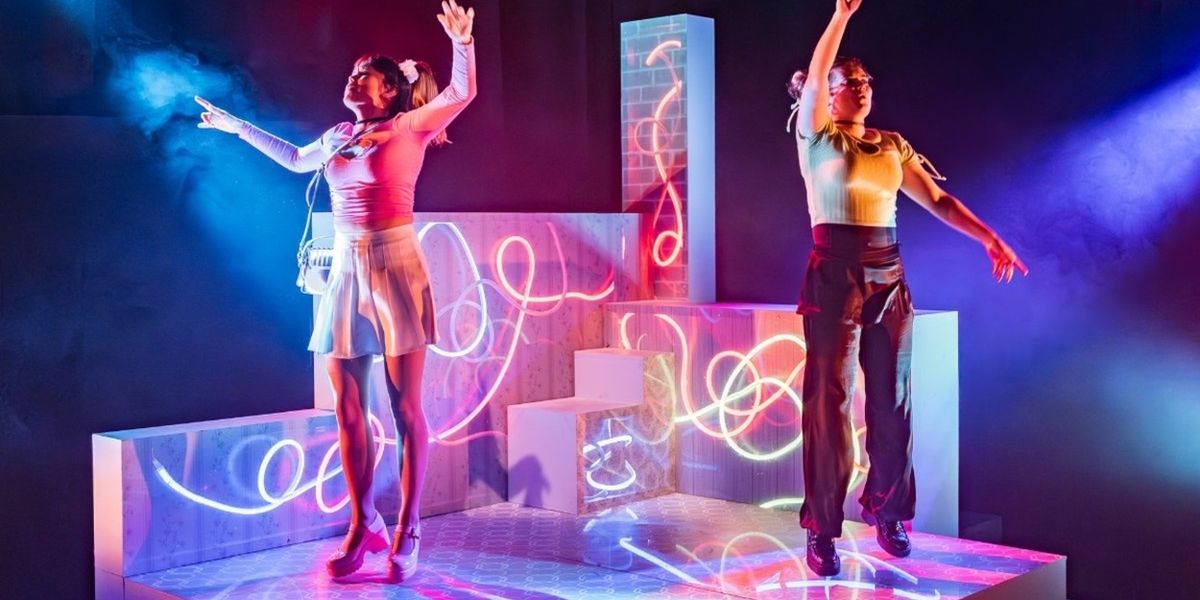
 The tail end of the 90s is shaking the walls of Southwark Playhouse’s studio space. Inspired by over 30 testimonies from Donnyites, and originally shortlisted for both the 2023 Women’s Prize for Playwriting and the 2024 New Diorama Untapped Award, Children of the Night is a thumping anthem to friendship and club culture.
Post-Thatcherite Britain is on the cusp of the new millennium and the first heterosexual HIV cases are about to hit Doncaster, but Lindsay isn’t too concerned. She is just desperate to dance with her friend to her favourite songs, eager to hear that beat drop into her soul. Danielle Phillips writes a tender coming-of-age story that doubles as a love letter to her beloved hometown.
The topographic precision of the writing instantly drives the audience some 200 miles north from London. Nestled in Lindsay’s narration, Doncaster unfolds its secret beauty. The streets, the pubs, the music community all come to life with passionate descriptions of the characters’ usual routes. As Lindsay and Jen walk the pavements, the setting becomes more than a landscape: it turns into the backbone of the play. In an hour and a half, we learn to recognise the town as if it was our own haunt.
.jpg?format=auto&width=800)
Phillips owns the role of Lindsay with tireless fervour. Directed by Kimberley Sykes, she hardly ever stops moving. She climbs, jumps, straddles, and walks an impressive distance on Hannah Sibai’s blocky set. Neon tubes wrap just below the surface, lighting the scene up in technicolour and transporting us to Lindsay’s kingdom: the dancefloor. Phillips’s energy never falters.
She’s joined by Charlotte Brown as her best mate Jen, an overthinker who deeply cares for Lindsay. The universal 90s teenage experience, with all its anxieties and uglies, lines the depth of their bond. Gareth Radcliffe completes the cast as Lindsay’s single dad, an understanding, loving (if a little brash) aul’ lad who shares the same devotion to music as his daughter.
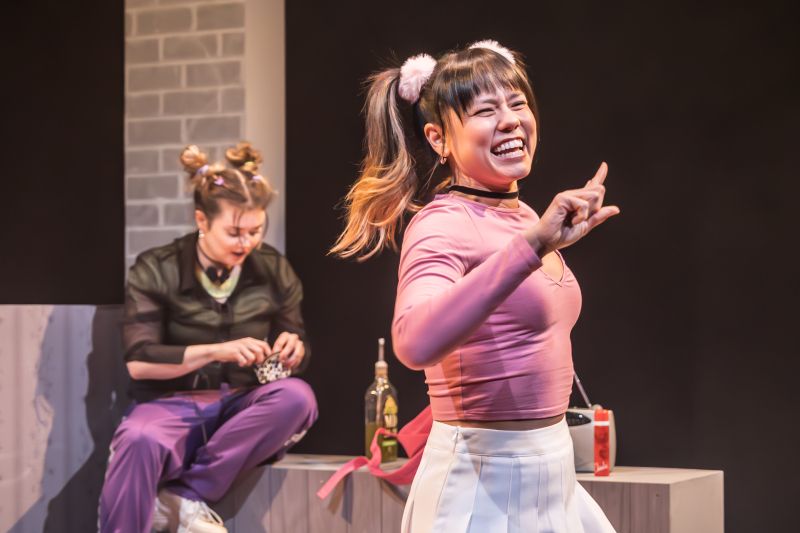
Between the euphoria of finally dancing at the legendary nightclub Karisma and the growing pains of finishing school with no plan for the future, the tabloids descend on Doncaster as the first cluster of HIV hits the news. Lindsay wants to shut it out and dance. But what started as her enjoying the taste of freedom turns into an endless bender of sex with strangers and chaotic drinking. Suddenly, clubbing stops being the revelatory, transcendental epiphany Lindsay used to share with Jen and it becomes an addiction.
The script tackles the issue with subtle determination, making Lindsay have some real fun before she spirals out of control and hits rock bottom. It’s an energetic, necessary tour de force for the actor. The piece doubles down on its breathless, anxious, bittersweet nostalgia, becoming a melancholic eulogy to the long-dead art of clubbing too (if this was a while back, we’d say the show is very “brat” in parts). This said, it very cleverly refrains from glamourising any of it.
.jpg?format=auto&width=800)
Phillips looks at a time when MCs ruled the waves and DJs knew how to command a dancefloor with fondness, but singles out its contextual dangers. “The disco’s in our DNA like coal’s in our blood,” Lindsay declares. The production crystallises a specific point in history, delivering its faceted contradictions and political hypocrisy without sermonising it. Phillips prefers to let her characters’ actions be the products of their environments. What might seem like a triumph of vibrant atmospheric theatre hides a profound socio-political reflection too. And that’s how you do it.
Children of the Night runs at Southwark Playhouse until 4 April.
Photo Credits: Marc Brenner
Sign up for all the news on the Fall season, discounts & more...






Reader Reviews
To post a comment, you must register and login.