


Review: Matthew Lombardo's WHEN PLAYWRIGHTS KILL Slays with Laughter
The world premiere production runs through April 18 at the Huntington Theatre
Seven years ago, an already hot summer in Boston heated up even more during a pre-Broadway tryout of a truncated version of playwright Matthew Lombardo’s “Tea at Five” at the Huntington Theatre when its star, Academy Award winner Faye Dunaway, was fired after allegations that she physically and verbally assaulted crew members on the troubled production.
Pretty serious stuff for sure, but Lombardo soon realized the incident could be more than just fodder for nasty gossip. Inspired by the Dunaway dust-up, Lombardo wrote a new comedy, “When Playwrights Kill,” which is having its world premiere at the Huntington Theatre through April 18.
There are many behind-the-scenes comedies about theater, with some, including Noel Coward’s “Present Laughter,” Michael Frayn’s “Noises Off,” and Terrence McNally’s “It’s Only a Play,” quite good, and others, like James Kirkwood’s “Legends!” – which made two forgettable tour stops at Boston’s Shubert Theatre, in 1986 with Mary Martin and Carol Channing and in 2006 with Joan Collins and Linda Evans – worth crossing Tremont Street in traffic to avoid.
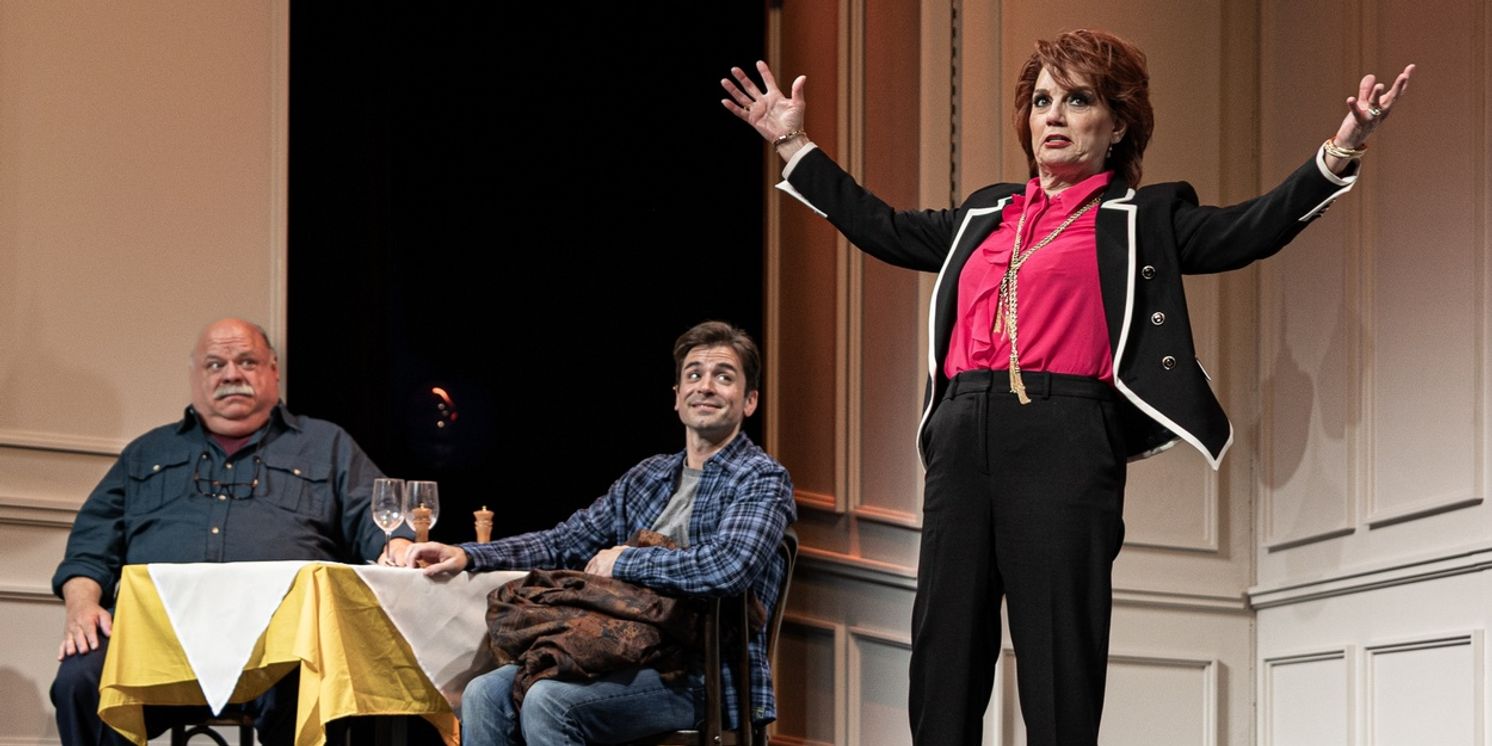
The sharply written “When Playwrights Kill” joins the list of well crafted backstage comedies. In this one, earnest young playwright Jack Hawkins (Matt Doyle, a 2022 Tony Award winner for “Company”) crosses swords with his star, drug-addled narcissist Brooke Remington (Beth Leavel, winner of a 2006 Tony for “The Drowsy Chaperone”).
Lombardo, who wrote “Tea at Five” about Katharine Hepburn with original star Kate Mulgrew in mind and watched it become an off-Broadway hit – presented previously at The American Repertory Theatre in 2002, and then on tour at the Shubert in 2004 – knows the risk and the value of working with big-name stars, as he has not only with Dunaway and Mulgrew in “Tea at Five” but also with Kathleen Turner in “High,” and both Valerie Harper and Stefanie Powers in “Looped.”
When we first meet Jack, he’s in a straitjacket, seated alone on the floor of what seems to be a mental institution, clearly experiencing the risk side of the equation. To set the stage, Jack tells a story about the real-life clash between legendary playwright Neil Simon and the iconic Mary Tyler Moore while the latter was starring in what would be Simon’s final play, 2003’s “Rose’s Dilemma.” As the story goes, when Simon’s wife, actress Elaine Joyce, delivered a note from the writer critical of Moore’s inability to memorize the script to the actress’s dressing room, Moore stormed out of the theater, minutes before a matinee, never to return.
That fraught episode isn’t exactly like what transpired with “Tea at Five” but it does provide Lombardo with framing for his new play and deftly broadens the focus so that this new work’s future isn’t tied only to the past wrath of Dunaway. Jack and the other characters in this piece may feel familiar but they are fictionalizations, allowing the audience to ponder just who Lombardo had in mind when he put pen to paper.
Jack is likely the playwright’s own early-career doppelganger, while Beth Leavel – who starred as fire-breathing fashion matron Miranda Priestly in the 2022 Chicago world premiere of the musical “The Devil Wears Prada,” and self-absorbed star-on-the-downslide Dee Dee Allen in 2018’s “The Prom” – could be conjuring up Brooke from an amalgam of her recent diva roles.
Whoever their characters are based on, Jack and Brooke are a classic oil-and-water pairing, brought together by a stereotypically craven producer Freddie Carlton (Adam Heller, real-life husband to Leavel) who is more interested in box office revenue than art, especially when it comes to casting the play’s star. So, after potential grande dames from Jessica Lange to Glenn Close, Nicole Kidman, Annette Bening, Angela Bassett and Meryl Streep are eliminated from consideration, Freddie, with support from kindly director Oliver Kendall Walker (an even-keeled Kevin Chamberlin), suggests to Jack they cast a certain aging star plotting her own comeback.
Just hearing the name Brooke Remington sends Jack – whose Broadway-bound play “The Return” is about a movie star who moves to New York to restart her career on the stage – into a tailspin.
“It would be a terrible idea. A horrible, appalling thought concocted for the sole purpose of lifting Freddie’s reputation from the ashes and to enhance his personal financial gain. And the very possibility of this unimaginable notion, the name he would speak aloud would change the course of my destiny forever,” Jack thinks aloud to himself.
Jack’s destiny – not forever, for sure, but for an out-of-town tryout anyway – takes him to Boston’s Colonial Theatre, where Oliver has assembled a crew, including Tobias Deschanel (a splendid Tomás Matos), the star’s line prompter, and frequently exasperated stage manager Liz Jennings (Tony Award winner Marissa Jaret Winokur, the original Tracy Turnblad in “Hairspray”) in a too-small role for her many talents.
Under Noah Himmelstein’s knowing direction, the cast moves through each scene at a rapid clip without missing a single quip or inside joke. At the show’s recent opening, lines poking fun at Actors Equity, the American Repertory Theater, and the musical version of “Back to the Future,” drew some of the night’s biggest laughs.
The supporting cast – especially Matos, whose Tobias is a high-energy whirling dervish – handles the brisk pacing with aplomb. Nobody bests Leavel, however, when it comes to rapid-fire line delivery of Lombardo’s very specific, often hilarious dialogue, such as when her character orders lunch.
“I want to start with a small Caesar salad. But I don’t want garlic croutons. I want the plain croutons. But if they don’t have plain croutons, then no croutons whatsoever. Now the sliced parmesan cheese I’d prefer they keep off the lettuce and on a separate plate to the left of the salad. The cheese must be cut to about an eighth of an inch. Any thicker and I won’t eat it. I won’t eat it. I won’t eat it, I tell you! And if the cheese can’t be sliced the way I want then they should substitute the cheese with baby artichokes. But I’m allergic to artichokes. Why would you want me to eat artichokes?! Now, 13 minutes after the salad is served, I want them to serve the scallops. But I don’t want the quinoa. And I don’t want the beans. And I don’t want the celery. I just want scallops. So, I’m going to have a Caesar salad. Plain croutons. Or no croutons. Parmesan cheese. Eighth of an inch. Separate plate. Left of the salad. Thirteen minutes. Scallops. No. Wait. Screw it. Just get me a burger and fries,” she says, each word rolling off her tongue perfectly enunciated.
Back when Boston truly was a try-out town, laugh-a-minute comedies like this one, featuring name casts and designed to provide pure escapism through laughter, were common. That approach is rare these days, however, when even comedies must convey deep meaning, making “When Playwrights Kill” a special treat on the City’s spring theater menu.
Photo caption: Kevin Chamberlin, Matt Doyle, and Beth Leavel in a scene from the world premiere production of Matthew Lombardo’s “When Playwrights Kill.” Photo by Jim Sabitus.
Reader Reviews
Videos